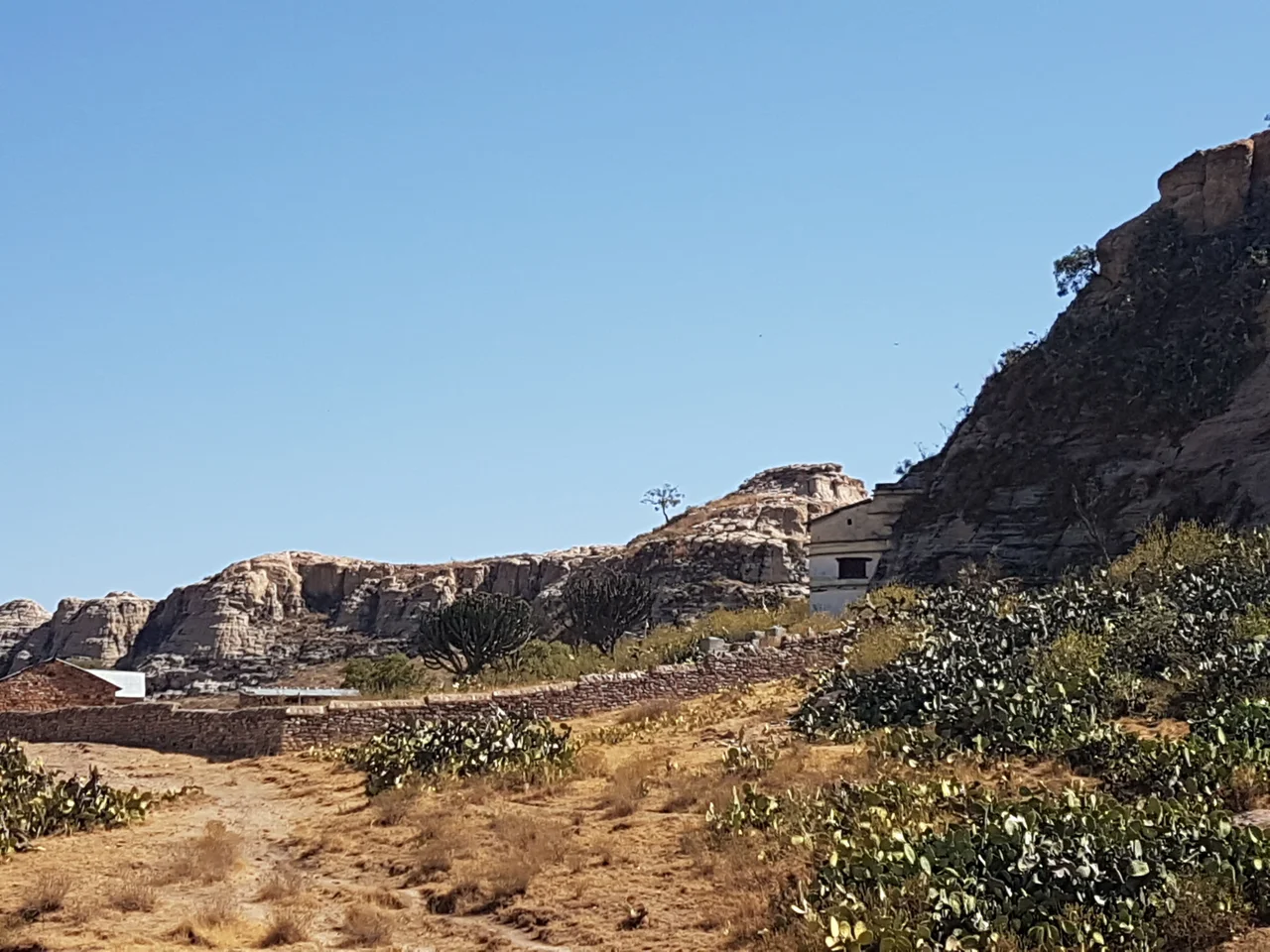

Debre Maryam Qorqor
To reach Debre Maryam Qorqor you walk for forty-five minutes up a path cut into sandstone. At the top, carved out of a high cliff face on the Gheralta plateau of northern Tigray, stands one of the largest rock-hewn churches in Ethiopia - six cruciform pillars, arched ceilings, frescoes older than most European cathedrals. The interior is 17 metres deep, 9 metres wide, 6 metres high. Every surface is stone, and most of the stone surfaces are painted. In one of them, the Virgin Mary holds the Christ child shown still in utero - a composition almost unheard of anywhere else in Christian art.
Gheralta's Cliffside Churches
The Tigray Region of northern Ethiopia is home to more than 120 rock-hewn churches carved into the sandstone cliffs of the Gheralta, Tembien, and Atsbi clusters. Most of them stand on ledges, summits, or inside caves that can only be reached by climbing. Debre Maryam Qorqor - near the village of Megab, about eight kilometres south of the town of Hawzen - is among the most architecturally ambitious. The church follows the classic Ethiopian Orthodox tripartite plan: nave, aisles, and sanctuary. Six massive cruciform pillars support the ceiling. Bracket capitals and carved arches indicate a sophistication of construction that has led scholars Jacques Mercier and Claude Lepage to propose a date in the late Aksumite or early medieval period - seventh to eighth centuries, or tenth to thirteenth. The precise date is debated. What is not is that the church has been in continuous use by the Ethiopian Orthodox Tewahedo Church ever since it was carved.
The Frescoes
The paintings inside Debre Maryam Qorqor were executed by at least three different hands, working in different phases across several generations of clerical patronage. Art historian T. C. Tribe identified the distinct styles. Marilyn E. Heldman's research shows Byzantine and Coptic influences overlaid on firmly Ethiopian traditions. Adam and Eve appear on one wall - the Ethiopian iconographic tradition depicts them frequently, often in a garden of stylised plants. Christ in Majesty appears in the sanctuary. The most striking single image is the Virgin Mary showing the Christ child in utero - a visual theology that emphasises the Incarnation, a moment many European traditions depict only through the Annunciation. The frescoes are dated primarily to the thirteenth century, with later repainting in some areas. They have survived in sandstone that is soft enough to carve easily but vulnerable to salt weathering and erosion.
Abba Daniel of Qorqor
Oral tradition credits the church's foundation to Abba Daniel of Qorqor, a monk believed to have lived in the Gheralta mountains during the medieval period. Clerical memory says he painted some of the earliest frescoes himself. A nearby hermitage still bears his name. The tradition of extreme asceticism - hermits living for years alone in the caves and ledges around Maryam Qorqor, descending only for liturgical celebrations - persists into the present. Local legend also says the church was miraculously protected from enemies: when hostile forces approached, a divine mist would hide the sanctuary. Such stories are common across Ethiopia's cliffside churches, where the inaccessibility of the sites themselves seems to invite mythmaking about divine protection.
The Stone That Carves Like Butter
The church was excavated in Adigrat Sandstone - a Mesozoic sedimentary rock that dominates the Gheralta cluster. The stone is relatively soft. Medieval masons could cut into it with iron chisels and hammers. But softness is the problem too: salt weathering from groundwater, thermal cycling, and wind erosion all eat at the surfaces. Geological studies published over the last two decades have raised concerns about the long-term preservation of sites like Debre Maryam Qorqor, particularly in an era when tourism traffic has increased the moisture and wear patterns inside the churches. Some sites are now closed for restoration. Maryam Qorqor remains open - priests and deacons still chant the Divine Liturgy inside its painted chamber on feast days - but the frescoes have begun to flake in places where they have been exposed to a thousand years of seasonal humidity.
What the Climb Is For
Tourists on the Gheralta circuit usually climb Debre Maryam Qorqor after Abuna Yemata Guh - the more famous rock-hewn church, reached by scaling a sheer vertical face with the help of a rope and a local guide. Maryam Qorqor is less terrifying to approach but more ambitious as architecture. Steven Kaplan, historian of Ethiopian Christianity, has argued that monasteries and churches like this one played a central role in consolidating the Ethiopian Orthodox Church's presence during the Solomonic revival of the thirteenth century, particularly in the peripheral regions of the empire like Gheralta. The rock-hewn churches of Tigray have been proposed for the UNESCO World Heritage Tentative List - considered equivalent in importance to the better-known monolithic churches of Lalibela. At the top of the climb, when your lungs are burning and the plateau opens out below you, the point of carving a church this way becomes obvious: the people who cut it were trying to build something closer to heaven than to the roads they lived on.
From the Air
Debre Maryam Qorqor is in the Gheralta Mountains of Tigray, Ethiopia at 13.92N, 39.36E, about 2,400m elevation. The nearest airport is Mekele (HAMK/MQX) about 90 km south; Axum (HAAX/AXU) lies about 120 km west. The Gheralta cluster is a system of prominent sandstone cliffs 200-400m high. Recommended viewing altitude 10,000-12,000 ft AGL for context; lower for architectural detail. The Tigray Region has experienced severe conflict since 2020 and current security conditions must be reviewed.
Nearby Stories
- Tigray Region 19 km away
- Simien Mountains 35 km away
- Dallol (hydrothermal system) 62 km away
- Southern region (Eritrea) 66 km away
- Danakil Depression 69 km away
- Dedebit Elementary School airstrike 81 km away
- Eritrean-Ethiopian War 100 km away
- Wollo Province 248 km away