
Eritrean-Ethiopian War
They had been allies. Seven years earlier, in May 1991, forces from the Eritrean People's Liberation Front and the Tigray People's Liberation Front had marched together into Addis Ababa and overthrown the Mengistu regime. Eritrea voted for independence in 1993. Ethiopia helped draft the boundary. Then, on 6 May 1998, an Eritrean mechanized force rolled into the Badme region and a firefight broke out with Tigrayan militia. What followed was the biggest war in the world at that moment, with over 500,000 troops on both sides, trench lines 30 kilometers long, and death tolls that neither country has ever fully admitted.
A Border That Was Never Drawn
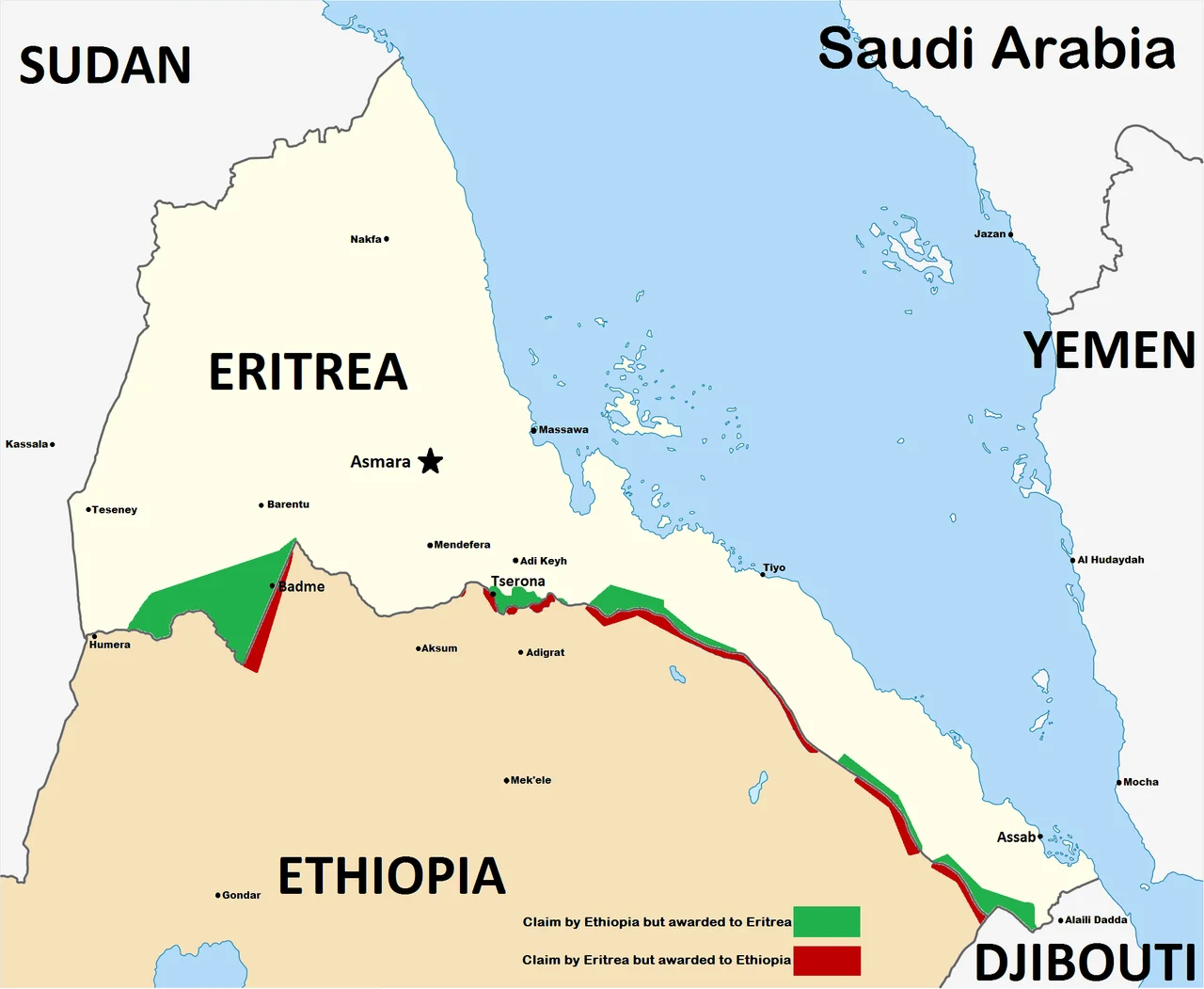
When Eritrea and Ethiopia agreed to separate in 1991, the internal provincial line between them became an international frontier, but no one had ever put it precisely on a map. A commission set up in November 1997 started the work. It moved slowly. The disputed areas included Bure, Bada, and a dry scrubland village called Badme that sits on black-cotton plains near the Tekeze River. In July 1997, over 1,000 Ethiopian troops occupied Bada. Ethiopian administrators reportedly burned Eritrean villages in some disputed zones. From Asmara, it looked like Addis Ababa was quietly redrawing the map. Thousands of Eritreans living in western Tigray were ordered to accept Ethiopian nationality or leave. When the Eritrean armor crossed into Badme in May 1998, each side told a different story about who started what. Observers agreed only that both governments had known this was coming.
Trenches and Human Waves
The fighting quickly became what one analyst called the most intense combat in Africa since World War II. Eritrea dug trenches that ran for tens of kilometers across the borderlands, reinforced with concrete and mines. Ethiopia, with three times the population, funneled conscripts into frontal assaults. 'The Eritreans are good at digging trenches,' observed Ethiopian General Samora Yunis, 'and we are good at converting trenches into graves.' In March 1999, Ethiopia launched Operation Sunset. Three divisions broke through Eritrean defenses near Biyukundi, encircled an Eritrean division, and destroyed it. Mi-24 helicopter gunships attacked retreating soldiers with rockets. After five days, Ethiopian forces were 10 kilometers deep into Eritrean territory. Independent observers estimated 30,000 men had died on both sides in that single offensive. Then came Tsorona, where tens of thousands of poorly trained Ethiopian recruits were sent in successive waves against fortified Eritrean positions. Many never came back.
The Cost Nobody Counted
By the end of the May 2000 offensive, Ethiopia occupied roughly a quarter of Eritrean territory. About 650,000 Eritreans were displaced. Ethiopia expelled 77,000 Eritreans and Ethiopians of Eritrean origin it deemed security risks, deporting them after confiscating their belongings. Eritrea forced out an estimated 70,000 Ethiopians. In July 1998, Ethiopia alleged that as many as 60 Ethiopians had died in Assab after being locked in a shipping container in 40-degree heat. Human Rights Watch reported torture and rape by both sides. The Coalition to Stop the Use of Child Soldiers documented credible reports that the Ethiopian armed forces used thousands of children; most Ethiopian prisoners in one large Eritrean POW camp were estimated to be 14 to 18 years old. Eritrea claimed 19,000 of its soldiers died. Ethiopia claimed losses of 34,000 to 60,000 and said it killed up to 67,000 Eritreans. Some regional analysts put the combined death toll as high as 300,000. No one will ever know the exact number.
Badme, and the Twenty-Year Freeze
On 12 December 2000, the two governments signed the Algiers Agreement in the Algerian capital. A 25-kilometer-wide Temporary Security Zone was carved into Eritrea, patrolled by UN peacekeepers from more than 60 countries. An international boundary commission was established. In April 2002, the commission ruled that Badme - the village where the war began - belonged to Eritrea. Ethiopia refused to accept the ruling. The UN mission stayed until 2008, when Eritrea expelled it. For the next sixteen years, thousands of soldiers faced each other across the line, not shooting but not leaving either. Eritrea used the frozen conflict to justify indefinite military conscription and the suspension of its constitution. Ethiopia moved on. An entire generation of young people grew up under the shadow of a war technically still underway.
Peace, Mostly
In April 2018, a 41-year-old reformer named Abiy Ahmed became Prime Minister of Ethiopia. On 5 June 2018 his government announced it would fully accept the 2002 boundary ruling and implement the Algiers Agreement. In July, Abiy flew to Asmara. He and Eritrean President Isaias Afwerki signed a Joint Declaration of Peace and Friendship. Flights between Addis Ababa and Asmara resumed after 20 years. Families separated since the 1990s crossed the border to find each other. The deal won Abiy the Nobel Peace Prize in 2019. But the peace has been uneven. When Ethiopia's Tigray War broke out in November 2020, Eritrean forces crossed into Tigray to fight alongside Abiy's army - turning yesterday's enemies into today's allies against a shared opponent. The war in Tigray produced its own accusations of atrocities. The borderlands where Badme sits are quieter now, but not quite at rest. The dead from 1998 to 2000 still lie where they fell.
From the Air
The war's front lines ran along the Eritrea-Ethiopia border from Badme (roughly 14.62°N, 37.83°E) east through Zalambessa, Tsorona, and down to the Red Sea coast near Assab. Nearest airports: Asmara International (ICAO: HHAS) in Eritrea, Axum Airport (ICAO: HAAX) and Mekelle (HAMK) in northern Ethiopia. From cruising altitude, the Badme area appears as dry scrubland on the plateau edge; Tsorona and Zalambessa show rugged escarpment terrain. The former Temporary Security Zone is still visible on satellite imagery as a buffer of empty cropland. The region is politically sensitive; consult current NOTAMs before overflight. Best visibility October through May; summer monsoon brings heavy cumulus over the highlands.
Nearby Stories
- Asmara 8.7 km away
- Italian Eritrea 9.2 km away
- Adulis 40 km away
- Battle of Agordat (1941) 55 km away
- Obelisk of Axum 72 km away
- Dedebit Elementary School airstrike 85 km away
- Gash-Barka Region 91 km away
- Danakil Depression 115 km away