
Danakil Depression
'Ardi' was a small female hominid who lived in this region about 4.4 million years ago. 'Lucy,' who came 1.2 million years later, was smaller still - maybe 1.1 metres tall. Both were found in the Afar region of Ethiopia, both are candidates for some version of our earliest ancestors, and both lived within a few hundred kilometres of the Danakil Depression. In June 2010 paleontologists found what remains the oldest direct evidence of stone tool manufacture in the world here, dated to more than 3 million years ago. The place that gave us our own beginnings is, today, officially the hottest place on Earth.
When to Go
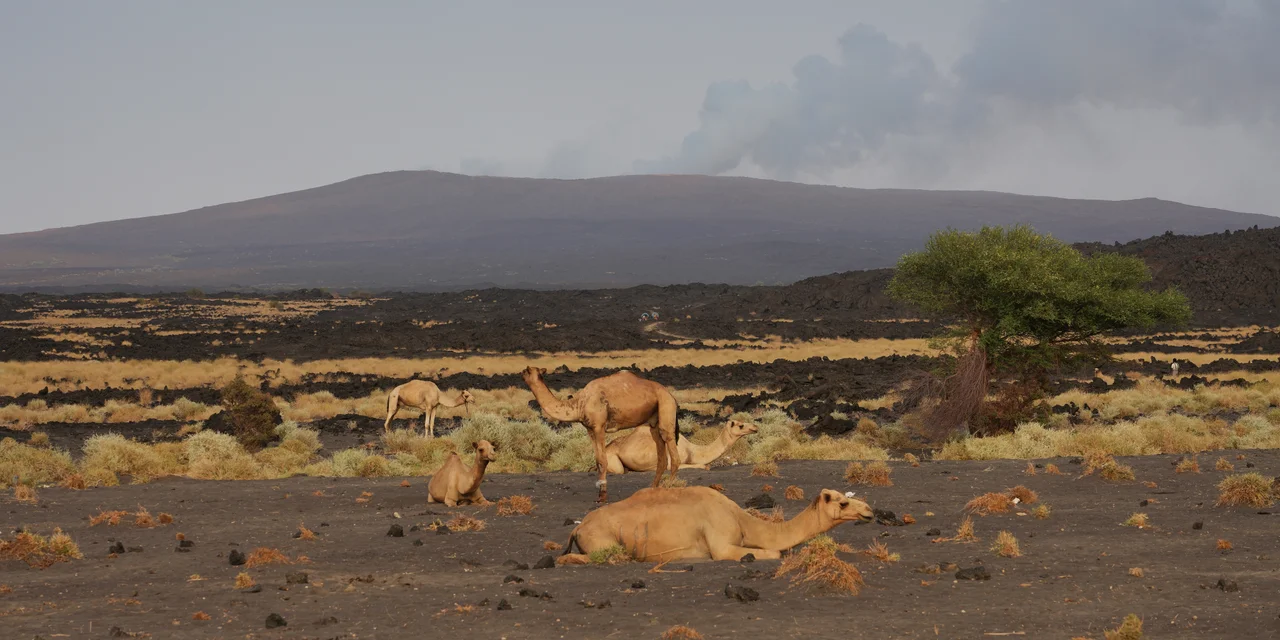
November to February is the season. Day temperatures in the shade hover around 30 C - hot, but survivable. The rest of the year approaches 50 C at the crater surfaces. Rain falls, on average, every eight or nine months. Most tours start from Mekele - a three-hour drive to the village of Berhale, then another hour of dirt track to Hamad-Ela, the base camp for Dallol and Lake Kerum. From Hamad-Ela it's one more hour on jeep tracks along the salt crust of Lake Kerum, then a 15-minute walk to the sulphur springs. Mount Erta Ale - the active shield volcano with one of the world's only persistent lava lakes - is reached from a different direction, out of Abala, with a base camp doubling as a military post and a 2.5-hour hike up the mountain in each direction. Camels accompany the hike and can be ridden for a small fee.
Who Lives Here
The Afar people have lived in the Danakil for longer than nations existed. Roughly three million Afar inhabit the broader region today, their territory crossing the notional borders of Ethiopia, Eritrea, Djibouti, and Somaliland - borders they have generally ignored. Salt mining is the economic backbone: men cut rectangular slabs from the salt pan at Lake Kerum and load them onto camel caravans that carry them up into the Tigrayan highlands, where the salt is traded for grain. The caravans move in early morning and late afternoon. In between, everything stops because nothing with a body can move in the midday heat. The Afar have a fierce reputation earned in an environment that does not forgive mistakes. Their curved dagger, the jile, was used to castrate infrequent visitors as late as the 1930s.
The Landscape Does Not Behave
Dallol, the mineral-stained salt dome on the northern edge of the depression, changes week to week. Pools that were lime green in March have gone ochre by May. Geysers that spouted a metre tall have gone dormant, and new ones have opened in different places. You walk across terrain that looks engineered - cream-white salt terraces, sulphur ponds with rims of crystallised yellow, chimneys of iron-rich brine - and the guide will tell you that what you are standing on may not be there next season. Earth tremors are frequent. Erta Ale, south of Dallol, holds a lava lake that has been continuously active since 1906 - one of only about five persistent lava lakes in the world. You stand on the crater rim and look down at molten stone, and the tour guide will tell you to stay at least a metre back because there are no warning signs and no fences.
Practicalities
You cannot visit the Danakil on your own. Tour operators - ETT Travel, Ethiodanakil Tours, Awaze Tours among others - organise the trip with an included guide and armed military escort. The armed escort is not performative. In 2012 five European tourists were killed and two kidnapped at Erta Ale. In 2017 a German tourist was shot dead and an Ethiopian guide wounded. The Tigray War, which ended in November 2022, further destabilised the region. Tours run two, three, or four days depending on depth. Meals come with the tour operator: injera with sauce, pasta, rice, stews, goat, fish, coffee prepared in the traditional Ethiopian way. Accommodation at the base camps is sleeping bags and mattresses under stars. There is no hiking, cycling, or public transport. Hospitals are hours away through Berhale. The nearest real bed is in Mekele.
What the Danakil Teaches
Most travel is about discovering things - cultures, foods, architecture. The Danakil is about the opposite. It is about confronting what the planet looks like with the human comforts stripped away. You sleep on salt, drink from bottled water that your drivers have been carrying since Mekele, and understand that the climate you are visiting is normal - it's what the Earth has decided to put here. The bones of our distant ancestors lie in this ground. Volcanic activity below your feet is slowly turning the whole region into a new ocean. Somewhere near here, our lineage's first hand-struck stone tool was made. The Danakil does not welcome. It endures, and it allows you to endure it for a week, and you leave with a small understanding that might - if you let it - change how you see every city, every garden, every comfortable hotel lobby you ever walk into again.
From the Air
The Danakil Depression centres on 14.24N, 40.30E, 100-125m below sea level, in Ethiopia's Afar Region. The nearest serviceable airport is Mekele (HAMK/MQX) about 250 km southwest at 2,250m. Temperatures above 45C create significant density-altitude concerns even at low altitude. Airspace is remote, with minimal ATC coverage. Recommended overflight at 8,000-10,000 ft AGL for the full scale of the depression. The Tigray region saw severe conflict from 2020-2022 and security conditions remain sensitive - confirm current advisories before planning operations.
Nearby Stories
- Debre Maryam Qorqor 42 km away
- Adulis 75 km away
- Southern Red Sea region 85 km away
- Tigray Province 86 km away
- Attacks on the Sounion 104 km away
- Mekelle 105 km away
- Italian Eritrea 120 km away
- Italian Submarine Guglielmotti (1938) 202 km away