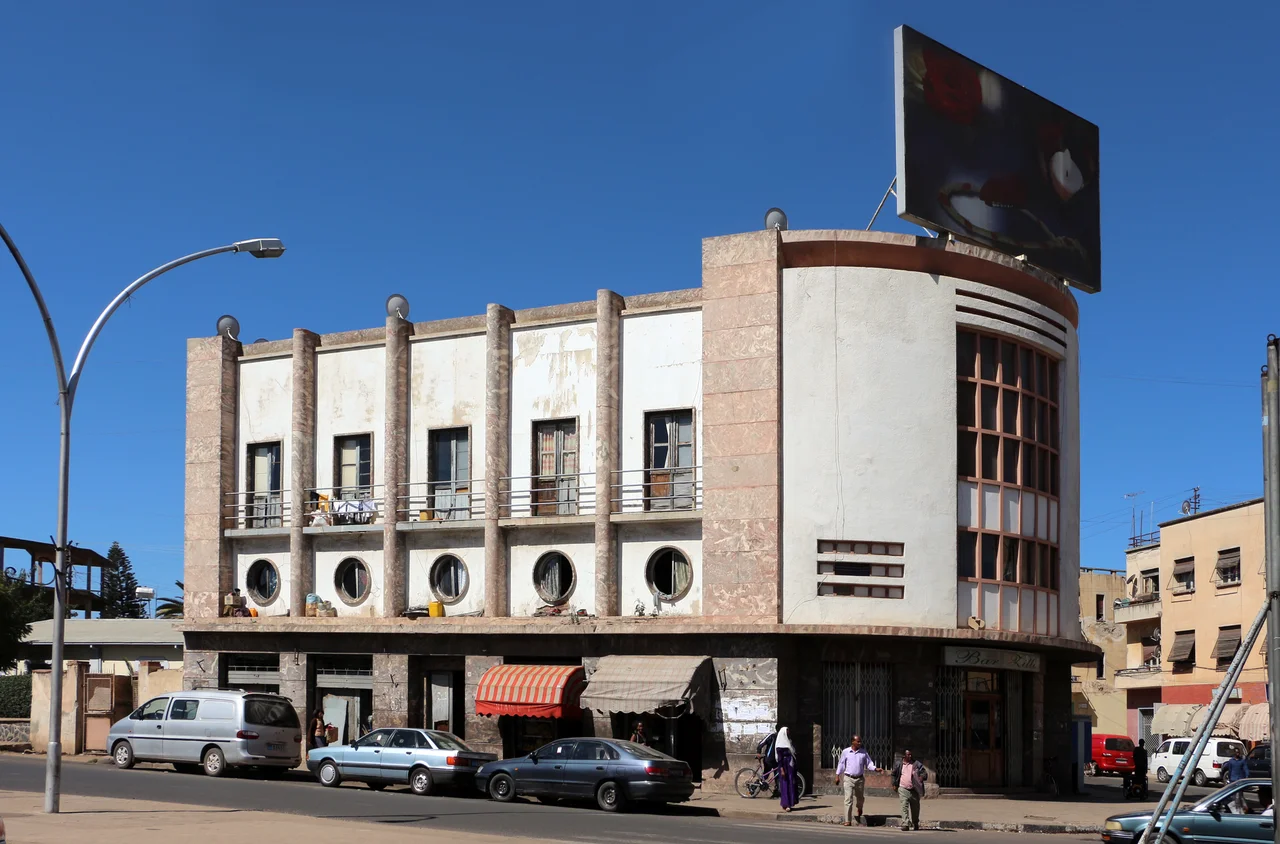

Asmara
In the 1930s, Benito Mussolini decided Asmara would be the laboratory of his second Roman Empire. Italian architects were given money, time, and an almost complete absence of limits. What they built in the highlands of what is now Eritrea was their fantasy - futurist filling stations shaped like aeroplanes, cubist cinemas, Art Deco bowling alleys, basilicas that borrowed from ancient Rome. Then the empire collapsed. The architects went home. The Eritreans stayed, and kept the buildings, and made the city theirs.
The City Mussolini Built, the City Eritrea Kept
Harnet Avenue - known locally as Kombishtato, a creole of the Italian Campo Cintato - is a palm-lined mile of cafes, bars, shops, and old cinemas, and it would not look entirely out of place in Milan. The Fiat Tagliero service station was built in 1938 in the shape of an aircraft, its reinforced concrete wings cantilevered twenty metres out from a central tower with no supports underneath. The Cinema Impero still advertises films beneath its original Art Deco signage. The Italian presence was brutal - a colonial occupation that reduced Eritreans to second-class status in their own country, conscripted them into fascist armies, enforced racial segregation. The buildings survive that history, and after Eritrean independence in 1991 they became what they had always really been: Eritrean architecture, made by Eritrean labour, now in Eritrean keeping. UNESCO inscribed them as a World Heritage site in 2017.
Two Centuries Without Self-Rule
Founded in the twelfth century when four clan villages united to protect themselves from bandits, Asmara - the name comes from the Tigrinya for those who unite - grew under successive outside rulers. The Italians arrived in the late nineteenth century and made it their colonial capital. The British administered Eritrea after World War II. Ethiopia annexed the territory in 1952, then abolished its federal autonomy in 1962. The resulting war for independence lasted thirty years and cost perhaps 150,000 Eritrean lives. When liberation finally came in May 1991, Asmara became the capital of a country which had not governed itself for two centuries. Every street the city fathers walked down still bore someone else's name.
Above the Clouds
Asmara sits at 2,300 metres. The air is thin and dry, and temperatures rarely rise above a comfortable 30 degrees Celsius even at midday; between December and February, nights can drop below zero. From the terrace of the Nyala Hotel, the city falls away toward the Red Sea escarpment - a cliff edge where, on the Massawa road past Biet Ghiorghis, the land plunges two thousand metres in a few kilometres. The rural highland village of Tselot lies seven kilometres south-east, reachable by the No. 28 red bus. Its stone Hidmo houses, its ancient churches and mosques, its farmers herding with mule and camel, resemble illustrations from a book of Biblical parables. The Martyrs National Park at the edge of the plateau offers viewpoints where chasms drop beneath a sea of clouds.
The Quiet Capital
Power is intermittent. Electricity runs reliably in the centre for parts of the day, with blackouts common - especially in the rainy season. Internet is slow. A traveller's permit is required to leave the city in any direction, and military roadblocks called blocco still dot the roads. Homosexuality is illegal, and the penal system is opaque. The government keeps a firm and unhappy grip on its citizens. And yet - Asmara is safe enough to walk at night. The Asmara Beer is exceptionally good; there is only one brewery producing only one Pilsener, which needs no label. The Gelateria da Fortuna, on a small street near Mai Jah Jah, turns out gelato as good as Italy's. The kitchens keep producing injera and silsi and fuul. Life continues, as it does.
A Horn of Africa Crossroads
Asmara rises from a highland plateau that drops sharply to the Red Sea coast. The narrow-gauge railway built by the Italians between Asmara and Massawa still climbs the escarpment, pulled by a steam engine now used mainly for chartered tours. The country's second city, Keren, lies west across arid lowlands. To the south, the Ethiopian border at Zalambessa remains closed. From altitude, the city appears as a dense grid of red roofs on a green plateau, surrounded by dry rubble-scattered terrain that looks, in certain dry-season light, almost lunar.
From the Air
Asmara sits at 15.33 degrees N, 38.92 degrees E at an elevation of approximately 2,300 metres. Asmara International Airport (ICAO HHAS) lies three kilometres south of the city and is served by Ethiopian Airlines, flydubai, and others. From the air, the city is identifiable by its dense red-tile urban grid on a flat highland plateau, with the Red Sea escarpment dropping dramatically to the east toward Massawa. The Italian Deco cinemas and the Fiat Tagliero service station are central landmarks. Photography near government installations is strictly prohibited; check current Eritrean airspace restrictions before approach. Best visibility is October through April.
Nearby Stories
- Arkiko 19 km away
- Southern region (Eritrea) 39 km away
- Northern Red Sea region 43 km away
- Battle of Agordat (1941) 50 km away
- Anseba region 52 km away
- Nokra Naval Base 61 km away
- Eritrean-Ethiopian War 76 km away
- Danakil Depression 139 km away