_The_Obelisk_at_Axum.png)
Obelisk of Axum
In the local languages of northern Ethiopia, the towering stone is not called an obelisk at all. In Tigrinya it is hawelti. In Ge'ez, the ancient liturgical language of Ethiopian Orthodox Christianity, it is also hawelti. What stands in Axum today, 24 meters tall and weighing 160 tons, is a grave marker from the 4th century CE - a royal stele carved by the subjects of the Kingdom of Aksum, one of the great trading empires of the ancient world. It took more than sixty years of diplomatic wrangling, a runway upgrade, and an Antonov An-124 cargo plane to bring it home.
Markers for the Dead
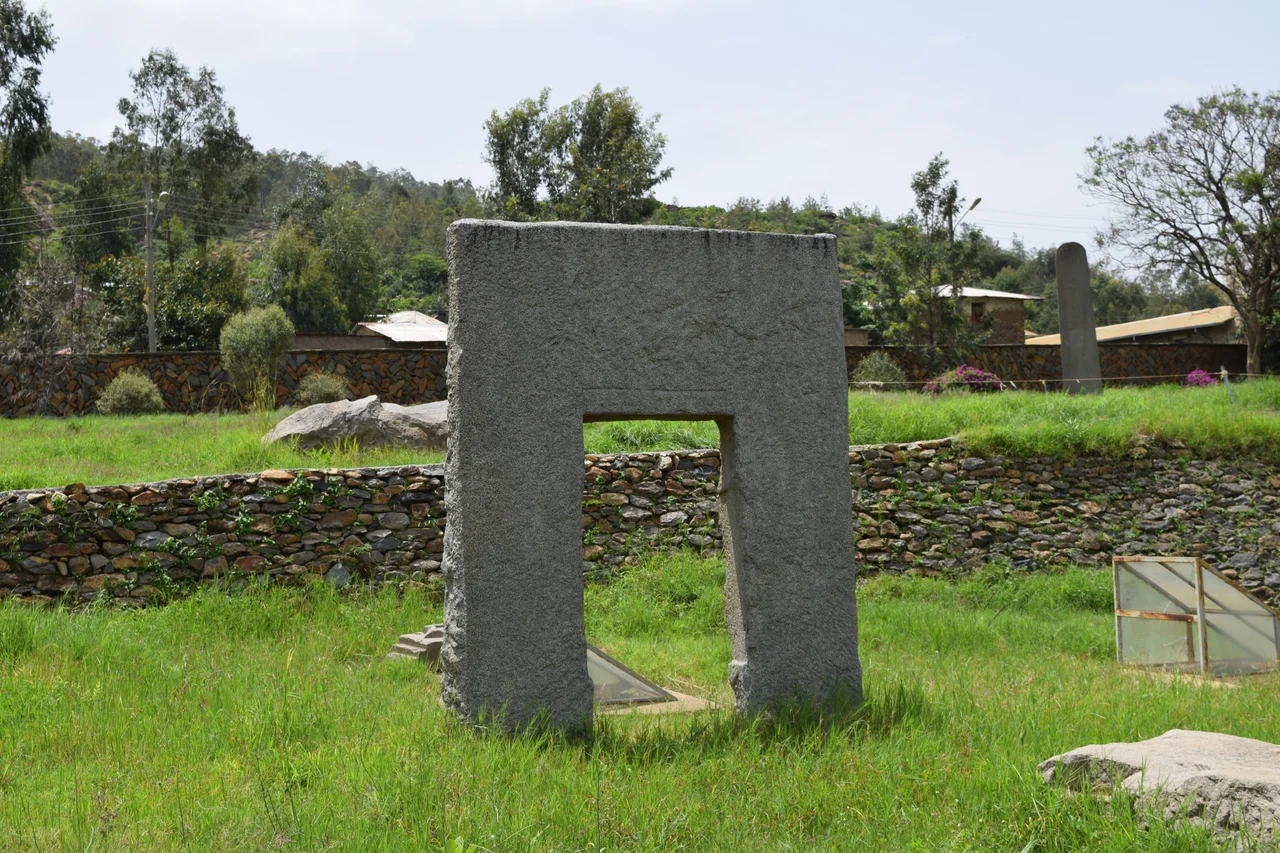
In the steles fields of Axum, hundreds of stone pillars rise from the earth. Most are small, rough, unmarked - graves of ordinary people. A few are enormous and carved with false doors and rows of windows that mimic multi-story buildings, markers for royal burial chambers below. The largest, known as the Great Stele, measured 33 meters before it collapsed, probably soon after it was raised. The one standing in Rome through much of the 20th century was not the greatest but the greatest survivor. When King Ezana introduced Christianity to Axum around 330 CE, the practice of raising these pagan burial markers ended. The hawelti stopped multiplying. They also started falling - to earthquakes, to time, and to the military incursions of Imam Ahmad Ibrahim during the Ethiopian-Adal War of 1529 to 1543.
The Theft
Mussolini's Italy invaded Ethiopia in 1935 and proclaimed its empire two years later. In 1937, as part of the looting that accompanied the occupation, Italian engineers cut the stele into three sections and trucked them piece by piece along the difficult road from Axum to the port of Massawa - five trips spread over two months. The fragments sailed to Naples aboard the Adwa, a ship named after the 1896 battle where an earlier Italian army had been defeated by Emperor Menelik II's forces. In Rome the stele was reassembled, steel bars inserted between its sections, and erected on Porta Capena square in front of the Ministry of Italian Africa. The unveiling was staged for October 28, 1937 - the fifteenth anniversary of the March on Rome. A monument made as a grave marker for an Ethiopian Christian king became a trophy for fascism.
The Long Road Home
Emperor Haile Selassie visited Italy in 1961. The monument to the Lion of Judah, also looted, was returned in 1967. The stele stayed. For more than fifty years Ethiopia asked and Italy demurred, citing technical difficulties that were real but also convenient. The runway at Axum was too short. The roads from Addis Ababa were inadequate. The port of Massawa, through which the stele had originally left Africa, was now in Eritrea - a country at odds with Ethiopia after a bloody war of independence. Then in 2002 lightning struck the stele during a Roman thunderstorm and caused considerable damage. The repatriation began to feel urgent. Axum's runway was upgraded. In April 2005, an Antonov An-124, one of the largest cargo aircraft in the world, landed in Ethiopia carrying the middle section. Local celebration surrounded its arrival. The reassembly used aramid fiber bars - Kevlar - instead of steel, both to prevent rust and to avoid giving lightning another conductor. The stele stands again where it was carved, among the other hawelti of Axum, on ground that holds the bones of the kings it was made to honor.
What the Stone Remembers
To stand before the Obelisk of Axum today is to read three kinds of history at once. The phonolite surface, quarried nearby and carved with what look like windows of a nine-story tower, speaks of the wealth and ambition of a 4th-century African kingdom that traded with Rome, Arabia, and India. The fresh joints where Kevlar binds the sections speak of the 20th century - of fascism, theft, and the long negotiation required to undo theft. The crowd of smaller steles around it, some still standing, some fallen and split like the Great Stele, speak of deep time: of all the kings whose names are lost, whose chambers lie empty, whose markers remain. The Aksumite kingdom's descendants still live here. Their church still uses Ge'ez. Their identity runs straight back through these stones.
Flight Over Axum
The Simien Mountains rise to the west. The Eritrean border runs to the north. Axum sits at 2,100 meters elevation on a high plateau where dust haze often thickens the air in the dry months. The town is small, the airport small, the runway now long enough to accommodate what it needed to - a plane large enough to return what should never have left.
From the Air
Located at 14.13°N, 38.72°E in Ethiopia's Tigray region, on a high plateau at approximately 2,100 meters elevation. Axum Airport (HAAX) serves the town. The stelae park is visible near the town center on clear days. Recommended viewing altitude FL200-300. Mountainous terrain to the west (Simien Mountains), Eritrean border approximately 25 nautical miles north. Expect haze in dry season (November-May), better visibility during rainy months.
Nearby Stories
- Dedebit Elementary School airstrike 42 km away
- Tigray Region 43 km away
- Mekelle 45 km away
- Southern region (Eritrea) 46 km away
- Eritrean-Ethiopian War 57 km away
- Simien National Park 84 km away
- Battle of Amba Aradam 92 km away
- Adulis 99 km away