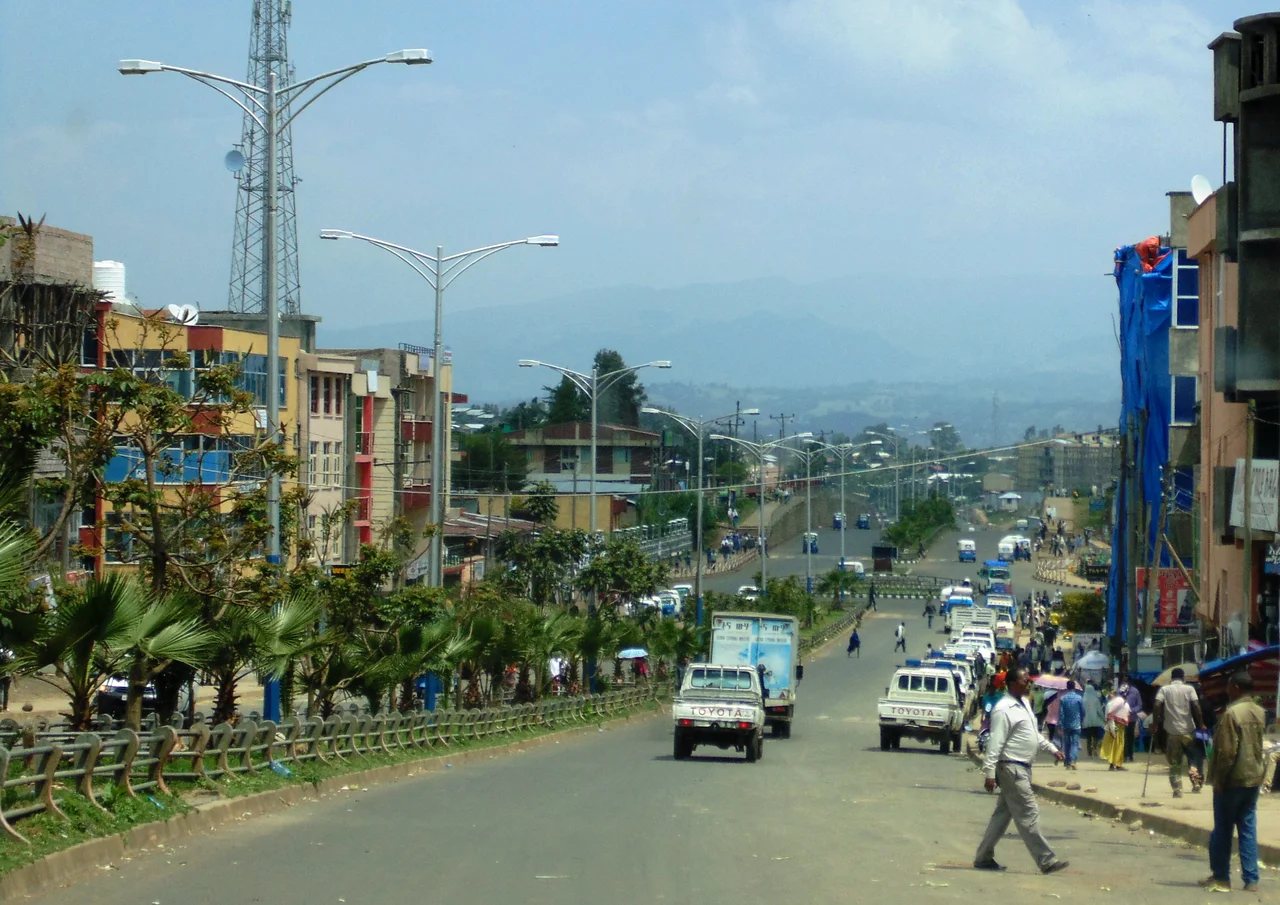

Debre Tabor
Forty-eight springs rise from the slopes around Debre Tabor. That is the practical reason, the old Ethiopian chroniclers say, the town exists where it does - at 2,706 metres in the Amhara highlands, about a hundred kilometres southeast of Gondar and fifty east of Lake Tana. The other reason is the name: Debre Tabor translates from Ge'ez as 'Mount Tabor,' named for the biblical site of the Transfiguration of Christ, and the early Ethiopian Christians who named it saw in the shape of the surrounding hills a northern Ethiopian echo of the Galilean mountain where Matthew says Jesus was transfigured before Peter, James, and John.
Who Founded It
The chroniclers disagree. Local tradition credits Seyfa Ared IV, who ruled in the late thirteenth century, with discovering the site. Mordechai Abir, the Israeli historian of Ethiopia, attributes the founding to Ras Ali I. Richard Pankhurst, perhaps the most respected twentieth-century historian of Ethiopia, gives a detailed account crediting Ras Gugsa - with the tradition that the location was selected with supernatural help. What everyone agrees on is that by the eighteenth and nineteenth centuries, Debre Tabor was the seat of the Regents of the Ethiopian Emperor during the period Ethiopians call the Zemene Mesafint - the Age of the Princes - when regional rulers held real power and the emperor himself was often a figurehead. Several churches and the ruins of two palaces from this period still survive in the town.
Capital Under Two Emperors
Debre Tabor served as the capital of Ethiopia under two emperors - Tewodros II and Yohannes IV - though in each case the capital status was mobile, contingent, and often contested. The town's population in the nineteenth century rose and fell depending on whether the emperor was in residence. If he was, it could reach 30,000 as it did under Yohannes IV. If he was not, the population fell to about 5,000 - farmers and traders and clergy, the permanent residents of a place designed to accommodate a court. Ras Ali built four churches here: Iyasus on the mountain to the southeast; Ennatitu Maryam and Legitu Maryam to the east; Tegur Mikael to the north. A second palace was built for his mother, Empress Menen Liben Amede.
Tewodros's Capital
Emperor Tewodros II - the reforming, short-tempered monarch who sought to unify Ethiopia and modernise its army - used Debre Tabor as his capital after defeating Ras Ali in 1853. He burned the town in May of that year, then rebuilt it. By the end of his reign his situation had worsened steadily. In 1867, forced to abandon Debre Tabor, he retreated to his mountain stronghold of Magdala. There, on 13 April 1868, after British forces under Robert Napier had breached his defences, Tewodros shot himself with a revolver - a pistol that had been a gift from Queen Victoria. Emperor Yohannes IV, the northerner who rose to the throne after him, often resided at Debre Tabor; during his reign, the Heruy Giyorgis church was built. Here, in October 1878, Yohannes met with British General Charles Gordon - representing the Egyptian government - to discuss Ethiopian demands for access to the Red Sea. Three years later, in January 1881, Tekle Haymanot was crowned Negus of Gojjam in the town's churches.
The Italian Interval
During the Second Italo-Abyssinian War, Italian forces advanced from Bahir Dar and occupied Debre Tabor on 28 April 1936. Under the occupation a telegraph office opened, postal service was restored, and the Italians cut a road from Gondar through Debre Tabor to Dessie. The first mosque in the town was constructed. Eucalyptus planting expanded. These changes did not reconcile the local population to foreign rule. By August 1937 the arbegnoch - the Ethiopian patriot fighters - were launching attacks on Italian garrisons near Debre Tabor and Bahir Dar almost simultaneously. After years of guerrilla pressure, the British convinced Colonel Angelini to surrender the town on 6 July 1941. The surrender at Debre Tabor opened the road north to Gondar - the last Italian stronghold in East Africa - where General Guglielmo Nasi would hold out until November.
Twentieth Century and After
In 1931, when the Bank of Ethiopia first opened, one of its branch offices - with two employees - was in Debre Tabor. In September 1975, after the Derg regime began nationalising land and killing opposition figures, Debre Tabor was briefly seized by a coalition of local landlords and their followers in opposition to the government. They killed the provincial governor and expelled both a Chinese road-building team and Seventh Day Adventist missionaries who had been running a local hospital. The government reestablished control within a month. In August 2021, during the Amhara phase of the Tigray War's aftermath, Debre Tabor was the site of fierce clashes between Fano militia and the Ethiopian National Defense Force. Today the town holds about 56,000 people, nearly all Amhara, nearly all Ethiopian Orthodox Christian, living in a place whose springs still provide the water they always did. The town also hosts Debre Tabor University and an airport with ICAO code HADT. It is cool enough year-round that the warmest month peaks at 75 Fahrenheit and the coolest nights drop to 54. After centuries of emperors and armies, Debre Tabor has become, finally, a quiet provincial capital with good weather and too much history.
From the Air
Debre Tabor is at 11.85N, 38.02E, elevation 2,706m (8,880 ft) in the Amhara Region's Debub Gondar Zone. Debre Tabor Airport (HADT/DBT) serves the town. Lake Tana lies 50 km west, Gondar 100 km northwest. The surrounding terrain is Ethiopian highland plateau with distinct climate zones. Recommended viewing altitude 11,000-13,000 ft AGL. Expect significant performance reduction due to high elevation density altitude, especially in summer. Regional security conditions have been sensitive since the 2020-2022 Tigray War and its spillover into Amhara.
Nearby Stories
- Bahir Dar 25 km away
- Lake Tana Biosphere Reserve 31 km away
- Lalibela 45 km away
- Fasilides 52 km away
- Battle of Culqualber 55 km away
- Amba Geshen 71 km away
- Battle of Gondar 90 km away
- Battle of Amba Aradam 162 km away