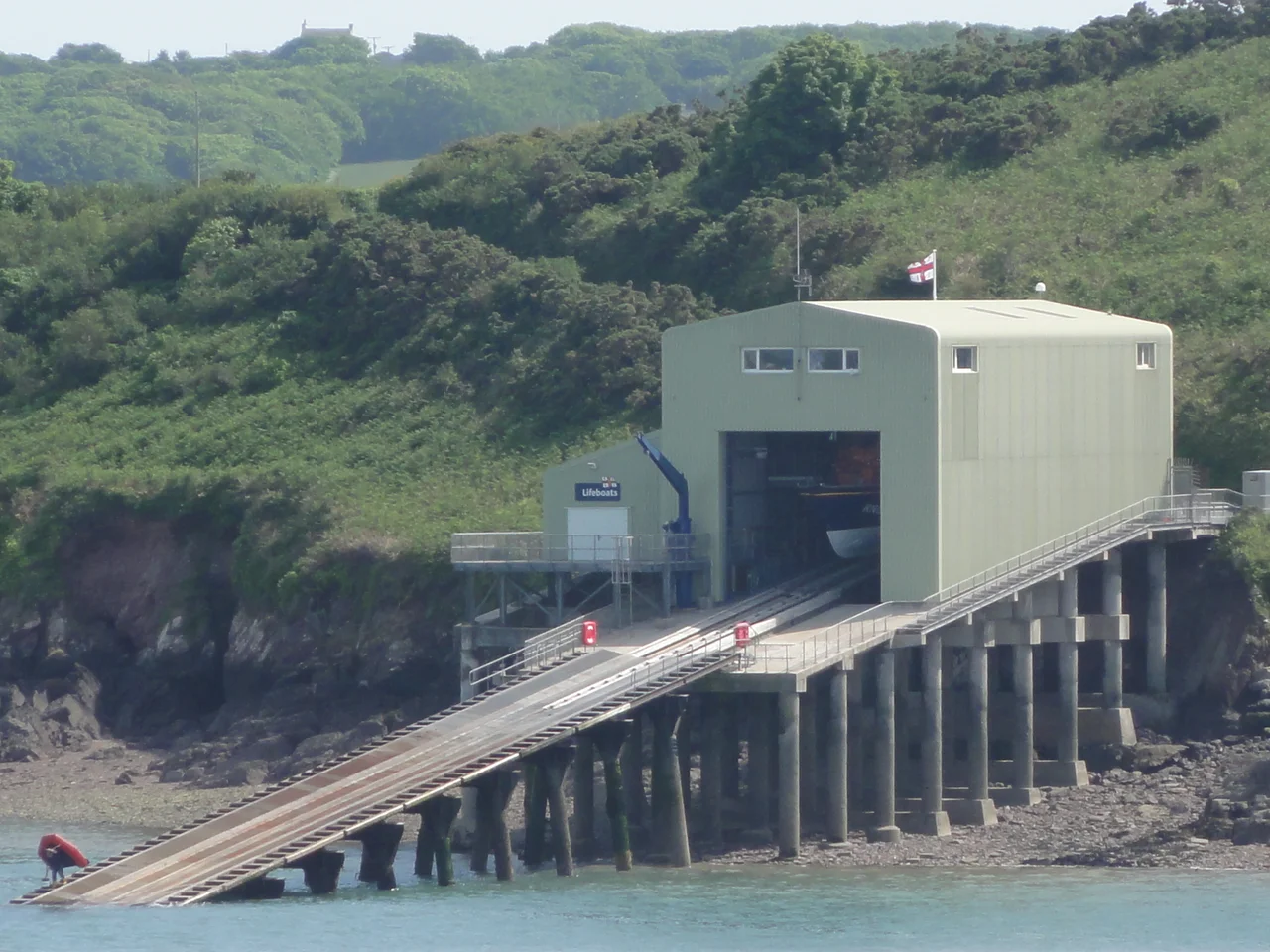

Angle Lifeboat Station
Bottles of beer worth a thousand pounds each were once auctioned out of these waters. The bottles came from the wreck of the Loch Shiel, an iron sailing ship that ran onto the rocks at Thorn Island in 1894 just inside Milford Haven, and the only reason all 33 people aboard survived is that the Angle lifeboat crew rowed out and got them. Six of the survivors were lifted off the ship itself. Twenty-seven had scrambled onto Thorn Island in the dark and were stranded above the surf; three Angle lifeboatmen had to be landed on the island, climb its cliffs from another angle, and haul the 27 up by rope, one at a time, through the night. The beer, sealed and bobbing in the hold, kept the salvors busy for over a century afterwards.
A Letter from the Coastguard
Milford Haven is one of the deepest natural harbours in Europe, a long fjord-like inlet that has sheltered everything from Royal Navy frigates to modern LNG supertankers. In December 1867, Inspecting Commander Harvey of the Milford coastguard wrote to the RNLI in London arguing that a lifeboat was overdue. The committee agreed quickly. They picked Angle Point, on the southern shore at the very entrance to the haven, where the slipway could meet weather coming straight in off the Atlantic. The stone boathouse and wooden slipway cost £170-4s-0d, built by a Mr P. James. The first lifeboat was a 33-foot self-righting pulling-and-sailing boat from the Shadwell builder Woolfe of London, costing £275 more.
The Salt Money
Most lifeboats start as letters and finish as legacies. Angle's first boat was bought with money from a man with one of the more striking family stories in Victorian industry: Titus Salt Jr., son of Sir Titus Salt, the Bradford wool magnate who built the model village of Saltaire to house his workers in conditions then unheard of. The younger Salt wrote to the RNLI on 23 November 1867 enclosing a cheque for £420 to defray the cost of the new station. The boat was named Katherine after his wife, Catherine Crossley of the Halifax carpet-manufacturing family, at a christening on 28 November 1868. The same name was given to a street in Saltaire. Industrial wealth and lifesaving philanthropy were, in this period, often the same letterhead.
From Sail to Petrol
Katherine gave way in 1888 to a 37-foot lifeboat called Henry Martin Harvey, which was sent back to London in 1891 to have a drop-keel fitted and returned in 1892. That same year the station's name shifted from Milford to Angle. The next leap was mechanical: in 1926 the RNLI announced plans for a motor lifeboat, and a new larger boathouse and deep-water slipway went up at a cost of £20,000, opening in January 1929. The new boat was the 45ft 6in Elizabeth Elson, twin 40-horsepower petrol engines pushing her along at 8.23 knots. Across 28 years on station she launched 58 times and rescued 144 people. Her coxswain James Watkins, who served 24 years in that role after 13 as second coxswain, earned a Silver Medal in 1944 for getting six men off the motor boat Thor in heavy seas, and a Bronze clasp the following year for a steamer rescue.
The Tanker Watch
Angle's current lifeboat is the Tamar-class Mark Mason (ON 1291), on station since 2009. Her job has shifted with the haven itself. The estuary she guards is now lined with oil refineries, LNG terminals, and the kind of tanker traffic that did not exist when Katherine first launched. The crew still come from the village, still volunteer beyond the two paid staff, but in July 2024 the RNLI announced a six-month trial in which the all-weather lifeboat would operate from the Milford Haven port authority jetty rather than from Angle itself, a logistical compromise driven by the increasing difficulty of sustaining a slipway launch at a small village. The lifeboatmen and women themselves answer the same alarm their predecessors did 150 years ago. The water is the same. The ships, mostly, are much larger.
From the Air
Angle Lifeboat Station sits at 51.69 N, 5.08 W on Angle Bay near the southern entrance to the Milford Haven Waterway. From the air the haven opens out as a long deep east-west inlet flanked by oil terminals and LNG jetties; Angle Point is on the south shore where the haven meets the open sea, and Thorn Island (site of the Loch Shiel wreck) lies just to the west. Good viewing altitude is 1,500-3,000 feet. Nearest airport is Haverfordwest (EGFE) about 8 nm to the north-northeast; Swansea (EGFH) lies about 45 nm to the east. Watch for tanker traffic moving in and out of the haven at almost any hour.
Nearby Stories
- Abercych 1.3 km away
- Pendine Sands 6.4 km away
- HMS H47 20 km away
- HMHS Glenart Castle 43 km away
- Ilfracombe Lifeboat Station 45 km away
- Johnstown Castle 67 km away
- Hook Lighthouse 98 km away
- 1979 Fastnet Race 142 km away