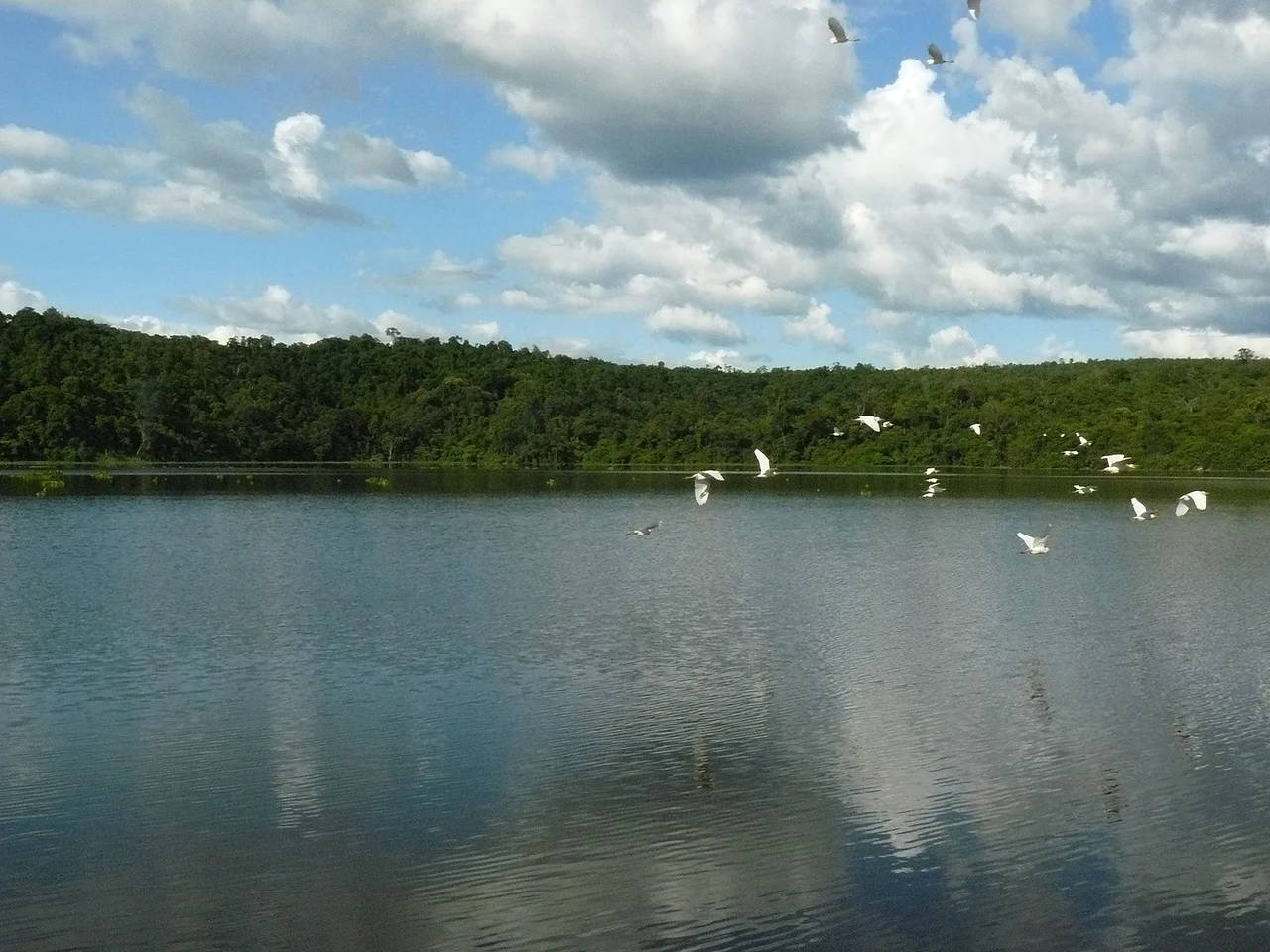

Ankarafantsika National Park
Stand at the edge of Lake Ravelobe at dawn and watch for a shape on a dead branch above the water. If you are lucky, it is the Madagascar fish eagle - and there may be no more than a few hundred breeding pairs of them left in the world. This is Ankarafantsika, a 136,513-hectare expanse of dry deciduous forest stretched across the sandy plateau between the Betsiboka and Mahajamba rivers in northwestern Madagascar. The forest here does something most rainforests never do: it loses its leaves. Through the long dry months the canopy turns bare and silver-gray, the ground cracks, and the whole landscape seems to hold its breath until the rains return.
A Forest That Sheds Its Skin
Dry deciduous forest is one of the rarest habitats on the planet, and Madagascar's is among the most threatened of all. Ankarafantsika protects one of the largest surviving fragments. More than 800 plant species grow here, most found nowhere outside Madagascar. Among them are the flowering shrub the Sakalava call mpanjakabenitany, the medicinal katrafay tree whose bark still flavors traditional remedies, and the sakoanala, a large tree that bursts into conspicuous bloom. It is a forest built for thirst, its trees timing their growth to a calendar of drought and downpour, surviving on sandy, eroded soil where little else takes root.
The Fish Eagle's Lake
The Madagascar fish eagle is one of the rarest birds of prey on Earth, and Ravelobe Lake is one of the best places anywhere to see it. Rust-brown with a pale head, it perches over the water and drops to snatch fish from the surface. It is far from alone. One hundred and twenty-nine bird species have been recorded in the park, more than half of them Malagasy endemics. Watch for the Van Dam's vanga, restricted to a handful of western forests; the rufous vanga; and the elusive banded kestrel, glimpsed more often than seen. For birders, Ankarafantsika is one of the richest single sites in the country.
Creatures of the Sand
Some residents here exist literally nowhere else. The greater big-footed mouse, a soft-furred rodent with oversized hind feet, is known only from this park - found within these few hectares of forest and on no other patch of ground in the world. Lemurs move through the canopy, chameleons cling to the branches, and the sandy clearings hide their own specialists. It is the kind of place that rewards patience: a forest that looks austere at first glance and then, slowly, reveals just how many lives it is quietly holding.
Living Land
Ankarafantsika is not wilderness in the sense of land without people. The Sakalava have lived and farmed across this region for generations, and their fields and villages sit within and around the park's boundaries. The protected area itself was first established in 1927, and in 2002 two reserves on either side of the Route 4 national road were merged into the single national park that exists today. Crossed by tracks and dotted with lakes, with lodges and local guides at the main entrance near Andranofasika, it is among the most accessible of Madagascar's great forests - a rare chance to walk into a vanishing habitat and meet the things that live only there.
From the Air
Ankarafantsika sits near 16.15°S, 46.95°E on the sandy plateau between the Betsiboka River (west) and the Mahajamba River (east), roughly 115 km south of the coastal city of Mahajanga. From the air the dry forest reads as a pale gray-green block veined with lakes - Lake Ravelobe is the most prominent - bisected by the straight line of the RN4 highway. The nearest major airport is Mahajanga's Amborovy / Philibert Tsiranana Airport (ICAO FMNM, IATA MJN) to the north. Recommended viewing altitude 3,000 to 6,000 ft AGL; clearest in the dry season (May to October), though the forest is at its greenest just after the rains.
Nearby Stories
- Bombetoka Bay 15 km away
- Mahajanga: Madagascar's Sunlit Gateway 42 km away
- Anjajavy Forest: Where Stone Forests Meet Living Ones 93 km away
- Lake Alaotra 169 km away
- Zahamena National Park 220 km away
- Makira Natural Park 227 km away
- Ambohimanga 276 km away
- Tsingy de Bemaraha National Park 330 km away