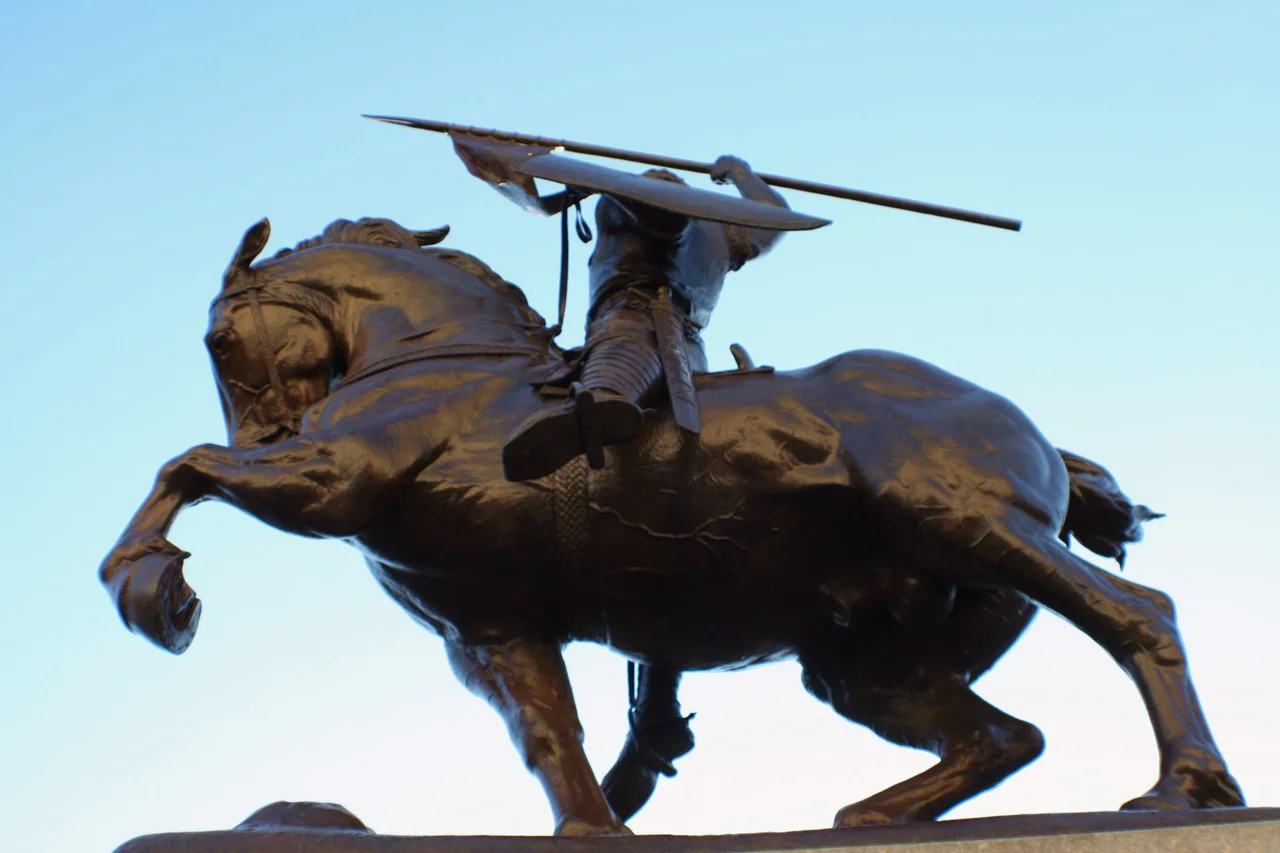

Anna Hyatt Huntington
Her first sculpture teacher in Boston, Henry Hudson Kitson, threw her out of his studio after she pointed out that his horses' anatomy was wrong. She was right about the horses. Anna Vaughn Hyatt had grown up around them, in stables and zoos and at the field stations where her father - a paleontology and zoology professor at Harvard and MIT - took her along to study live and fossil animals. By the time Kitson banished her she already knew more about equine musculature than most working sculptors in New England. She would spend the next seventy years proving it, animal by bronze animal, all the way from the Bronx Zoo to a low-country plantation in South Carolina that became, under her hands, the largest outdoor sculpture garden in America.
First in New York
After leaving Kitson she studied with Hermon Atkins MacNeil and Gutzon Borglum at the Art Students League, but most of her real training happened in zoos and circuses with a sketchbook on her knee. By the time she was forty, her animal sculptures combined precise anatomy with what critics persistently called emotional depth - a quality hard to define and impossible to fake. In 1915, with France at war and three years after the city had marked the 500th anniversary of Joan of Arc's birth, the city of New York unveiled Anna Vaughn Hyatt's equestrian Joan on Riverside Drive at 93rd Street. It was the first public monument by a woman ever erected in New York City, and the city's first monument honoring a historical woman of any kind. Mina Edison, Thomas Edison's wife, attended the unveiling. The statue catapulted Anna Hyatt into international view. Replicas now stand in Quebec City, in Blois, in San Francisco's Lincoln Park, and in Gloucester, Massachusetts.
Brookgreen
On her forty-seventh birthday in 1923, she married Archer Milton Huntington, heir to one of the great American railroad fortunes and a serious Hispanophile scholar. Together they had the means - and the temperament - to build institutions. In 1929 they bought four contiguous antebellum rice plantations on the Waccamaw River near Murrells Inlet, South Carolina, ground that had been worked for generations by enslaved Africans whose labor had produced the rice that paid for the plantation houses. The Huntingtons consolidated the land as Brookgreen Gardens and opened it to the public in 1932 as the first public sculpture garden in the United States. Anna's own bronzes - Fighting Stallions at the entrance, Diana of the Chase, Don Quixote, the small Sybil Ludington - became the founding collection. The site was added to the National Register of Historic Places in 1978 and named a National Historic Landmark in 1984. The plantation history is not erased there; it is part of what Brookgreen now teaches.
The Last Statue
She fought tuberculosis for a decade after contracting it in 1927 and recovered. She was elected to the American Academy of Arts and Letters in 1932, one of the earliest women so honored. She kept working into her nineties. In 1956, a sixth-grade class at Rice Elementary School in Lancaster, South Carolina, wrote her a letter asking if she would sculpt a young Andrew Jackson for their state park. She agreed. South Carolina schoolchildren raised the funds for the granite base with nickels and dimes. Already in her eighties, she modeled the figure first at half scale in clay, then climbed a tall ladder to finish the full-size statue. Andrew Jackson, A Boy of the Waxhaws was unveiled at Andrew Jackson State Park in March 1967, for the 200th anniversary of Jackson's birth. It was her last major work. She lived another six years, dying at home in Redding, Connecticut, on October 4, 1973, at the age of 97.
What Remains
Anna Hyatt Huntington's bronzes stand in Central Park (her José Martí, leaning forward in the saddle as if he can already see Cuba); in front of the Legion of Honor in San Francisco; in Seville and in Buenos Aires (her El Cid); at Stevens Institute and Stanford and the Mariners' Museum in Newport News; outside Putnam Memorial State Park in Connecticut; on the Allen University campus in Columbia. With Archer she founded fourteen museums and four wildlife preserves; together they donated 800 acres in Redding to Connecticut as Collis P. Huntington State Park. Her papers live at Syracuse University and at the Smithsonian's Archives of American Art. Metropolitan Museum scholars rank her with Malvina Hoffman and Evelyn Beatrice Longman as the American women sculptors who took on monumental public commissions when the field was still aggressively closed to them. She got the horses right, and then she kept going.
From the Air
Anna Hyatt Huntington's connection to the Columbia area is institutional rather than geographic - her bronzes stand at multiple South Carolina sites. The coordinates of 33.997°N, 81.031°W place this article in central Columbia near the State House. Brookgreen Gardens, her major South Carolina creation, lies about 110 miles east-southeast on the coast at Murrells Inlet (near KCRE Grand Strand). Andrew Jackson State Park, where her last major statue stands, is about 80 miles north near Lancaster, SC. Columbia Metropolitan (KCAE) is the closest major airport to the coordinates; Columbia Owens Downtown (KCUB) is about a mile to the south.
Nearby Stories
- Shaw Air Force Base 5.5 km away
- Fairfield County, South Carolina 16 km away
- Newberry Opera House 30 km away
- Graniteville Train Crash: The Night Invisible Death Came to a Mill Town 31 km away
- Orangeburg Massacre 33 km away
- Battle of Hammond's Store 33 km away
- Hartsville, South Carolina 41 km away
- Middleton Place 101 km away