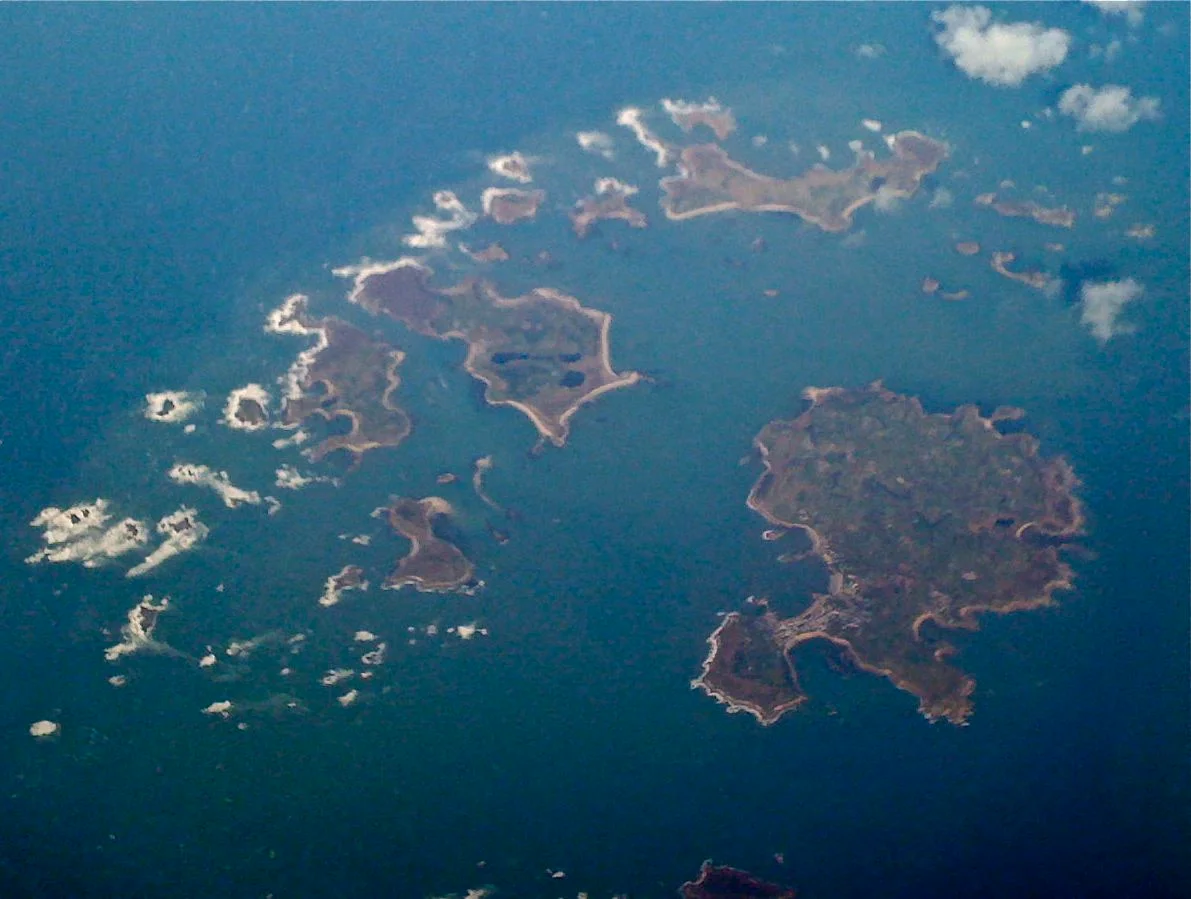

Annet, Isles of Scilly
The first time you see Annet from the water in early summer, you cannot quite parse what your eyes are showing you. The sea around the island is not water but plumage. Black bands of puffins and razorbills sit so densely that their white breasts disappear into glare, and above them the air shakes with the cries of gulls. Reverend Smart, in 1885, wrote that the ground itself was honeycombed, so soft with shearwater burrows that you could not walk across it without a leg sinking suddenly into someone else's home. Annet is the second-largest uninhabited island in the Isles of Scilly, only a kilometre long, and twelve species of seabird treat it as the most important nursery in the archipelago. No people are allowed to set foot on it. That arrangement is roughly a century old, and Annet's birds have already needed every minute of the protection it provides.
The Island That Will Not Hold Cattle
Annet is low, granite at its north end, almost cut in two at West Porth where storm waves overrun the neck. The carns at the head of the island, Annet Head and Carn Irish, rise as outcrops above heath and storm beach. Only one freshwater seepage exists on the whole island, which has historically been the limit on every human ambition for the place. Bronze Age people built a hut circle here and ate cattle and sheep, but nothing larger than a fragmentary field system survived them. Medieval St Agnes farmers used it for pasturage, but with only one trickle of fresh water there was never enough to graze many animals. The records of the name itself trace a small drift through time: Anet in 1302, Anete in 1305, Agnet by 1570, and finally Annet in 1650. For most of those seven centuries the island has belonged more to seabirds than to anyone with hands.
What Happens When Cattle Land on Bird Island
In June 1877 the steamship Castleford struck the Crebawethans, the rocks south of Annet, and her cargo of between 250 and 450 cattle was driven onto the island to wait. Some of those animals were still wandering Annet ten days later. The naturalist J. H. Gurney, visiting two months later, recorded the result with the practical horror of a man who had been counting nests: the cattle had trampled everything to pieces, broken into the shearwater burrows, and made a ruin of the colony at the peak of nesting season. Some cattle never made it ashore and washed up on the Cornish mainland at Mount's Bay and St Ives. Thirty years later, in December 1907, the seven-masted schooner Thomas W. Lawson wrecked nearby and spilled her oil cargo. Birds and rabbits were seen lying along the shoreline. People on St Agnes could still smell the oil eighteen months later. Annet survived these disasters, but its shearwater population did not recover quickly.
The Egg Collectors and the Permit
Even after shooting and egg collecting were officially banned, Annet remained on every Victorian collector's list. The Natural History Museum holds forty-five eggs taken between 1880 and 1936 by fourteen men from Holloway College alone, and the cards bear names familiar from English natural history: Charles Rothschild, Frederick William Frohawk. One entry preserves the permit the Souter brothers used to land in 1931, issued by Arthur Dorrien-Smith of Tresco, allowing one hour ashore on any island except the terneries. That a permit existed to remove eggs from a sanctuary now reads as quietly absurd, but it captures something honest about how recently the idea of leaving wild birds entirely alone became a moral consensus. Today no permit exists. Annet is closed to people year-round, protected as a Site of Special Scientific Interest and managed by the Isles of Scilly Wildlife Trust under lease from the Duchy of Cornwall.
What Comes Back, and Slowly
Twelve seabird species nest on Annet. European storm petrels tuck themselves between the rounded boulders of the storm beaches. The largest Manx shearwater colony in Scilly burrows the peat soil here, alongside puffins, razorbills, kittiwakes, fulmars, and the long flat shadows of greater black-backed gulls. Atlantic grey seals haul out for the winter pupping season, and in 2010 more than half of all observed Scilly pups, forty-six of eighty-five, were on Annet. The shearwaters, though, have not had an easy century. By 2000 the Manx shearwater count on Annet had fallen seventy-four percent below the 1974 survey. Brown rats, washed in on shipwrecks generations earlier, were the chief reason. Natural England began the eradication programme in the 1990s; rats were cleared from Annet itself, and in November 2013 the work moved to St Agnes and Gugh, the most likely sources of reinvasion. By early 2017 both neighbouring islands were declared rat-free, and in 2014 twelve Manx shearwater chicks fledged on St Agnes and Gugh for the first time in living memory. The birds remember what was taken from them. They are also, with help, learning to come back.
From the Air
Annet sits at 49.8967 N, 6.3733 W, a kilometre west of St Agnes and immediately east of the Western Rocks. The nearest airport is St Mary's (EGHE), about 6 km east-northeast, with Land's End (EGHC) some 50 km east on the Cornish mainland. The lighthouse at Bishop Rock, 4 km southwest, is the best visual landmark in poor weather. Recommended viewing altitude is 800-1500 ft AGL for the seabird colonies in summer; expect strong Atlantic crosswinds and rapidly changing visibility. Do not overfly low in the breeding season (April through August) - the island is a designated bird sanctuary.
Nearby Stories
- Wolf Rock Lighthouse 17 km away
- The Brisons 18 km away
- SS Irma (1905) 22 km away
- HMS Brisk (1851) 31 km away
- Cape Cornwall Mine 57 km away
- SM U-27 73 km away
- Wolfpack Prien 162 km away
- Tower of Hercules 696 km away