
Cape Cornwall Mine
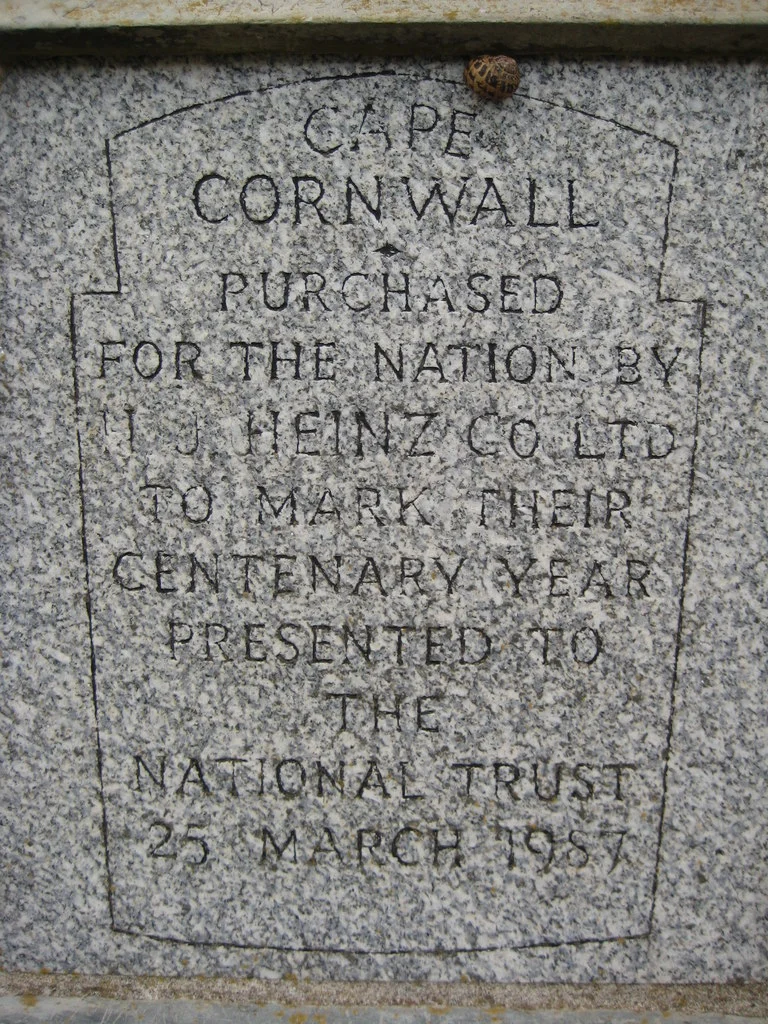
There is a stone chimney standing on top of Cape Cornwall, and at its base is a plaque shaped like a Heinz Baked Beans label. The pairing tells the whole story. The chimney was raised in 1864 for the boilers of a struggling tin mine. By 1880 the same chimney had been retired from mining duty but kept upright, because mariners coming around Land's End used it as a landmark. The mine itself closed for good in 1883. A century later, in 1987, the H. J. Heinz Company bought the entire headland and gave it to the nation, and the company that built its fortune on canned beans got to commemorate the gift with the only piece of corporate branding in any UNESCO World Heritage Site. Cornwall accepted it on the spot.
A Mine That Could Not Quite Succeed
Cape Cornwall Mine opened in 1838, during the height of the Cornish mining boom. The site was unpromising. Steep cliffs surrounded the workings on three sides, leaving almost no flat ground for the surface operations that any nineteenth-century mine required: floors for breaking ore, sheds for the engines, space for the spoil. The first incarnation closed in 1849. In 1864 St Just Consolidated Mines reopened the workings, built the new engine house, and fitted spalling braces, platforms bolted to the shaft itself, so that the work of breaking the ore into sortable chunks could be done over the cliff. The 1864 chimney joined the engine house to a flue running up the hill. The whole operation read like a small triumph of stubbornness over geology. It was not enough. St Just Consolidated walked away from the site in 1869, and although it kept operating intermittently under different owners, the mine was always second-rate.
The Industry Ends
By 1879, when the mine reopened for what would be its last attempt, the Cornish industry was already collapsing. Cheap tin from Malaya and Bolivia was flooding the world market. Parliament had begun to regulate the worst of the working conditions: the Metalliferous Mines Regulation Act of 1872 and the Factory and Workshop Act of 1878 restricted the cheap female and child labour that had kept the marginal mines alive. The bal maidens who broke ore on the surface, often girls as young as ten, were now protected by law from the longest shifts. The bargain that had made Cape Cornwall Mine economically possible no longer worked. In 1883 the mine was permanently abandoned, the engine house demolished, the 1864 chimney left standing for the ships.
Greenhouses and a Diamond Magnate
The site then took an unexpected turn. In 1907 Francis Oats, the Cornishman who had risen to become chairman of De Beers in South Africa, built himself an 11,660-square-foot country house called Porthledden on the slope above the abandoned mine. Oats was born in the village just up the hill in St Just, gone out to Kimberley in his twenties, and made a fortune in diamonds. When he came home, he commissioned a house modelled on Cecil Rhodes's Groote Schuur in Cape Town. The old mine workings became his garden. The ore dressing floors, walled flat platforms where the bal maidens had hammered rock for sixty years, were roofed over as greenhouses and wineries. The surrounding cliffs were planted with mesembryanthemums, succulent African flowers that thrived in the maritime climate. The man who left Cornwall in poverty had come back rich enough to convert an industrial ruin into a private paradise.
Heinz Buys a Cape
By the 1980s the workings had returned to ruin and Porthledden was changing hands. In 1987, to mark a hundred years of operating in the United Kingdom, the H. J. Heinz Company bought the entire headland, mine and chimney and all, and presented it to the nation through the National Trust. Porthledden House remains in private hands; everything else is now public ground. At the base of the 1864 chimney is the famous plaque, cast in the shape of a Heinz baked beans label, commemorating the gift. Since 2006 the mine has been part of the UNESCO Cornwall and West Devon Mining Landscape. Walkers come up the hill to read the plaque, laugh, and then look out at the Brisons rising from the swell a mile offshore. The chimney still works as a navigation aid, doing the only job it was kept for, and probably the only thing it ever did well.
From the Air
Located at 50.1269°N, 5.7092°W on the summit of Cape Cornwall headland, 1.2 miles west of St Just. Best viewed from 800-2,000 feet AGL approaching from the south or east. Nearest airport: Land's End (EGHC), 4 nautical miles south-southeast. The 1864 chimney is the prominent feature on the cape's silhouette, a square stone stack visible from far out to sea. From the air the headland's hooked shape stands out clearly against the Atlantic; the Brisons rise from open water a mile to the southwest, and the remnants of stone walls outline the former ore floors and Porthledden's gardens on the slope below the chimney.
Nearby Stories
- Bartholomew Ledges Wreck 1.8 km away
- Carn Brea Castle 4.6 km away
- Battle off Lizard Point 12 km away
- Carnewas and Bedruthan Steps 18 km away
- King Charles's Castle 25 km away
- MV Cita 34 km away
- 1979 Fastnet Race 47 km away
- Trevose Head Lighthouse 55 km away