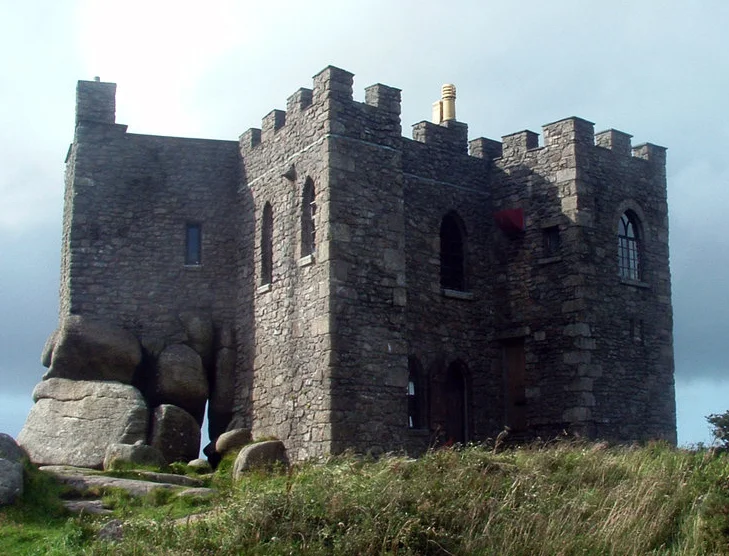

Carn Brea Castle
Carn Brea is the kind of place that explains the rest of Cornwall. From its 738-foot granite summit, looking north, you can see the long brown scar of the Camborne-Redruth mining district, every old engine house and chimney stack pointing at a shaft that once tapped the underlying lode. Looking south, the land softens toward Falmouth and the sea. And right on top of the hill, growing out of the boulders as though the rock itself decided to build a roof, sits Carn Brea Castle: medieval chapel, fake medieval folly, and currently a Middle Eastern restaurant. Few buildings in England have been so many things to so many centuries.
A Chapel on the Hill
The castle was originally built as a chapel in 1379, thought to have been dedicated to St Michael, who turns up on Cornish hilltops the way lighthouses turn up on Cornish headlands. The 15th-century antiquarian William Worcester recorded 32 castles on the Cornish peninsula, including this one, which he described as a tower. It was a beacon as much as a building, a stone exclamation point planted on a granite outcrop that had already been occupied for millennia. The hillfort below the chapel dates to the Iron Age, and Neolithic earthworks predate even that. Christianity simply added another stratum to a hill that had been sacred, or at least strategic, since people first noticed that you could see for thirty miles from the top of it.
The Bassets Make a Folly
In the 18th century the Basset family, whose copper mines below the hill were minting them a Cornish fortune, decided the old tower needed to be more impressive. They rebuilt it as a hunting lodge styled to look like a medieval castle. Four rectangular turrets, an embattled parapet, an irregular layout that hugged the existing stone outcrop. The huge uncut boulders left exposed at the foundations make the building look as though it is melting into the land, or perhaps growing out of it. It is, in the technical architectural sense, a folly: a building that pretends to be older and grander than it is. But unlike most Georgian follies, this one was built from the rock it was standing on, by people whose fortune came from the rock immediately beneath their feet.
Light in the North Window
By 1898 the lease on the castle stipulated something practical: the tenant must show a light in the north-facing window each night, to guide ships steering off the Cornish coast. The hill is high enough and the position prominent enough that a lamp on its peak was visible from the sea. A medieval chapel, refashioned as a hunting fantasy, repurposed as a navigation beacon for the merchant fleet of an industrial nation. The castle drifted in and out of use through the early 20th century, fell into disrepair from the 1950s to the 1970s, and was rescued by private renovation between 1975 and 1980. English Heritage listed it Grade II in 1975. In the 1980s a Middle Eastern restaurant moved in, and as of the 2020s it is still there, serving meze in turrets and tagines under embattled parapets.
The Bond Sequence
In 1983 the castle made an unlikely cameo in the Sean Connery James Bond film Never Say Never Again. Two air-launched cruise missiles armed with nuclear warheads streak across the English countryside on their way to a Mediterranean target. The viewpoint is from the missile's head-up display, and what flashes past on screen is Carn Brea Castle and the nearby Basset monument. Cornwall, used by the film as generic English countryside, was actually the most strategically significant English countryside on offer: directly below, the Cornubian batholith held the tin and copper that built the British Empire, the mines that produced the metals that built the missiles. The geology, the metallurgy, and the warhead were all part of one chain of causation, and the cinematographer probably had no idea.
The Anglia and the View
There is one more layer. In 2006 the stolen Ford Anglia featured in the Harry Potter films was found, of all places, at Carn Brea Castle. How a flying car prop ended up on a Cornish granite peak nobody seemed willing to say. But it fit the building's pattern: every century leaves something on Carn Brea. Iron Age earthworks. A medieval chapel. A Georgian folly. A Victorian shipping beacon. A Cold War film prop and a 21st-century film prop. Climb the path up the hill today and you will see all of it at once: the granite below, the engine houses on the plain to the north, the embattled walls of the restaurant rising out of the rock, and on a clear day, the silver glint of the English Channel beyond Falmouth.
From the Air
Carn Brea sits at 50.22°N, 5.24°W, on a granite ridge between Camborne and Redruth in west Cornwall. The summit is 738 feet (225 m) above sea level and conspicuous from the air as a low ridge running roughly east-west, with the castle a recognisable squarish structure on its eastern end and the Basset Monument as a tall obelisk on the western. From a transit at 2,500 feet the surrounding mining landscape reads clearly: the long line of derelict engine houses south of the hill marks the Great Flat Lode, one of the world's richest tin lodes. Newquay Cornwall Airport (EGHQ) is 17 nm to the northeast; Land's End (EGHC) 18 nm to the west-southwest. Strong westerlies are common; the granite peak generates lee turbulence in fresh winds.
Nearby Stories
- Morvah 2.9 km away
- Carnewas and Bedruthan Steps 6.1 km away
- Liskeard 7.5 km away
- Battle off Lizard Point 14 km away
- Polperro 17 km away
- MV Cita 47 km away
- HMS Affray 86 km away
- 1979 Fastnet Race 96 km away