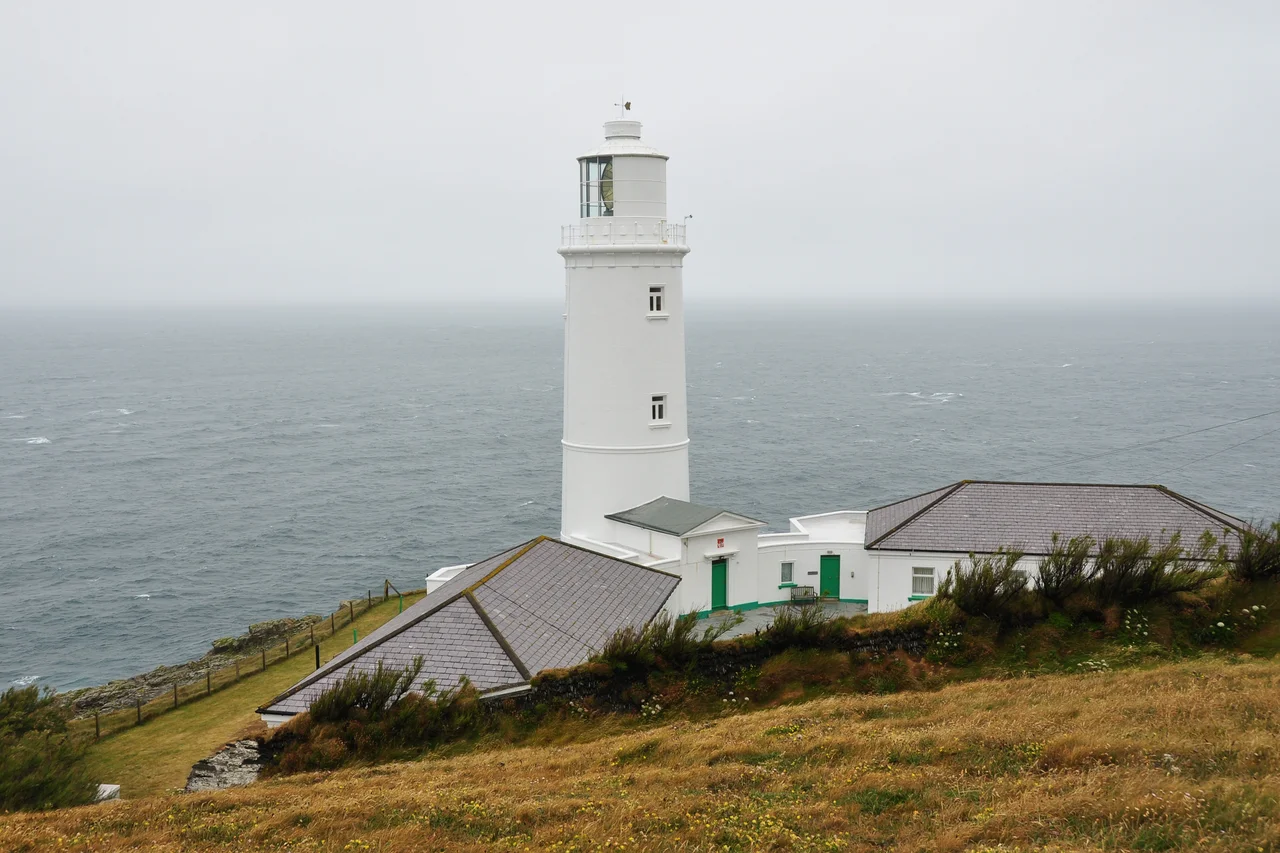

Trevose Head Lighthouse
Until 1847, a ship rounding the north coast of Cornwall from Land's End could see no lighthouse until it reached Lundy, eighty miles north up the Bristol Channel. The intervening cliffs - Cape Cornwall, Pendeen, Trevose, Hartland - were among the most dangerous on the British coast, and the gap was killing trade. Trevose Head Lighthouse was built to close it. Eighty-nine feet of granite tower, perched on the headland west of Padstow, the light first shone in 1847 and is still operating today. On a clear night its flash can be seen 35 miles south-west at Pendeen Lighthouse, further along the same north Cornish coast near Land's End. The keepers are gone. The light remains.
The Gap That Killed
Trinity House surveyed the site in July 1844 on its own order. The design was submitted in November 1844 and approved that February. Construction began in May 1845 with the laying out of an access road; the building contract was let the following month. The tower's purpose was straightforward enough - it was sited specifically because there was previously no light from Land's End to Lundy, and a light at Trevose Head would be visible from Cape Cornwall in the south to Hartland Point in the north. That arc of cliff covers roughly a third of the south-west coast of Britain, and it had been operating without warning lights since shipping began. When the lighthouse was completed it found, almost immediately, that its single light could under certain weather conditions be mistaken for another aid to navigation. A second tower, a 'low light', was therefore built fifty feet in front of the high light, with a covered passage between them so the keepers could walk between in any weather. The low light came into service after 1847.
Douglass and the Occulting Light
In 1882 the engineer-in-chief of Trinity House, James Douglass - the same Douglass who would build the fourth and current Eddystone Lighthouse a few years later - rationalised Trevose Head. The high light was converted to an occulting light, eclipsed for three seconds three times in quick succession every minute. The low light was put out of use. Douglass installed a new six-wick lamp, the brightest the technology of the time allowed. The economy of one tower replacing two was real - it cut staffing requirements and simplified the mechanism. The covered passage between the two towers became, in time, a curiosity left over from a more cautious era. From 1911 onward a series of further improvements modernised the station. The keepers' dwellings were rebuilt. A red filter was added to the lamp from 1 August 1912, giving Trevose Head a distinctive characteristic: one short red flash every five seconds.
Lord Rayleigh's Trumpet
In 1913 a fog signal came into service that the keepers nicknamed Lord Rayleigh's trumpet. It was a five-inch siren attached to a 36-foot-long acoustic horn, designed by John Strutt, 3rd Baron Rayleigh - the Nobel Prize-winning physicist who had done foundational work on the scattering of light and the propagation of sound. Rayleigh was an Elder Brother of Trinity House and the eminent acoustician of his generation. His horn was mounted on the roof of a new engine house, driven by a pair of Hornsby oil engines with their associated air compressor and reservoirs. The trumpet boomed out across the headland in fog, audible miles offshore. It served continuously for fifty years. In 1963 it was replaced by a set of eight modern 'supertyfon' air horns mounted in a metal turret on the engine house roof, driven by new diesel engines and Reavell compressors. The red filter came off the light at the same time, and the rotation of the optic was slowed.
The LED That Replaced the Lens
Trevose Head was automated, like nearly all British lighthouses, in the late twentieth century. The revolving optic that had served from before 1913 - more than 110 years in continuous operation - was removed in 2023 and replaced by a fixed LED lantern that produces the required flash characteristic electronically. The nominal range of the light was reduced at the same time from 21 to 18 nautical miles. The change is consistent with what Trinity House has done across its lighthouse network: keep the warnings, simplify the hardware, eliminate moving parts that wear out. A century of slow rotating Fresnel optics gave way, in a few hours of careful work, to a fixed solid-state lantern. The result looks slightly less romantic, but it works in any weather and it does not need an engineer climbing a ladder to fix it.
Cottages for Rent
The former keepers' cottages at Trevose Head, arranged in two semi-detached pairs, are now available as holiday accommodation. People go there for the silence, the wind, the long views across to Padstow and the south down toward Newquay. The old fog horn is silent. The new air horns blast only occasionally, when the visibility actually drops. The Padstow Lifeboat station sits just along the headland, and the slipway that launches the Spirit of Padstow runs straight into the sea at the foot of the cliff. The shape of the original 1847 tower is unchanged. The Illustrated London News drew the freshly completed lighthouse in October of that year, both high and low lights side by side. The high light is still there. The low light is a memory. The keepers are gone, replaced by a microchip. Trevose Head still holds the gap.
From the Air
Trevose Head Lighthouse stands at 50.55°N, 5.04°W on the western tip of Trevose Head, a granite headland on the north Cornish coast just west of Padstow. Newquay Cornwall Airport (EGHQ) is twelve miles south. The lighthouse appears from the air as a single white tower at the very edge of a long, blocky headland that juts out into the Atlantic. The Padstow Lifeboat slipway is on the same headland, just to the south of the lighthouse. Mouls Island and the smaller offshore stacks sit a mile north. Approach from the west or south-west to see the lighthouse silhouetted against the open Atlantic; from the east it sits against the dark green of the headland and is harder to pick out.
Nearby Stories
- Jamaica Inn 2.8 km away
- Bude 3.3 km away
- Truro 3.5 km away
- Pendeen Lighthouse 13 km away
- Eddystone Lighthouse 24 km away
- HMHS Glenart Castle 35 km away
- Morvah 42 km away
- Hook Lighthouse 173 km away