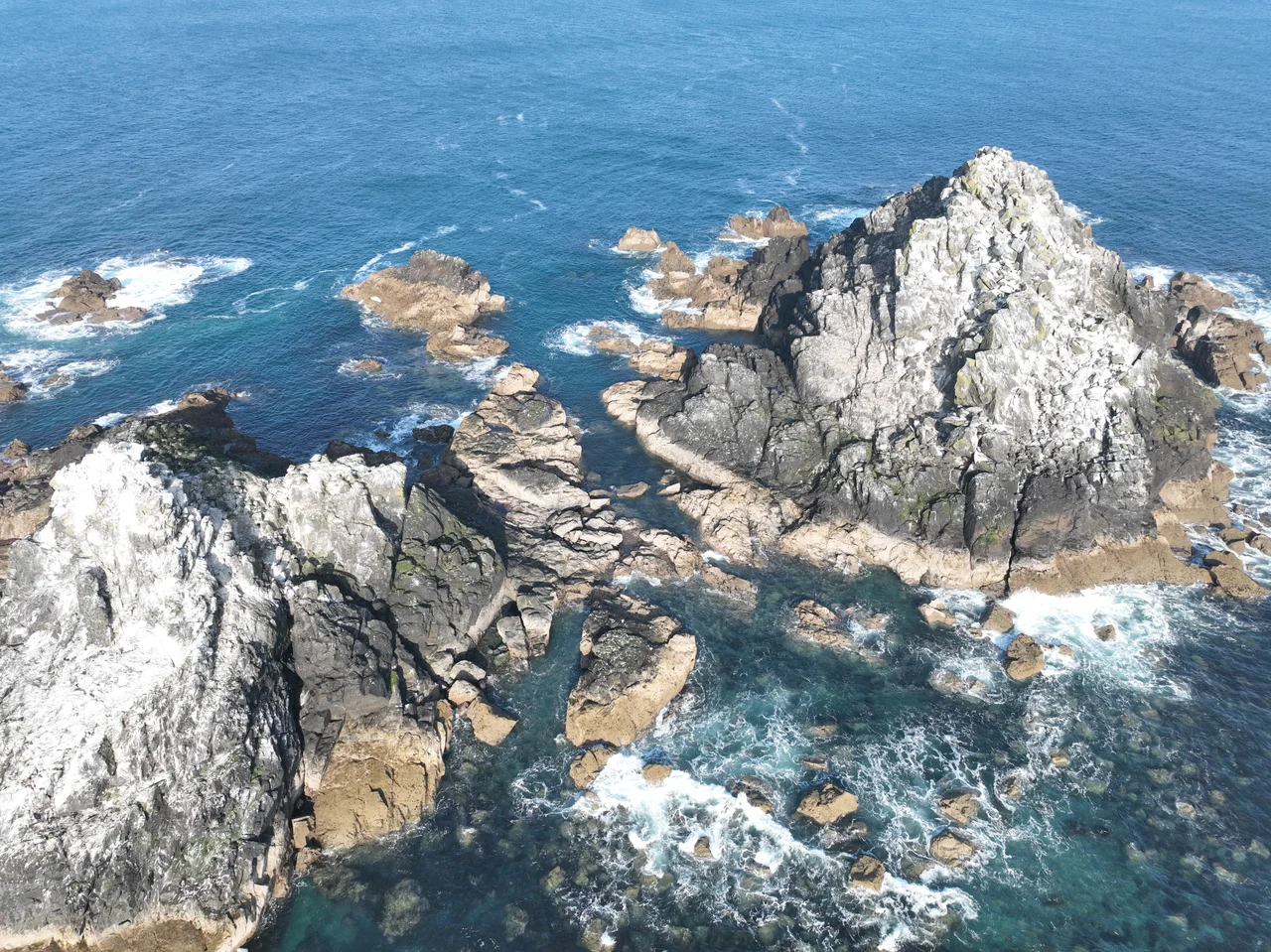

The Brisons
In 1851 the 250-ton brig New Commercial struck the ledge between the Great and Little Brisons and broke apart in the Atlantic swell. A rescue was attempted from the shore, but only two of the crew survived. The disaster shocked Cornwall. Two years later, in 1853, the National Institution for the Preservation of Life from Shipwreck, the body that would soon become the RNLI, opened a lifeboat station at Sennen Cove. It is still there. It still launches into the same seas that killed the men of the New Commercial. Every rescue boat that has put out from Sennen for more than 170 years can trace its existence back to the rocks called the Brisons.
The Breaker Islands
The name is French sailors' usage. Brisant in seamen's French meant a reef or a breaker, and Cornish fishermen kept the term: the Brisons are the breaker islands, the rocks where the Atlantic swell comes apart. They are not large. The taller of the two pinnacles stands 27 metres above the sea; its sister rises 22 metres. They are not really islands either, more like stone teeth set in a ledge that runs from the shore, and at low water the connecting reef called Guthen Gwidden, the white hidden one, breaks the surface. A gap between rocks and shore goes by the name Adgiwar, the green gap. The old Cornishman newspaper in 1878 recorded three such gaps, and the nearest was called Rose-an-pons. Modern charts have flattened the names, but the rocks themselves do what they have always done: they catch ships.
De Gaulle in His Bath
Look at the Brisons from the right angle on the cliff at Cape Cornwall, and the two peaks become a man lying on his back: a long nose, a heavy brow, a chest sloping into the water. The local nickname is unflattering and exact. The villagers call it General de Gaulle in his bath, the silhouette of the French president stretched out and contemplating the sky. Charles de Gaulle was leading the Free French out of London barely a few miles east of here in 1940, and the cliffs of Penwith were the closest piece of British rock to his exiled forces. The joke is gentle, faintly affectionate, the sort of thing Cornish people do when they want to claim a feature without taking it too seriously.
Birds on the Rocks
Almost nobody ever sets foot on the Brisons. The West Cornwall Ringing Group landed there in 2016 and discovered something remarkable: at least two European storm petrels were calling from crevices in the rock at night, which strongly suggests breeding. If confirmed, the Brisons are the only known breeding site for this small, sea-going bird in all of Cornwall. The ringers spent their visit working through the colonies of larger seabirds and tagged sixty-six birds: forty-two European shags, thirteen razorbills, eleven guillemots. Each ring is a tiny aluminium signature, a way of tracking individual birds through ocean migrations that can carry them as far as the Bay of Biscay or the coast of West Africa. For the seabirds, the Brisons are a fortress: too steep for predators, too small for human use, surrounded by the rich feeding grounds of the Celtic Sea.
The Annual Swim
Once a year, the Brisons become a starting line. The Cape Cornwall Swim is held every summer as part of an annual community sports event based at Priest Cove. Swimmers are boated out to the rocks, dropped into the water, and race a mile back to the beach. The course threads past the same ledge that wrecked the New Commercial, in waters where the swell rarely fully drops and seals occasionally surface alongside the leaders. It is a small event by international swimming standards. For the swimmers, it is a kind of communion with the rocks: a way of touching the most dangerous water in West Penwith and getting safely back to shore. The lifeboat that watches over the swimmers is the direct descendant of the boat that 1851 made unavoidable.
From the Air
Located at 50.1204°N, 5.7223°W in the Celtic Sea, one mile west-southwest of Cape Cornwall and the village of St Just. Best viewed from 500-1,500 feet AGL approaching from inland over Cape Cornwall, or from seaward at any low altitude. Nearest airport: Land's End (EGHC), 4 nautical miles south-southeast. The twin-peaked silhouette is unmistakable: two granite stacks rising vertically from the open Atlantic, with Cape Cornwall's hooked headland and the old mine chimney clearly visible to the east-northeast. Weather can change fast here; the rocks generate visible standing waves on any swell.
Nearby Stories
- Bartholomew Ledges Wreck 1.8 km away
- Carn Brea Castle 4.6 km away
- Battle off Lizard Point 12 km away
- Carnewas and Bedruthan Steps 18 km away
- King Charles's Castle 25 km away
- MV Cita 34 km away
- 1979 Fastnet Race 47 km away
- Trevose Head Lighthouse 55 km away