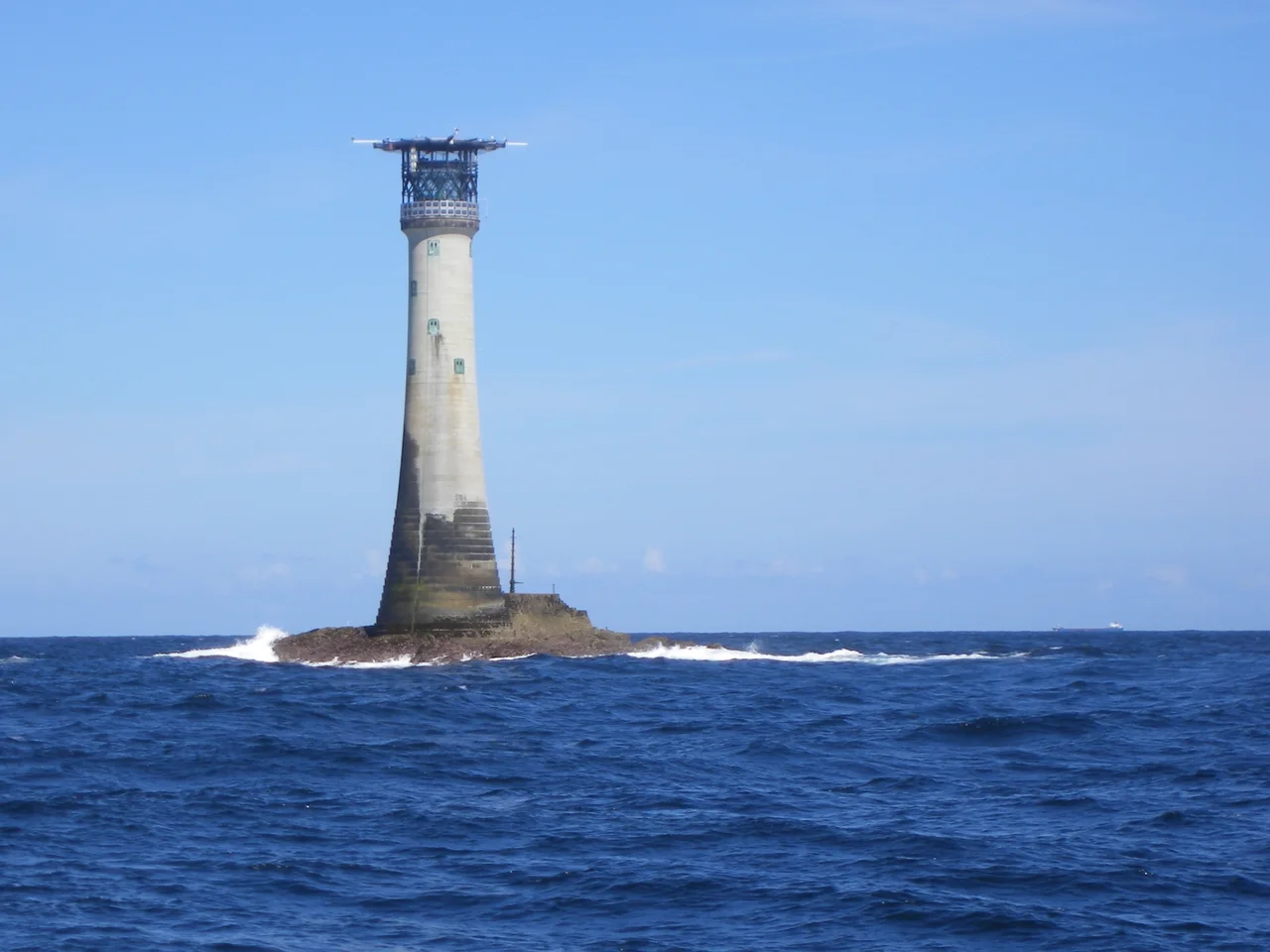

Wolf Rock Lighthouse
There is a single rock in the sea, eight nautical miles southwest of Land's End. It is small, perhaps the size of a tennis court at low water, and it is the wrong rock. Cornwall is granite. The Wolf is phonolite, a kind of volcanic plug forced up through the seabed in the early Cretaceous, about 130 million years ago, and exposed now as a black tooth in the Atlantic that does not match the geology of anything around it. In gales the fissures in the rock are said to produce a low howling note, which is how it got its name. In the eight years between 1861 and 1869 the engineers of Trinity House built a lighthouse on top of it, and they built it from the same granite they were not standing on, shipped out from Penzance one shaped block at a time.
The Failed Beacons
The Wolf had been killing ships for centuries. A vessel called the Gabrielle of Milford Haven was wrecked there in 1394, her cargo, valued at one thousand pounds, washed ashore on the Cornish mainland and collected as wreck. In 1790 Trinity House persuaded the Crown to grant a patent for a lighthouse on the rock, and a Lieutenant Henry Smith took the lease. Smith looked at the rock and at the weather, and instead of a lighthouse he built a six-metre wrought-iron daymark with a metal effigy of a wolf on top. By 1795 the daymark, wolf and all, had been washed away. In the late 1830s a man named John Thurburn built a beacon that was completed in 1840 and demolished by storms that same November. They rebuilt the top. The sea took it again in 1844. In 1848 the Trinity House engineer James Walker completed a four-metre cone-shaped beacon of iron plates filled with concrete rubble. It survived, and still stands today next to the lighthouse that finally replaced it.
The Building
James Walker drew up the lighthouse designs in 1860. The tower would be 117 feet tall, tapering from a base diameter of 41 feet to a top diameter of 17 feet, built from interlocking blocks of Cornish granite dressed in Penzance with dovetail joints that ran both vertically and horizontally so the masonry could not be prised apart by the sea. The design borrowed from Walker's earlier rock lighthouses at Bishop Rock and Les Hanois and the Smalls, but with refinements. Nicholas Douglass's son James Douglass became resident engineer, arriving in July 1861 fresh from finishing the Smalls. Construction took eight years. The crews could only work when the swell allowed them to land at all, and only the very lowest tides exposed enough of the rock for a footing. William Douglass laid the first stone on 6 August 1864. Masonry completion was reached on 19 July 1869. The light first shone on 1 January 1870, displaying alternating red and white flashes every thirty seconds, the result of a tinted Fresnel lens designed by James Chance of Chance Brothers in Smethwick that had been shown at the Paris Exhibition of 1867 as the most advanced lantern technology in the world.
The Keepers
The men who staffed the Wolf knew what they had signed for. Reliefs were notoriously dangerous. In normal conditions a boat from the mainland would come alongside the rock and the keepers would be lowered or swung across by a derrick mounted on the gallery. In abnormal conditions, which were frequent, reliefs were postponed for weeks. There are stories from the late nineteenth century of keepers who came ashore on schedule six months after the schedule was set. Letters were delivered in waterproof tins thrown from passing boats. Stores were lowered by rope. Life inside the tower was hot in summer, cold in winter, and at all times saturated by the smell of paraffin and damp wool. In big storms the tower shook in resonance with the wave pulses long enough to make the keepers seasick. It is among the most exposed lighthouses in the world. In 1972 Trinity House decided to do something about the reliefs. Wolf Rock became the first lighthouse anywhere to be fitted with a helipad, a steel platform cantilevered above the lantern room, first used in November 1973. Helicopters from Penzance Heliport could now lift the keepers off in thirty minutes. Automation followed in 1988, and the keepers were withdrawn for the last time.
The U-Boat and the Cannon Fire
The lighthouse has been hit twice in war. In March 1941 a German aircraft strafed the tower with aerial cannon fire, shattering the glass panes of the lenses. Trinity House removed the red sectors of the optic for the duration and the Wolf flashed white only, a sadder light, until repairs were possible. On 18 December 1944, the German submarine U-1209 was running submerged in the area when she struck the Wolf below the waterline. The collision crushed her forward pressure hull. She surfaced in distress, was scuttled by her crew, and nine of her sailors died. The remaining crew were taken prisoner by a Royal Navy patrol. The lighthouse, which the U-boat had been trying to avoid, was undamaged. Today the light is solar-powered, flashes once every fifteen seconds, has a range of sixteen nautical miles, and is monitored remotely from the Trinity House Planning Centre in Harwich, two hundred and fifty miles away. The howling is still audible in westerly gales. Nobody is left there to hear it.
From the Air
Tower at 49.9453 N, 5.80833 W, eight nautical miles southwest of Land's End and approximately eighteen miles east of St Mary's in the Isles of Scilly. Nearest airfield is Land's End Airport (EGHC), with St Mary's Airport (EGHE) about twenty miles to the southwest. Best appreciated from 1,500 to 3,000 feet on a southwesterly run from EGHC, when the tower appears as a vertical exclamation point in open water with no visible context but ocean. In rough weather the entire tower can be hidden by spray reaching a third of its height, which is one of the iconic images of the Cornish coast. Watch for the standard Atlantic-approach cautions about deteriorating visibility behind cold fronts and substantial turbulence in any westerly wind above 20 knots.
Nearby Stories
- Mullion Cove 1.3 km away
- Great Wheal Charlotte 3.7 km away
- Castle Down 5.3 km away
- SS Georgia (1890) 30 km away
- Wheal Coates 41 km away
- 1979 Fastnet Race 55 km away
- HMS Affray 126 km away
- Routes of Santiago de Compostela: Camino Frances and Routes of Northern Spain 713 km away