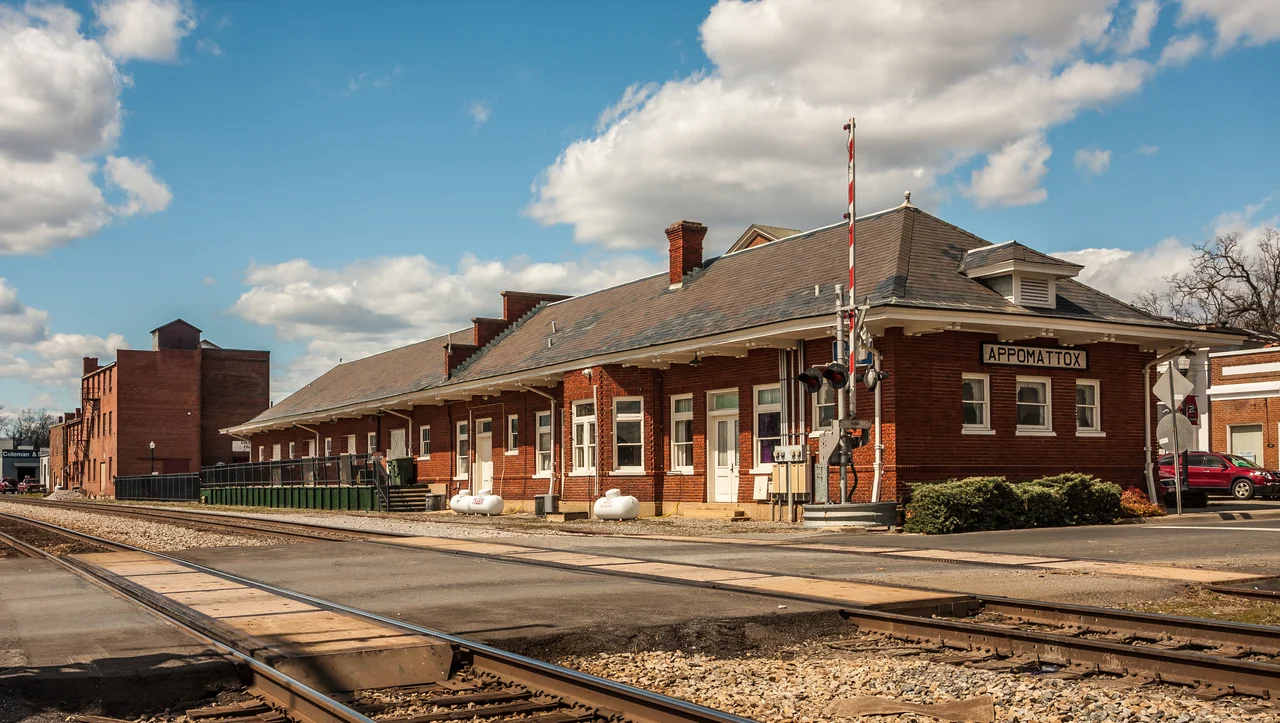

Appomattox Historic District
Walk down Court Street in the town of Appomattox today and you can read a small town's entire economic history in its facades: the 1892 courthouse with its mansard tower, the 1906 Bank of Appomattox in solid Romanesque brick, the 1892 Knickerbocker Hotel where traveling salesmen once paid two dollars a night. None of these buildings were standing during the events of April 1865. The famous surrender happened two miles to the northeast, in a different village now preserved as a national park. The town that bears the name Appomattox is something more ordinary and, in its way, more honest - a railroad town that grew up after the war, on the wager that a depot mattered more than a courthouse.
The Depot That Won
When the Southside Railroad pushed west through Appomattox County in the 1850s, it bypassed the old county seat at Appomattox Court House and put its station three miles southwest, at a settlement called Appomattox Station. After the war, the depot kept growing - first as a railroad stop, then as a tobacco shipping point, then as a county service center. By the 1890s the village of Appomattox Court House was emptying out and the railroad town was making the obvious argument: move the seat to where the trains stopped. The county did. The 1923 depot that still anchors the historic district is the third or fourth on the site, a modest brick freight and passenger building from the line's late maturity.
Courthouse Square
The new Appomattox Courthouse, completed in 1892, stands at the heart of the district - a two-story brick building with a tower clock and a Confederate monument out front, like a thousand other Virginia courthouse squares. Beside it, the Appomattox County Jail from 1895-1897 housed the daily ordinary inventory of a rural county. The 1940 County Office Building added New Deal solidity to the square. The Pentecostal Holiness Church from around 1900 added a steeple. Together these buildings record the slow accretion of a county seat: every generation putting up the structure it could afford for the work it needed done.
The Nebraska House and the Long View
Among the district's 297 contributing buildings, the oddest is the Nebraska House, with construction phases dated 1854, 1872, and around 1896. The house predates the surrender, witnessed Reconstruction, and was expanded again during the railroad boom - one building, nearly two centuries of Virginia history layered into the same walls. Its name reportedly comes from a Confederate sympathizer's pointed political joke during the 1854 Kansas-Nebraska Act controversy. The house has been continuously occupied for over 170 years, longer than the town it sits in has been the county seat. It is the kind of building most tourists drive past, focused on the famous park down the road.
The Other Appomattox
Tourists arriving in Appomattox today often expect to find the McLean House, the surrender ground, the wagon road where Confederate troops stacked their arms. They find none of those things in the historic district. Park rangers spend a fair amount of time pointing out that the surrender site is two miles northeast at Appomattox Court House National Historical Park - the old village, preserved as it was in 1865. The historic district downtown is the working town that the surrender village became after it lost the county seat. The two share names, share buildings of similar designation (a courthouse, a jail), and frequently get mixed up. The district was added to the National Register in 2002 precisely to recognize that the railroad town has its own coherent history, separate from the famous park.
A Town That Kept Working
Walk a few blocks off Court Street and the residential 19th and early 20th century houses unfold - frame two-stories with deep porches, Queen Anne details, Craftsman bungalows from the 1910s. The 1908 Appomattox Middle School is now adaptive-reused. The Bank of Appomattox is still a working bank. The depot, no longer served by passenger trains, hosts community events and a small museum. The historic district sits at an interesting kind of crossroads: a town named for a moment of national significance, but built and maintained for the unglamorous business of a Virginia county getting through one ordinary year after another. Both stories are true. Only one is on the postcards.
From the Air
Located at 37.35 degrees N, 78.83 degrees W along Route 460 in the town of Appomattox, Virginia, in the Piedmont of central Virginia. The historic district covers Courthouse Square, the commercial district along the railroad tracks, and surrounding residential streets. The 1923 depot, 1892 courthouse, and Knickerbocker Hotel are visible landmarks from above. Appomattox Court House National Historical Park lies about two miles northeast. Nearest airport is Lynchburg Regional (KLYH) about 18 miles west. Best viewed at 2,000 to 4,000 feet AGL.
Nearby Stories
- Battle of Cumberland Church 1.3 km away
- Red Hill Patrick Henry National Memorial 6.9 km away
- National D-Day Memorial 7.8 km away
- Smith Mountain Lake 9.1 km away
- Fork Union Military Academy 20 km away
- 2023 Virginia Cessna Citation Crash 38 km away
- Alleghany County, Virginia 52 km away
- Long Grass Plantation 60 km away