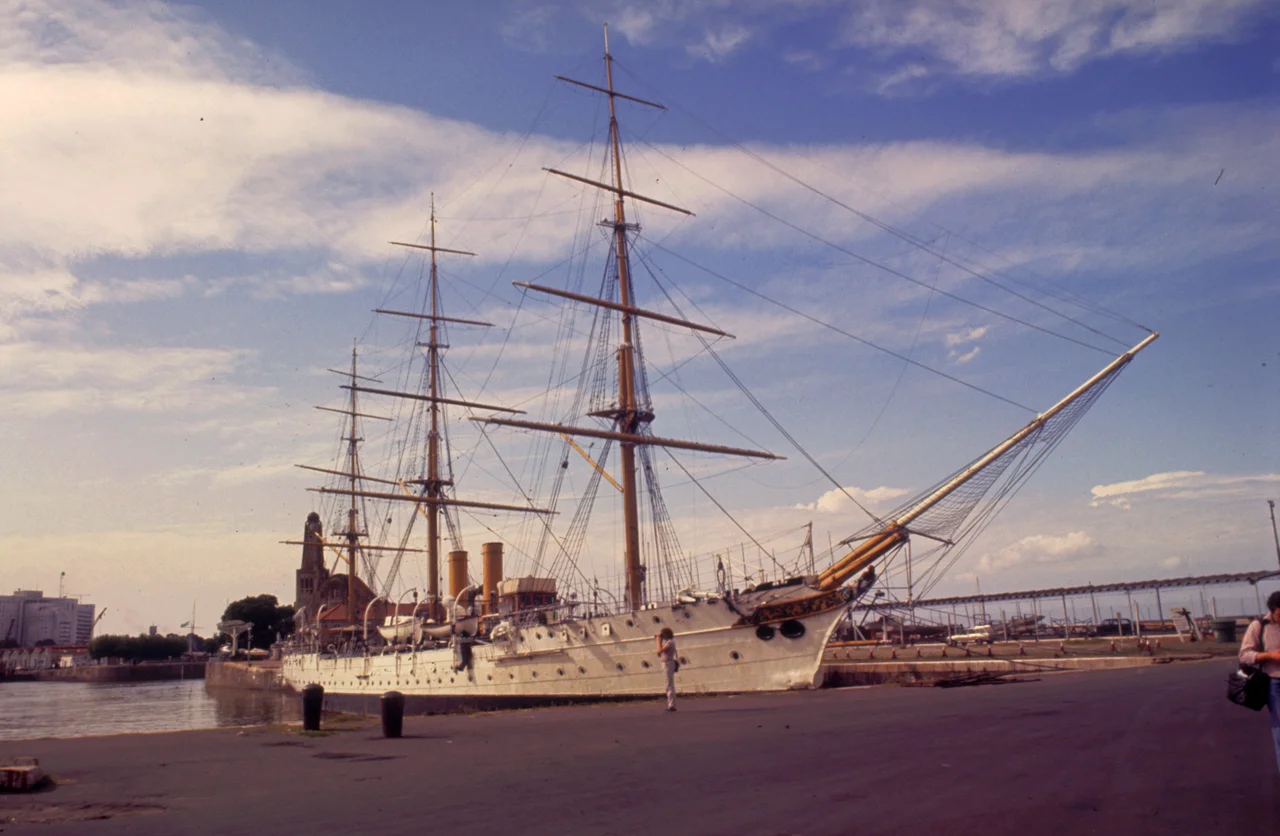

ARA Presidente Sarmiento
Six times this ship sailed all the way around the world. Cadets climbed her masts off the coast of Japan, hauled lines through Atlantic gales, and stood watch in harbors from Hamburg to Yokohama. Today the ARA Presidente Sarmiento sits perfectly still in a downtown Buenos Aires basin, her three masts rising above the renovated docks of Puerto Madero, surrounded by glass towers and weekend joggers. She is the last intact cruising training ship anywhere from the 1890s, and she earned that title the hard way - by going everywhere.
Built on the Mersey, Bound for the World
The frigate was ordered from Laird Brothers, the famous shipyard at Birkenhead on England's River Mersey, under a contract signed in 1896. She slid down the ways on 31 August 1897, christened by Ana Cane Dominguez, and reached Buenos Aires the following August. Argentina had commissioned her for a single ambitious purpose: to school the young officers of its growing navy. Named for Domingo Faustino Sarmiento - the writer, educator, and seventh president who believed a nation rose or fell on how it taught its people - the ship was itself a kind of floating classroom. Over the decades that followed she made thirty-seven annual training cruises, six of them complete circumnavigations of the planet.
A Machine of Iron and Canvas
Step below her teak decks and the Sarmiento reveals a beautiful contradiction. She is a sailing ship and a steamship at once. A towering rig of masts and yards drove her across the open ocean, but a massive triple-expansion steam engine, fed by two coal-fired boilers, waited for the days when the wind died. Her steering gear could be worked by an electric servo-drive, yet a three-wheel chain drive let up to six cadets wrestle the rudder by hand - not because it was necessary, but because learning the old way built the muscle memory of seamanship. Amidships sat four Armstrong gun mounts, two to a side, the guns of a vessel built when sail and steam, tradition and machinery, still shared a single deck.
From the Open Sea to a Quiet Basin
The world changed faster than the ship did. Retired from seagoing duty in 1938, the Sarmiento served on without her sails along Argentina's rivers around 1950, then settled into a stationary teaching role until 1961. The country never let her go. For seven years she even sailed across daily life as an engraving on the five-peso coin, from 1961 to 1968. Now preserved in her original 1898 appearance, she is a National Historic Monument and a museum, moored near the Bicentennial Plaza. A short walk away, in basin number three, floats her older companion the ARA Uruguay, a smaller tall ship that once steamed into Antarctic ice to rescue a stranded polar expedition.
Walking the Decks Today
Cross the gangway and the twenty-first century falls away. The brass gleams, the compass binnacle stands ready, and a single torpedo hangs suspended on the main deck above the spot where its launch scuttle once opened at the bow. Visitors duck through low passages past the engine room, the chart tables, and the cramped quarters where teenage cadets once slept between watches. Outside the hull, the towers of Puerto Madero reflect in the water - a neighborhood of luxury lofts and footbridges built on what were once the city's working docks. The Sarmiento is the oldest thing in sight, and somehow the most alive.
From the Air
The ARA Presidente Sarmiento is moored in a Puerto Madero basin at roughly 34.608S, 58.367W, on the eastern edge of downtown Buenos Aires beside the Rio de la Plata. Her three tall masts make her unmistakable from the air against the modern towers around her. The nearest airport is Aeroparque Jorge Newbery (ICAO SABE), barely 3 km north along the waterfront; Ezeiza/Ministro Pistarini International (ICAO SAEZ) lies about 30 km southwest. For sightseeing, a slow pass at 1,000-1,500 ft AGL in the clear, dry air of a Buenos Aires winter morning gives the best view of the ship and the surrounding docklands. Stay clear of the busy SABE traffic pattern just to the north.
Nearby Stories
- Ezeiza Massacre 1.9 km away
- Luján, Buenos Aires 5.1 km away
- Curutchet House 13 km away
- Colonia del Sacramento 17 km away
- Martín García Island 28 km away
- Atucha Nuclear Power Plant 37 km away
- Lobos 43 km away
- Cry of Asencio 87 km away