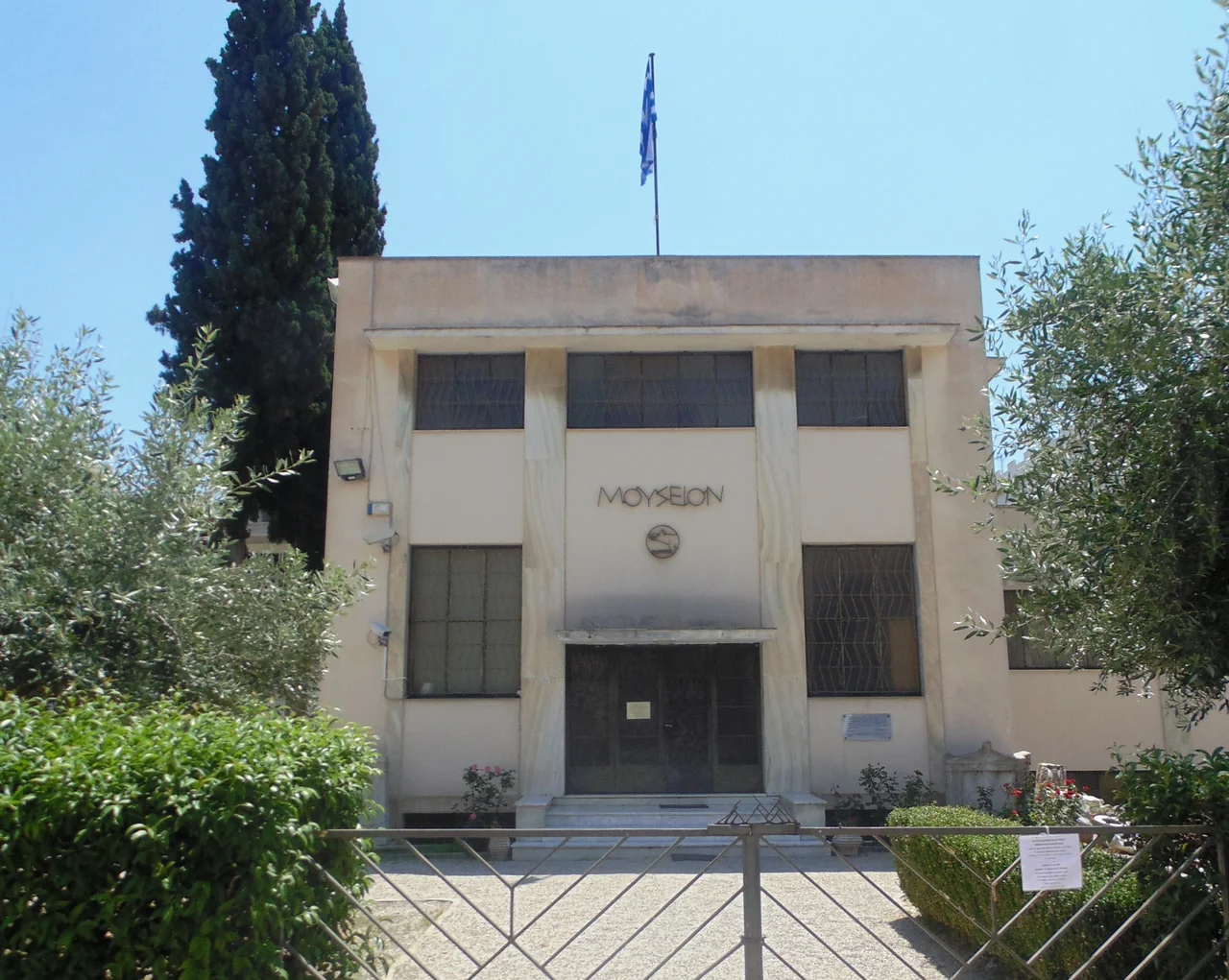

Archaeological Museum of Argos
Argos has a serious claim to being one of the oldest continuously inhabited cities in Europe. That's a contested title — several Greek cities make it — but it puts the Archaeological Museum of Argos in an unusual position: the collection it holds comes from a place that never stopped being inhabited, never became ruin, never had to be rediscovered. People have lived in Argos for something like 5,000 years, and the museum is where you go to see what they left behind. The building began its life as a private residence. In April 1932, the heirs of J. Kallergis donated it to the Argos city council; the city council gave it to the Greek state in 1955; the Kallergeio museum opened in 1957 and a new wing followed in 1961. The collection spans from the Bronze Age to the Roman period and reflects the archaeology of one of the most intensely excavated corners of the Peloponnese.
From Terracotta to Bronze Armor
The collection's range is wide but the individual objects are often quietly striking. There are Mycenaean terracotta figurines from the late Bronze Age, including a figurine of a woman holding a baby — a small, specific human image from a civilization known primarily through its palaces and tombs. The Geometric pottery of the 8th century BC reaches a kind of confident maturity here: vessels decorated with scenes of horse sacrifice, wrestlers, and narrative figures that include a rendering of Polyphemus and Odysseus — the Cyclops story already being told in fired clay at a time when the Iliad and Odyssey were only beginning to take written form. Among the most striking objects is a bronze cuirass and matching helmet recovered from a tomb and dated to the late 8th century BC. The Argive hoplite — the heavily armored citizen-soldier who became the Greek military ideal — had roots in this landscape, and these pieces are early physical evidence of the armor that defined Greek warfare for centuries.
The Pomegranates of Hera
The museum holds a distinctive class of objects that connects Argos to the great sanctuary of Hera — the Heraion of Argos — that lies a few kilometres outside the city. Among the finds are post-Geometric earthenware pomegranate models, both wheel-thrown and handmade. The pomegranate was sacred to Hera, associated with fertility, wealth, and the goddess's presence. These objects were votive offerings: worshippers made or purchased them and dedicated them at the shrine, placing them in Hera's care. The range of manufacturing techniques — some turned on a wheel, some shaped by hand — suggests they were produced by different makers across a period of time, offerings from people of varying means making the same gesture of devotion. They are modest objects, which is part of what makes them moving: evidence that ordinary people, not just elites, were participating in the religious life of the sanctuary.
The Courtyard and Its Seasons
Step outside the museum's main building into the courtyard and the chronology lurches forward to the Roman period. A number of mosaic panels are displayed there, depicting Dionysos and the seasons. The mosaics are notable for a detail that rewards close attention: the seasonal figures are dressed according to the weather. In winter, they wear cloaks and thick leggings, bundled against the cold. In summer, they appear in light tunics, dressed down. This is not allegorical in a heavy-handed way — it is simply accurate, a Roman craftsman's observation that seasons mean something specific about how people live in them. The mosaics came from local Roman-era buildings; Argos was an active city well into the imperial period, and its Roman remains are substantial, including a large theatre and Roman baths excavated alongside the earlier Greek layers.
Argos Through Its Objects
What the museum captures, across its two sections and its courtyard, is the archaeology of a city that was never a single thing. Argos was Bronze Age and Geometric, archaic and classical, Hellenistic and Roman — not in sequence, with clean breaks, but in layers that accumulated on top of each other in the way that long-inhabited places do. The Sophocles head in the collection — a Roman copy of the famous playwright — is a reminder that Argos participated in the broader Greek cultural world, not just the local military and religious one. The museum is compact and manageable, not overwhelming. It does what a good regional museum does: it roots the larger story of Greek civilization in a specific piece of ground, in the objects that specific people made and used and left behind, in a city that has been continuously occupied for long enough that the past here is not a foreign country but a neighbor.
From the Air
The Archaeological Museum of Argos sits at approximately 37.634°N, 22.727°E in the city center of Argos, in the Argolid region of the northeastern Peloponnese. From the air at 3,000 feet, Argos is visible as a substantial modern city in the flat valley of the Argolic plain, with the ancient acropolis of Larissa rising steeply above it to the west. The Argolic Gulf opens to the southeast, about 12 kilometres away. The nearest major airport is LGAV (Athens International Eleftherios Venizelos), approximately 115 kilometres to the northeast via the Corinth road. The plain of Argos, ringed by mountains, is one of the most productive agricultural areas in the Peloponnese; from altitude, the geometry of its orange groves and vegetable fields is visible around the city's edges.
Nearby Stories
- Villa of Herodes Atticus 3 km away
- Sicyon 3.5 km away
- Battle of Megalopolis 4.5 km away
- Hermione: The City at the Edge of the World 7.5 km away
- Agia Lavra 7.7 km away
- Megara 13 km away
- Agistri 13 km away
- Teuthis 15 km away