
Archaeological Museum of Nicopolis
There is a bronze object in this museum that once drove through the hull of a warship at the Battle of Actium. It is the last surviving ship ram from the fleet of Mark Antony and Cleopatra — one of what were originally thirty-six bronze rams displayed by the victorious Octavian on his monument hill above Nicopolis, evidence of the sea battle that ended the Roman Republic and made him Augustus. Everything else from that monument is marble and stone. This one object is still metal, still recognizably a weapon, still communicating something of the force of that September day in 31 BC.
A Collection That Survived History
The museum's own story is almost as layered as the objects it holds. Until 1940, the collection was housed in an Ottoman mosque in the city of Preveza. Italian aircraft bombed the mosque that year, partially destroying it and allowing some exhibits to be stolen. After the Second World War the Greek state demolished what remained of the building. A small replacement museum went up in 1965, tucked inside the Byzantine walls of ancient Nicopolis itself. Then, from 1998 to 2006, a new purpose-built museum was constructed 5 km north of Preveza, on the edge of the archaeological site. It opened to the public in July 2009.
The new building is designed for the scale of what Nicopolis represents: a Roman provincial capital founded by an emperor, occupied continuously for eight centuries, and layered with the artifacts of multiple civilizations. The museum is open daily from 8 am to 8 pm, including weekends.
Marble That Speaks
Walk through the galleries and the accumulation of marble begins to feel less like a collection and more like a census of Nicopolis's long life. There is a tomb sculpture listing the name of the deceased, his father's name, his profession, his age — the Roman habit of self-documentation in stone. There is a marble altar dedicated to Empress Sabina, wife of Hadrian, who visited Nicopolis with her husband in 128 AD. A marble head of Faustina, wife of Marcus Aurelius, shows signs of what appears to be strabismus — a crossed eye rendered with startling clinical precision.
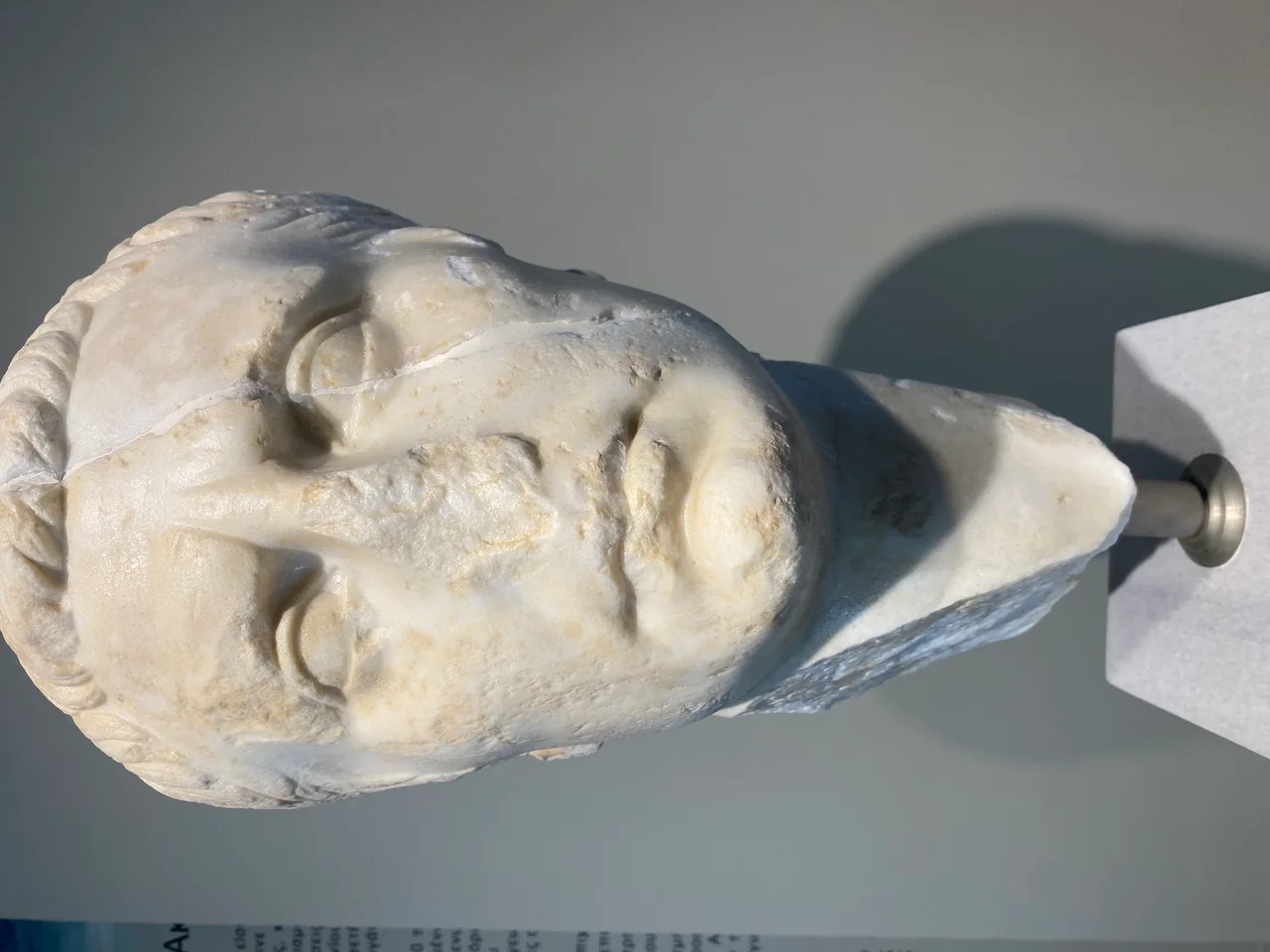
From earlier eras: a sitting marble lion dated to the 4th century BC, its surface worn smooth by centuries. A Roman copy of a 4th-century BC statue of Minerva. A muse called the "small Heracliotis." A reconstructed marble head of General Agrippa — the man who actually commanded Octavian's fleet at Actium — his features broken and re-assembled by restorers. A cylindrical statue base carved with the Amazonomachia, the mythological battle of Amazons, which was later partially reused as a Christian mosaic from the Alkysson Basilica: two worlds sharing the same stone.
The Actium Connection
The artifacts from the Monument of Augustus give the museum its most direct connection to the defining moment in Rome's history. Octavian built the monument on the hill north of the city where his tent had stood before the battle, adorning it with captured ship rams and dedicating it to Apollo, his patron deity. The semicircular marble base in the museum's collection was likely part of the altar of Apollo at that monument. Carved in an archaistic style, it depicts gods and heroes of the Greek pantheon — deliberate visual archaism, a statement that Octavian's victory stood within a long tradition of divine favor.
Many of the most significant objects from the monument site were excavated between 1995 and 2005. Some are still being catalogued and prepared for display. The museum holds a significant collection of decorative fragments from the monument, marble busts of both Augustus and Agrippa, and the bronze ship ram — that single survivor from the thirty-six Actium trophies that once gleamed on the hillside above the city.
Layers of Time Under One Roof
What makes the museum unusual is the span of time it covers without hierarchy. Attic reliefs from the 4th century BC sit near Roman imperial portraits. A marble sarcophagus decorated with lions and flowers stands beside glass urns, coins, and hairpins recovered from the Odeon of Nicopolis. A marble plaque showing a symposium scene — a reclining man and a woman — captures a moment of private life inside what was once a busy provincial capital. These domestic fragments matter as much as the imperial ones. The people who lived in Nicopolis for eight centuries were not only subjects of emperors and attendees at the Actian Games; they buried their dead, dedicated altars to goddesses, and left hair pins in the theater.
Approaching from the Air
The museum sits at the edge of the Nicopolis archaeological park, on the isthmus of the Preveza peninsula between the Ambracian Gulf to the east and the Ionian Sea to the west. From altitude, the thin neck of land is immediately recognizable: water on both sides, the ruins of the ancient city spread across the scrub of the peninsula, and the modern town of Preveza at the tip. Aktion National Airport (LGPZ) lies directly across the mouth of the gulf, barely 5 km away as the crow flies. Pilots approaching from the north on runway approaches pass almost directly over the site. The stadium and the long Byzantine walls are visible on clear days from low cruising altitude.
From the Air
The Archaeological Museum of Nicopolis is at approximately 39.008°N, 20.735°E, on the Preveza peninsula isthmus. Aktion National Airport (LGPZ) is directly across the Ambracian Gulf mouth, approximately 5 km east-southeast — one of the closest approaches of any museum to an airport in Greece. Recommended viewing altitude: 500–1,500 m for the archaeological site; the ruins of the city walls, stadium, and theater are clearly visible from low altitude. The Ambracian Gulf is calm and identifiable from high altitude as a large enclosed body of water opening westward to the Ionian Sea.
Nearby Stories
- 2015 Lefkada Earthquake 2.9 km away
- Cichyrus 4.9 km away
- Battle of Olpae 5.1 km away
- Stratos 19 km away
- Achilleion (Corfu) 42 km away
- Lake Plastiras 58 km away
- Corfu 75 km away
- Hellenic Trench 97 km away