
Archaeological Museum of Volos
Most ancient Greek art reaches us bleached. The marble we picture as pure white was once brightly painted, but time stripped the color away, leaving us to imagine the rest. In a neoclassical building in Volos, that rule breaks. Here hang the painted funerary stelae of Demetrias, gravestones whose reds, blues, and flesh tones survived more than two thousand years, because the ancient city accidentally entombed them. They are among the rarest survivors of Hellenistic painting anywhere, and they make the Archaeological Museum of Volos one of the most quietly moving rooms in Greece.
A Merchant's Gift
The museum exists because of one man's generosity. Alexios Athanassakis, a merchant from the mountain village of Portaria above Volos, paid for its construction and then handed it to the Greek State once it was finished. Completed in 1909, it is one of the oldest museums in the country, a dignified neoclassical hall built to house the flood of finds pouring out of Thessaly's excavations at the turn of the twentieth century. Its formal name still honors its founder: the Athanasakeion Archaeological Museum of Volos. More than a century on, it remains the keeper of a region that has been continuously inhabited since the Stone Age.
The Faces That Kept Their Color
The painted stelae are the museum's treasure, and the reason they survive is itself a story. When the people of Demetrias needed to repair their city walls, they reused old gravestones as building material, sealing the painted slabs inside the fortifications under a layer of brick. Sunlight and weather, which fade pigment, never reached them. Centuries later, archaeologists pulling apart the walls found portraits with their original colors intact: a seated woman, a soldier, a parting handshake between the living and the dead. The technique was modest, paint applied directly to white marble, drawn first in black and filled with subdued tones. It was the cheaper alternative to carved sculpture. That ordinariness is what makes them so intimate; these were not kings, but neighbors.
Deep Time on Display
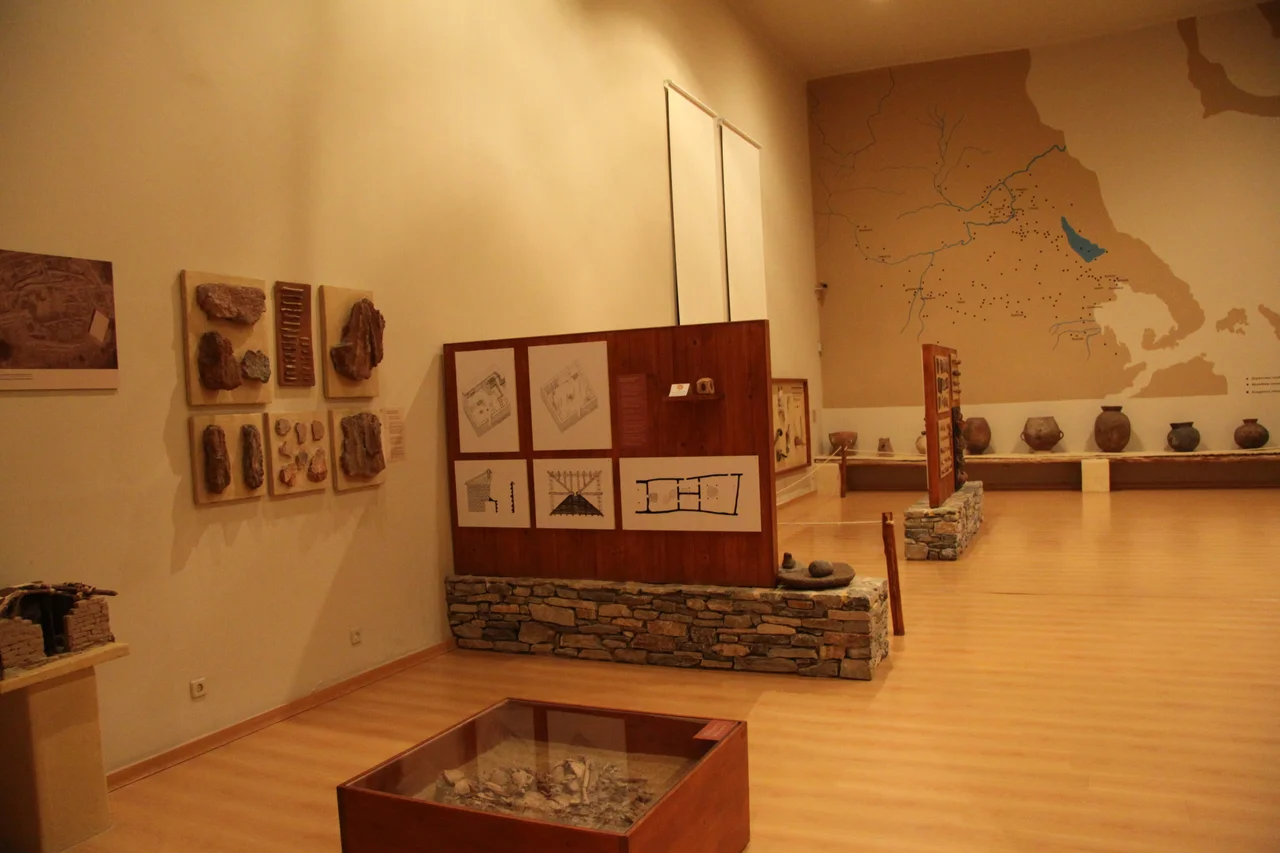
Walk the galleries and you travel backward through Thessaly's long memory. The earliest cases hold jewelry, household tools, and farming implements from the Neolithic villages of Dimini and Sesklo, objects nearly seven thousand years old. Beyond them come clay figurines and pottery from the Geometric period, the age that produced the legends of the Argonaut expedition and the Trojan War, and rare jointed statuettes from the classical era. Some exhibits arrived whole: entire tombs were lifted from their excavation sites and reassembled here, complete with the human skeleton and the offerings laid carefully around it, so visitors meet the dead exactly as the living once left them.
Houses You Can Walk Around
Step outside and the past becomes three-dimensional. In the museum grounds stand full reconstructions of the Neolithic houses of Dimini and Sesklo, built to show how Thessaly's first farmers actually lived: low stone foundations, mud-brick walls, timber and thatch above. It is one thing to read that people raised concentric walls and painted spirals on their pots before writing existed. It is another to duck through a doorway sized for a Stone Age family and stand where they cooked and slept. The museum, founded by a merchant who loved his region, lets you do exactly that, closing the distance between a glass case and a human life.
From the Air
The Archaeological Museum of Volos stands in the eastern part of the city at 39.352°N, 22.961°E, near the waterfront of the Pagasetic Gulf. The nearest airport is Nea Anchialos National (LGBL), about 18 km southwest. From 2,000 feet, the city of Volos fills the curve of the gulf, with Mount Pelion rising steeply to the east and the long enclosed bay to the south. The museum sits among the dense streets of the eastern districts; the harbor front and the marina are the easiest landmarks for orientation. Coastal haze can build in the afternoon, so midday or morning flights give the clearest look at the city against the mountain.
Nearby Stories
- Farsala 10 km away
- Oreus 10 km away
- Glossa 13 km away
- Archaeological Museum of Lamia 14 km away
- Tempi Train Crash 55 km away
- Mount Olympus 61 km away
- Siege of Euripos 62 km away
- Byzantine Empire under the Palaiologos Dynasty 112 km away