
Archaic Greece
Before there was a golden age, there was a making age. The three centuries between roughly 800 and 480 BC were when Greece became Greece: when villages fused into cities, when those cities wrote down their laws for the first time, when sailors pushed beyond familiar coasts and planted new communities from the Black Sea to the shores of southern France. Historians have sometimes treated this period — the Archaic — as a mere prelude, prologue to the glories of Classical Athens. But the Archaic Greeks themselves were not rehearsing. They were doing, inventing, and arguing, sometimes violently, about who was entitled to power and why. The institutions they built, and the conflicts those institutions produced, would define Greek life for centuries.
The Population Surge That Changed Everything
Something happened in the Greek world around 850 to 750 BC — possibly a shift toward cooler, wetter conditions — that made agriculture more productive. The population doubled during the 8th century alone. Cities that had held perhaps 1,500 people in 1000 BC may have swelled to 5,000 by 700 BC. The largest settlements, Athens and Knossos among them, grew larger still. More people meant more pressure on limited arable land, which meant colonization. Greeks sailed in every direction: east to the Black Sea coast and Asia Minor, west to southern Italy, Sicily, and the coast of France, south to Egypt and Libya. Modern Syracuse, Naples, Marseille, and Istanbul all began as Greek colonies — Syracusae, Neapolis, Massalia, Byzantion. These new cities were not dependencies of their founding poleis the way Roman colonies would be; they were independent city-states in their own right. But they remained culturally Greek and commercially connected, and together they built the trade network that stitched the ancient Mediterranean together.
The Invention of the Polis
The polis — the city-state — was the great Archaic political invention. Not just a settlement but a community of citizens with shared laws, shared cults, and shared obligations to one another. The process by which villages merged into urban centers, what historians call synoecism, took place across much of Greece during the 8th century. Athens and Argos both coalesced into single settlements around the end of that century. What emerged was something new in the ancient world: dozens of small, fiercely independent political units, each with its own constitution. Athens moved from kingship to aristocracy to an appointed chief magistracy; Draco codified its first laws in 621 BC; Solon restructured its constitution around 594 BC, replacing noble birth with income as a qualification for office and abolishing debt slavery; Cleisthenes completed the transformation around 508 BC, redividing the citizen body into ten new tribes and establishing the Council of Five Hundred that gave ordinary Athenians genuine legislative power. The word democracy had not yet been coined, but the institution was taking shape. Sparta, meanwhile, developed its own radical system: two hereditary kings, a council of elders, five elected ephors, and a military society in which every male citizen, or homoios — meaning 'equal' — was trained from childhood as a soldier.
The Age of Tyrants
The word tyrant carries a weight of modern horror it did not always have. In Archaic Greece, a tyrannos was simply a man who seized power outside the normal constitutional channels — not necessarily cruel, not necessarily illegitimate in the eyes of the people he governed. The earliest Greek tyrant on record is Cypselus, who took power in Corinth around 657 BC. He was followed by Orthagoras in Sicyon, Theagenes in Megara, and eventually Peisistratos in Athens, who ruled across much of the mid-6th century and was succeeded by his son Hippias. These rulers often came to power because the established aristocracies had become intolerable — Aristotle's explanation — or because ambitious individuals had built private military followings. Some governed well. Peisistratos patronized the arts and presided over Athens during a period of growing prosperity. The negative connotation of the word tyrannos only hardened later, as 5th-century writers looked back with democratic eyes on men who had held power without popular mandate.
Money, Art, and the Written Word
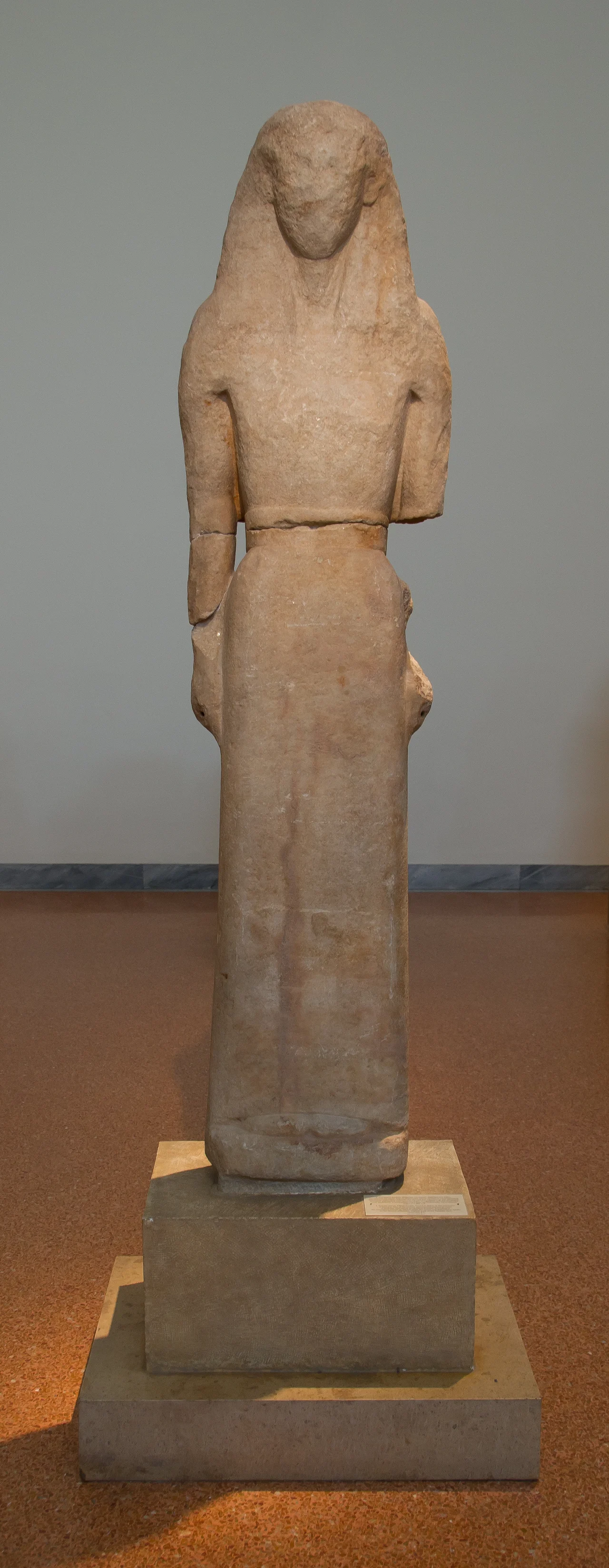
Coinage arrived in Lydia around 650 BC and spread rapidly into the Greek world. The island of Aegina struck its distinctive 'turtle' coins before 550 BC; Athens followed with its 'owl' coins from around 515 BC, issued in such quantities that they circulated across the entire Mediterranean. Before coins, Greeks had measured value in oxen, tripods, and handfuls of metal spits — the handfuls (drachmai) giving their name to the currency that replaced them. Money made trade faster and more transparent, and it made cities possible in new ways. At the same time, Archaic sculptors were producing the first monumental stone figures in Greek history: the kouroi and korai, standing male and female figures that appeared first in Cycladic workshops and spread across the Greek world. The proportions of the earliest kouroi correspond exactly to Egyptian rules for carving the human figure — testimony to the orientalizing influence flowing into Greece from Near Eastern trade. Pottery shifted from geometric abstraction toward naturalistic figures; black-figure and then red-figure vases would become the period's great visual legacy. And the Greek alphabet — derived from the Phoenician script that arrived via trade in the 8th century — enabled everything: law codes carved in stone, lyric poets composing their verses in writing, historians beginning to record the past.
The Contest That Defined Competition
According to Greek tradition, the first Olympic Games were revived in 776 BC — the conventional starting date for the Archaic period and for Greek chronology itself. Whether or not the story is precisely accurate, Olympia in the western Peloponnese became during the Archaic period a sanctuary of pan-Hellenic significance, drawing dedications from across the Greek world and from as far as Italy and the eastern Mediterranean. In the 8th century alone, the number of bronze animal figurines dedicated at Olympia jumped from 160 in the entire preceding century to 1,461. The Games that were held every four years in its stadium were about more than athletic competition: they were an assertion of shared Greek identity at a moment when the poleis were otherwise conspicuously divided. Athletes from rival cities who might fight each other next year ran the same stadium, invoked the same Zeus, and accepted the same judges. The truce that allowed travel to the Games was one of the few things all of Greece reliably respected. That the Archaic age both invented the political fragmentation of the polis and simultaneously created institutions asserting Greek cultural unity — the games, the shared sanctuaries, the common alphabet and literature — captures something essential about what made ancient Greek civilization both brilliant and perpetually combustible.
From the Air
Centered on central Greece at 38.5°N, 23.0°E — the Archaic Greek heartland. Athens International Airport (LGAV, 37.94°N, 23.94°E) is the nearest major hub, roughly 70 km southeast of the geographic center. At 10,000 feet heading northwest from LGAV, the Peloponnese opens to the left — Corinth, where the first Greek tyrant Cypselus seized power in 655 BC, sits at the narrow isthmus connecting the peninsula to the mainland. Olympia lies further southwest along the western coast of the Peloponnese. Turning northeast from Athens, the Aegean island clusters that served as the nodes of Archaic trade networks — Aegina with its turtle coins visible as a low shape in the Saronic Gulf — spread across the water. Early morning light in the region is particularly striking, when the limestone ridges catch the sun and the sea between the islands turns deep violet.
Nearby Stories
- Battle of Alamana 3.6 km away
- Free and Real 5.7 km away
- Agios Thomas Tanagras 5.7 km away
- Pythian Games 11 km away
- Thespiae 12 km away
- Euripus Strait 14 km away
- French Cruiser Châteaurenault (1898) 17 km away
- Skopelos 32 km away