
Ardfert
In the sixth century, a Kerry monk built a leather boat and sailed west into the Atlantic looking for the Land of Promise. He may or may not have reached North America. He certainly reached the imagination of medieval Europe, where the Voyage of St. Brendan became one of the most copied manuscripts of the Middle Ages, with crossings of icebergs (described as crystal columns), encounters with whales mistaken for islands, and a final landfall in a country covered with sweet-smelling fruit. The monk's name was Brendan, and he was born in Ardfert, a village 8 kilometres north of Tralee that has been a religious centre since well before he learned to row.
The Hill of Miracles
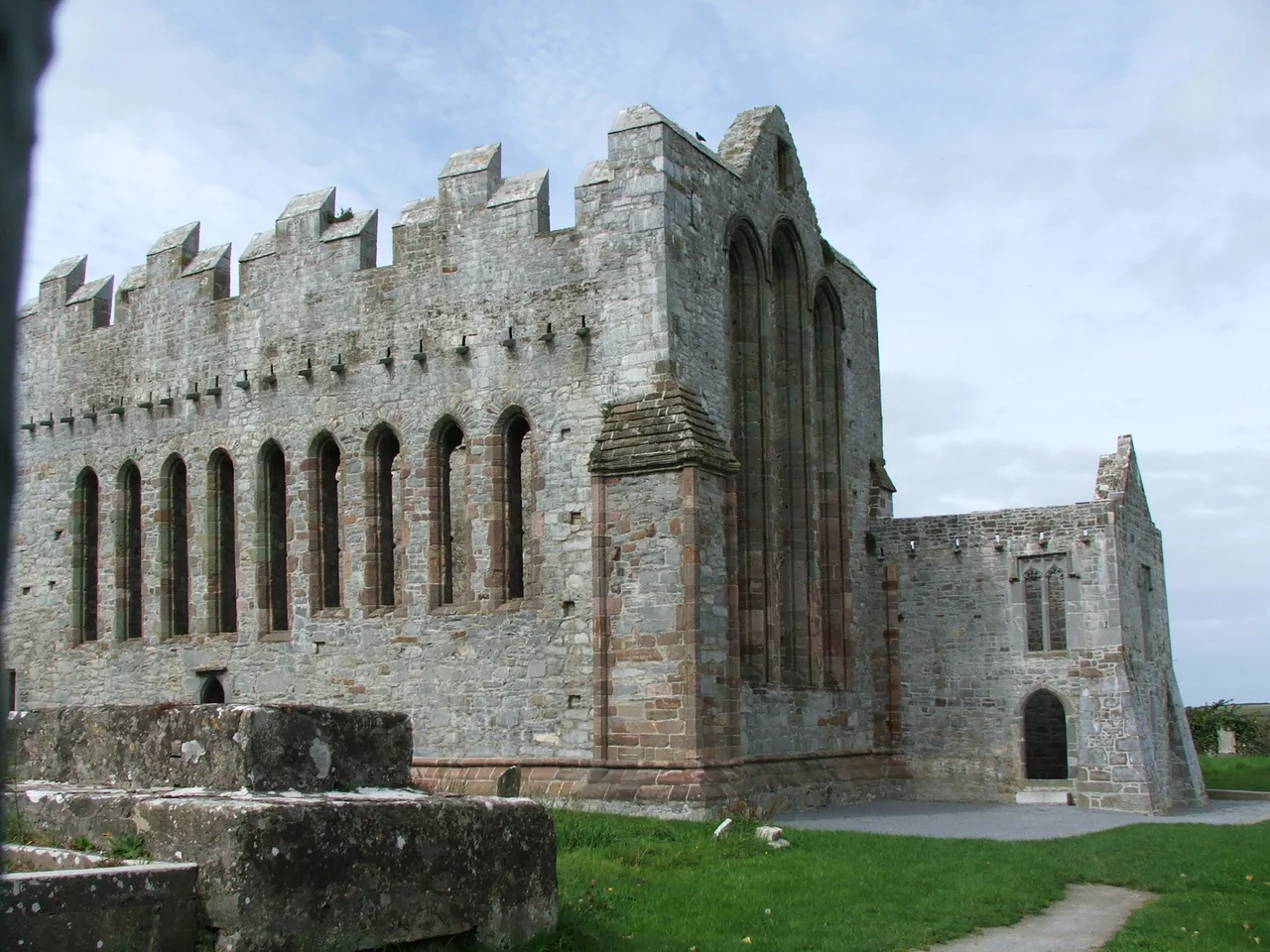
The name itself argues for the place's importance. Sir James Ware, the 17th-century antiquary, read Ardfert as 'a wonderful place on an eminence' - or, more poetically, 'the hill of miracles.' Others trace it to Ard Erc, 'the high place of Erc,' after the fifth-century bishop Saint Erc who established it as a bishop's seat. The Four Masters - the 17th-century chroniclers compiling Ireland's history from the earliest sources - wrote it as Ard-ferta, 'the height of the grave.' Whatever the etymology, the village's reason for existing is religious. Brendan founded a monastery here in the sixth century. Both town and monastery were destroyed by fire in 1089, and again in 1151 - the kind of accidents that befell timber-roofed settlements with annoying regularity. The stone cathedral that replaced them, St. Brendan's, is still here, ruined but standing. It lost its roof in the Irish Rebellion of 1641 and never got it back.
Brendan and the Whale
Brendan the Navigator was born around 484, educated in the local monastic schools, and ordained a priest in 512. The voyage that made him famous is recorded in the Navigatio Sancti Brendani, an Irish text from around the ninth or tenth century that was copied and translated obsessively across medieval Europe. The story: Brendan and seventeen monks set out west in a curragh - a wooden-framed boat covered in hide - searching for the Isle of the Blessed. They sail for seven years, encountering Judas Iscariot chained to a rock, a 'crystal column' that scholars suspect was an iceberg, a fire-vomiting monster on a black island that has been identified plausibly as Icelandic volcanism, and a giant whale named Jasconius on whose back they say Mass thinking he's an island. In 1976 the British explorer Tim Severin built a curragh by medieval specifications and sailed it from Ireland to Newfoundland to prove the trip was at least possible. It was. Whether Brendan actually did it - reaching North America a thousand years before Columbus - is unprovable. The story outlived the man either way.
Norman Stones
Long after Brendan's wooden monastery had burned twice, the Normans arrived in the late 12th century and built in stone. Thomas FitzMaurice, the 1st Baron Kerry, founded a Franciscan friary at Ardfert in 1253. His son Nicholas added a leper house in 1312 - one of many medieval institutions for people suffering from what was probably a mixture of true leprosy and other disfiguring skin diseases. The Knights Hospitaller of St. John of Jerusalem, the same crusading order that would later become the Knights of Malta, had rights in Ardfert too. In 1325 the Hospitallers and Franciscans got into a dispute over the village's market cross and pillory - who could erect what, who could collect what tolls, who had jurisdiction. Medieval ecclesiastical disputes were as much about money and power as theology, and Ardfert, small as it was, was rich enough to argue over.
The Year 1601
Ardfert played a small role in one of the largest events in Irish history. In late 1601, Spanish troops landed at Kinsale in support of Hugh Roe O'Donnell and Hugh O'Neill's rebellion against Elizabeth I. O'Donnell, marching south from Donegal to join the Spanish, sent a detachment of his men westward to reclaim Ardfert, Lixnaw, and Ballykeally for his ally Lord Kerry, FitzMaurice. They captured Caislean Gearr - the Short Castle - next to the cathedral, of which no trace now survives. An O'Donnell from Tyrconnell remained behind as steward. Within weeks, the main O'Donnell-O'Neill army was crushed at the Battle of Kinsale on Christmas Eve 1601, ending Gaelic Ireland's last great military stand. A large tomb in the cathedral grounds was built two centuries later by John O'Donnell, a descendant of the steward who held Ardfert for those few months in the autumn of 1601.
Ruins, Friary, Football
Walk Ardfert today and the medieval layers are everywhere. The cathedral, roofless since 1641, still raises its gable end against the sky. The 13th-century Franciscan friary survives to the northeast. Two smaller medieval churches, Temple na Hoe (Church of the Young Virgin) and Temple na Griffin, complete the ecclesiastical complex. The Talbot-Crosbie mansion - confusingly named 'Ardfert Abbey' though it was a Big House, not a monastery - was burned by the IRA in 1922 during the Civil War. The Crosbies left. The deer park became fields. Population growth has been modest: 648 in 1996, 749 in 2016. The Tralee-Ballyheigue road bisects the village east-west. Ardfert GAA won the All-Ireland Junior Club Football Championship at Croke Park in 2006 and the Intermediate version in 2007. The eventing horse Village Gossip, who placed second at Badminton in 1978 with Lucinda Green in the saddle, was born and bred here. Saints, soldiers, footballers, horses. The hill keeps producing them.
From the Air
Ardfert sits at 52.35°N, 9.78°W (the coordinates 52.35°N, 9.68°W in the source put the village just east of its actual position) in the flat farmland of North Kerry, 8 km north of Tralee and 5 km from the Atlantic coast. From the air, look for the cathedral ruin's prominent gable end on the eastern edge of the village. Kerry Airport (EIKY) at Farranfore is 20 km southeast; Shannon Airport (EINN) is 80 km north across the Shannon estuary. The wide curve of Tralee Bay and Banna Strand lie just to the west. Best viewing altitude is 2,500-4,500 feet for clear sight of the ruins and surrounding ringfort-dotted countryside.
Nearby Stories
- Leacanabuaile 9.3 km away
- Ballynavenooragh 10 km away
- Muskerry West 11 km away
- Killarney National Park 11 km away
- Siege of Carrigafoyle Castle 12 km away
- Newcastle West 18 km away
- 1961 President Airlines Douglas DC-6 crash 19 km away
- RMS Carinthia (1925) 80 km away