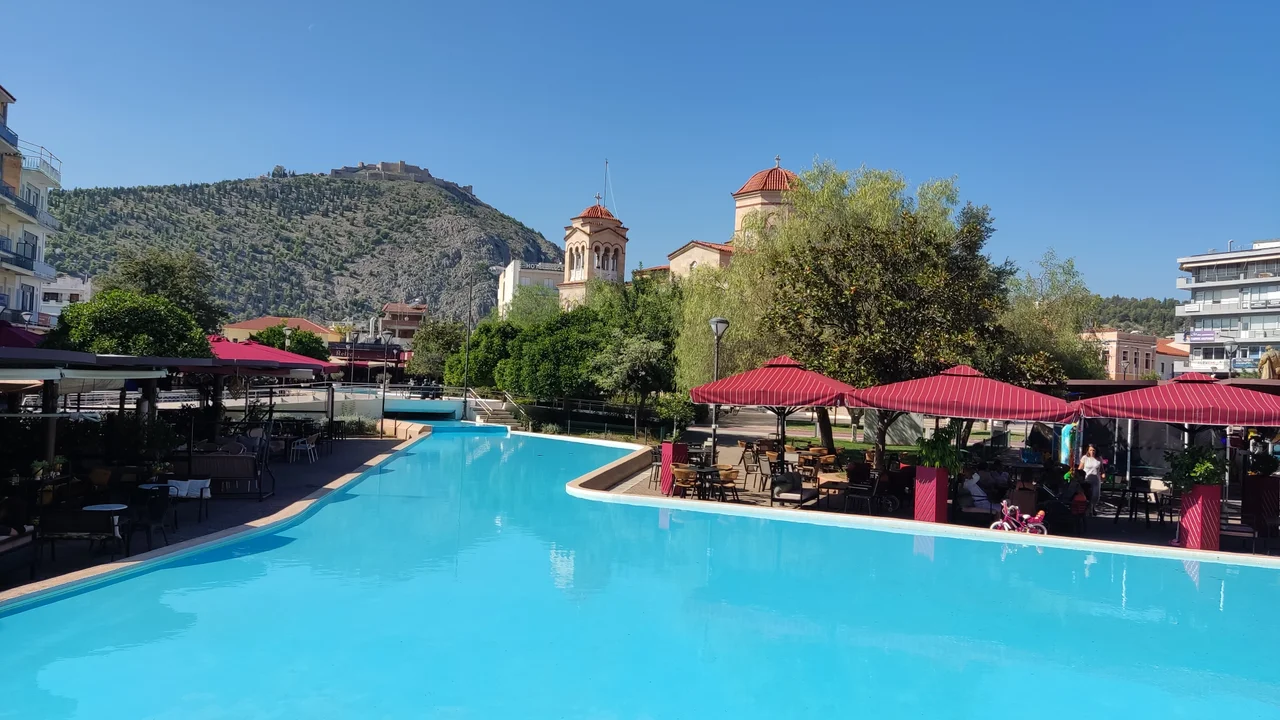

Argos, Peloponnese
An old woman stood on a rooftop in 272 BC and changed the course of history. King Pyrrhus of Epirus, the most celebrated general of his age, had snuck his army into Argos by night to settle a local dispute. The streets were narrow, the fighting was close, and as Pyrrhus struggled against a common Argive soldier, the soldier's mother hurled a roof tile from above. It struck the king on the head, fracturing vertebrae in his neck, and left him senseless in the dirt. A frightened Macedonian soldier named Zopyrus finished the job with a sword. Plutarch told the story centuries later with undisguised relish: one of the world's great conquerors, laid low by a mother with a roof tile in a street brawl. That is Argos — where history arrives in unexpected forms, and refuses to leave.
Seven Thousand Years on the Same Plain
Argos sits at the northern edge of the Argolic plain, its flat expanse of cultivated land ringed by limestone ridges and open to the south toward the gulf. People have lived here without interruption for at least 7,000 years; the earliest evidence is a Neolithic village at the foot of Aspida Hill. By the Mycenaean era, Argos was already a major stronghold on the fertile plain — a strategic position that made it worth holding and worth fighting over across every subsequent age. The name itself is ancient: scholars link it to the Greek word argós, meaning 'white' or 'shining,' possibly describing the pale glitter of the harvested plain in summer. In its prime, the city could boast pottery and bronze-sculpting workshops, tanneries, cloth-makers, and at least twenty-five civic festivals a year. Homer used 'Argive' as a synonym for Greek — a measure of the city's authority in the Bronze Age imagination.
Rival to Sparta, Cautious with Everyone Else
Classical Argos played its cards carefully, sometimes too carefully. In 494 BC, Sparta crushed the Argive army at the Battle of Sepeia — a defeat so severe it reshaped the city's politics and may have pushed it toward democratic reform. When the Persians invaded in 480 BC, Argos refused to join the Greek alliance, earning lasting contempt from other city-states. It was not simple neutrality: Argos had pre-war diplomatic contact with Persia and, according to Herodotus, actively fed military intelligence to the Persian general Mardonios during the 479 BC campaign. It was a calculated survival strategy from a city that had just lost a generation of soldiers to Sparta — but one that crossed into collaboration. Argos did eventually align with Athens and Thessaly, built one of Greece's older democratic institutions (an Assembly, a Council, and a mysterious body called 'The Eighty'), and resisted Spartan power through the fourth century. When Philip II of Macedon reorganized the Peloponnese, he rewarded Argos with Spartan border territories, extending the city's reach significantly into the Thyreatis region. The legendary connection helped: Argos was said to be the ancestral homeland of the Argead dynasty — the royal house of Philip and Alexander the Great.
The Hills Above the City
Two hills stand over Argos, and both were fortified in antiquity. Larissa Hill, at 289 meters, carries the remains of a castle continuously occupied for roughly nineteen centuries — from ancient acropolis through Byzantine tower to Venetian walls. Three monasteries cling to its slopes today. Aspida Hill, lower and to the east, was once connected to Larissa by walls, making the combined circuit a formidable double citadel. Cut into the hillside between them and the city is the ancient theatre, built in the late fourth century BC (around 320 BC) to hold 20,000 spectators. The theatre was visible from anywhere in the ancient city and from the Argolic Gulf. It was here, in 1829, that Ioannis Kapodistrias convened the Fourth National Assembly of the newly independent Greek state — the meeting that established the Senate and formally ratified the phoenix as Greece's national currency. The same theatre hosts summer performances today.
Layers the City Keeps
Walk through modern Argos and the past is always underfoot. The Criterion, a legal monument at the foot of Larissa Hill, served as the ancient city's court — later converted into a Roman fountain fed by Hadrian's aqueduct. The Barracks of Kapodistrias were built in the 1690s as a Venetian hospital, served as an Ottoman market, became a cavalry barracks under Kapodistrias, sheltered refugees from the 1920s population exchange between Greece and Turkey, and functioned as an interrogation site during the German occupation. It now houses the Byzantine Museum. The Ottoman-era mosque on the site of ancient Karamoutza quarter survives as the church of Agios Konstadinos, its minaret long gone but its walls from 1570–1600 still standing. Even the open-air market in the main square has occupied the same ground continuously since Ottoman times. Argos accumulates history the way other cities accumulate traffic: layer upon layer, each generation leaving its mark on the one below.
The City Today
Modern Argos is a working agricultural town of some 21,891 people, according to the 2021 Greek census. The economy runs on farming — olives, citrus, and vegetables from the Argolic plain. Saint Peter's square anchors daily life, its fountain (completed in 2022) flanked by four marble lions and figures from the myth of the Danaids. A replica of Lysippus's ancient statue of Heracles, the original Roman copy of which is the Farnese Hercules in Naples, was unveiled nearby in the same year. Football and handball clubs give the city a local sporting identity. The Hellinikon Pyramid, a structure from the late fourth century BC at the edge of the plain, has generated theories ranging from the mundane to the extravagant: most archaeologists read it as a watchtower or guard post, though its unusual form — and its rough contemporaneity with the pyramids of Egypt — has inspired persistent speculation.
From the Air
Argos lies at 37.63°N, 22.73°E on the flat northern end of the Argolic plain, visible as a compact urban area against the surrounding farmland. From altitude, the two hills — Larissa to the west and Aspida to its east — bracket the city distinctly. The ancient theatre is cut into Larissa's eastern slope and may be visible as a curved scar in the hillside. The Argolic Gulf opens to the south. The nearest major airport is Athens International (LGAV), approximately 100 km northeast via the A7 motorway. Recommend overflying at 5,000–8,000 feet in clear conditions for optimal view of the plain and its citadels.
Nearby Stories
- Villa of Herodes Atticus 3 km away
- Sicyon 3.5 km away
- Battle of Megalopolis 4.5 km away
- Hermione: The City at the Edge of the World 7.5 km away
- Agia Lavra 7.7 km away
- Megara 13 km away
- Agistri 13 km away
- Teuthis 15 km away
Sources
- Argos, Peloponnese - Wikipedia
- Death of Pyrrhus — Plutarch, Life of Pyrrhus (via Wikipedia)
- Battle of Sepeia — Wikipedia
- Second Persian Invasion of Greece — Herodotus / Wikipedia
- Ancient Theatre of Argos — Greek Ministry of Culture
- Fourth National Assembly of Greece — Wikipedia
- Farnese Hercules — Museo Archeologico Nazionale di Napoli