_-_btv1b85954830.jpg)
Arguin
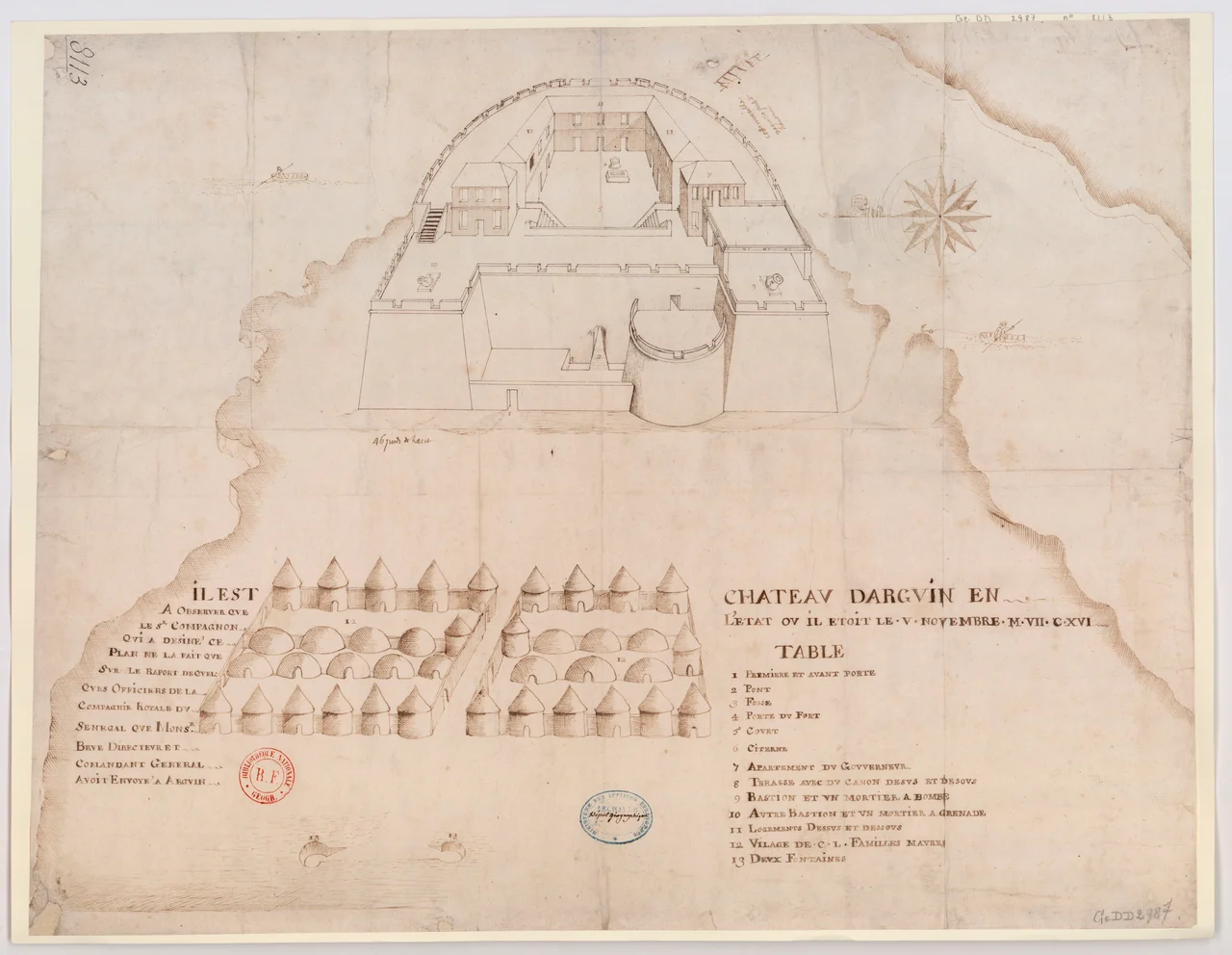
It is a low, arid scrap of land in a bay full of treacherous reefs, hardly the kind of place history usually remembers. But Arguin holds a terrible distinction. In 1445, on this island off the Mauritanian coast, the Portuguese built the first European fortress ever raised outside Europe - and turned it into one of the earliest engines of the Atlantic slave trade. The fort changed hands again and again over the centuries that followed, flying Portuguese, Dutch, English, Brandenburg, and French flags in turn. But its founding purpose left the deepest mark: from here, human beings were carried away from their homeland in chains.
The First Fort
The Portuguese explorer Nuno Tristao reached Arguin in 1443, the first European known to set foot there. Two years later, under the patronage of Prince Henry the Navigator, Portugal established a feitoria - a fortified trading post - on the island. It was a landmark of a grim kind: the first stone European outpost built beyond Europe's own shores, the prototype for the fortified trading network that would eventually ring the coasts of Africa, Asia, and the Americas. The Portuguese had come chasing rumors of gold carried north by trans-Saharan caravan. They found little of it. What they built their commerce on instead was gum arabic - and people.
The Trade in Human Beings
The numbers are stark and they should not be softened. By 1455, around 800 enslaved West Africans were being shipped from Arguin to Portugal every year, and as the trade matured that figure rose toward a thousand. They were carried to Portugal itself and to the sugar plantations of Sao Tome in the Gulf of Guinea, sold to fund a colonial enterprise that treated their lives as cargo. These were not statistics. They were people taken from their families and homelands - farmers, herders, parents, children - funneled to the coast through networks of intermediaries and loaded onto ships bound for a world they had never chosen to enter. Arguin was one of the first places where the machinery of the transatlantic slave trade was assembled, and the human cost of that machinery began here, in the holds of these early ships.
A Fort Everyone Wanted
Because of its trade, the little island was fought over for centuries. In January 1633 a Dutch force seized the fort for the Dutch West India Company; that same year the company's young chief factor, Daniel van Peere, was taken and killed by local people during a trading mission, touching off a mutiny in the garrison. The English held it briefly in 1665. France took it in 1678. Later it passed to Brandenburg, then back to France in a violent assault in 1721, then to the Dutch, then to France again. Through all of it, the island's own disadvantages persisted - too dry, too poor an anchorage for any power to truly settle. By 1728 it had reverted to the indigenous peoples of the coast. The flags kept changing; the human cost of what the fort had set in motion did not.
The Sea Takes Its Due
The reefs that made Arguin so hard to approach claimed their most famous victim in July 1816, when the French frigate Meduse, bound for Senegal, wrecked off the island. Around 350 people died in the disaster and its harrowing aftermath, when survivors were abandoned on a makeshift raft. The tragedy inspired Theodore Gericault's monumental painting 'The Raft of the Medusa,' now in the Louvre. Today Arguin lies within the Banc d'Arguin National Park, a protected sanctuary for migratory birds and Imraguen fishers. The fort is a ruin, the trade long ended - but the island remains a place where one of the modern world's longest cruelties first found its footing, and where remembering that honestly is the least we owe the people who passed through it.
From the Air
Arguin island sits at roughly 20.60 degrees N, 16.46 degrees W in the Bay of Arguin, ringed by extensive and dangerous reefs within the Banc d'Arguin National Park. From the air, look for a small low island set amid pale shallows and shifting sandbanks off the Mauritanian coast - the reefs show as lighter water surrounding it. It makes a striking coastal waypoint. Nouadhibou (GQPP) lies to the north; Nouakchott (GQNN) to the south. Expect coastal haze and blowing sand near the shoreline.
Nearby Stories
- Ras Nouadhibou 22 km away
- Banc d'Arguin National Park 30 km away
- Tasiast Gold Mine 34 km away
- Guerguerat 57 km away
- Inal, Mauritania 98 km away
- Afonso Gonçalves Baldaia 151 km away
- Akjoujt 166 km away
- SS Noemijulia 331 km away