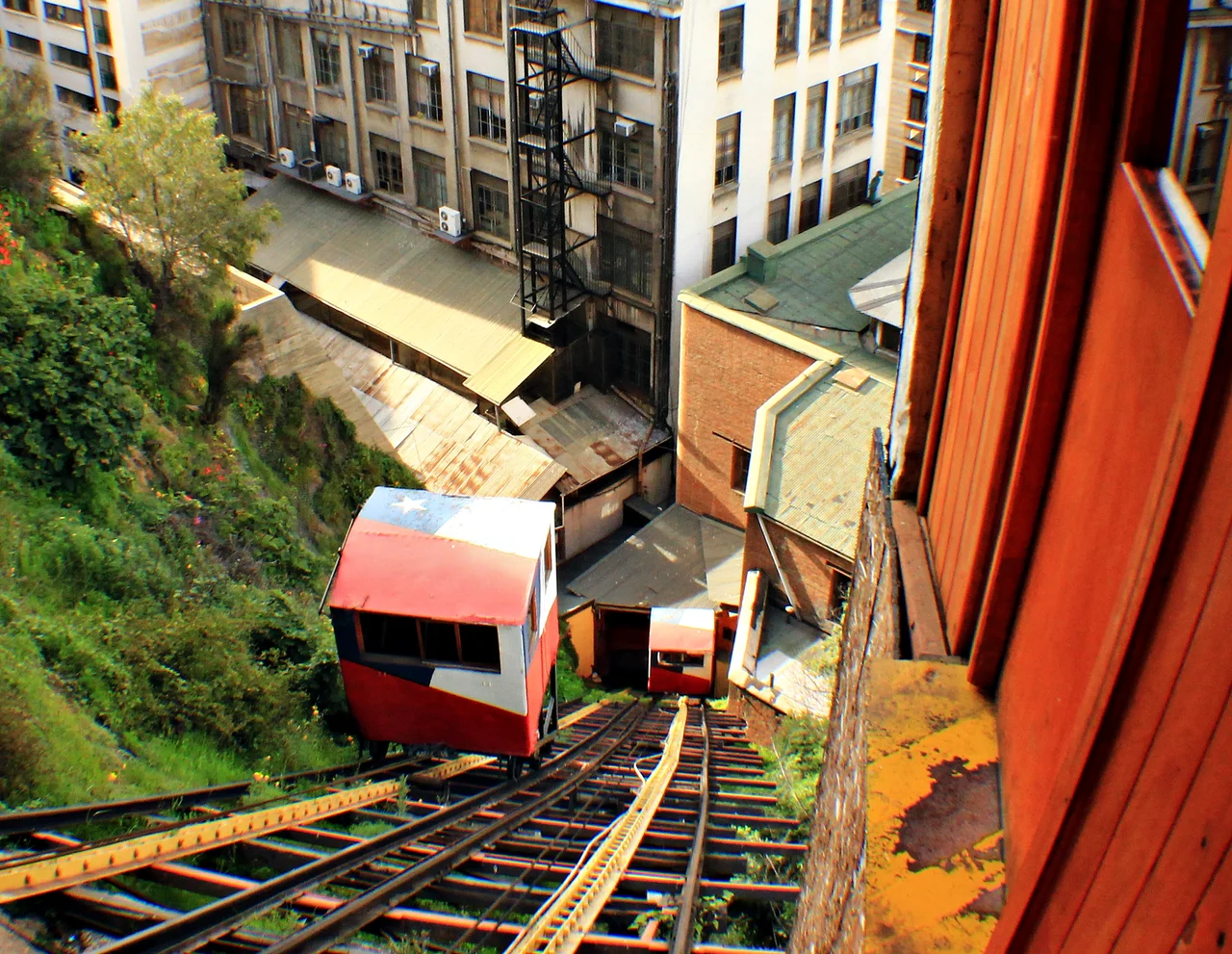

Ascensor Concepción
In 1883 the citizens of Valparaíso found a way to cheat the hills. Their port city is built on a ring of steep slopes that tumble straight into the Pacific, and getting home meant a punishing climb up stairs and goat paths. So the Compañía de Ascensores Mecánicos installed a funicular: two little wooden cars, hauled up a 46-degree incline by nothing more clever than water and gravity. It was the first of its kind in the city, and more than 140 years later the Ascensor Concepción still runs - the oldest of the funiculars that became Valparaíso's signature.
Water and Gravity
The mechanism was elegantly simple. Two cars were linked by a cable over a wheel at the top of the slope, and a tank beneath the upper car was filled with water until its weight pulled it down, dragging the lower car up. At the bottom the water was emptied and the cycle began again - a boiler raised steam to manage the system, but the lifting was done by gravity alone. It was cheap, quiet, and reliable on a hillside too steep for almost anything else. In time the water counterbalance gave way to electric motors and the original wooden cabins were replaced with metal ones, but the principle that first carried passengers up Cerro Concepción in 1883 is still recognizable in the ride today.
The Climb
The lower station hides at the end of the Pasaje Elías, a narrow alley off Prat Street, tucked beneath the slender silhouette of the Reloj Turri, the wedge-shaped clock tower that is one of the port's best-loved landmarks. From there the little car tilts back and begins its short, steep haul up rails laid right against the face of the hill. Each cabin holds only seven passengers, so the experience is intimate - a brief, creaking ascent during which the rooftops, the harbor, and the cargo cranes drop away beneath you. At the top the doors open onto the Paseo Gervasoni, a promenade with one of the finest views in Valparaíso, the whole amphitheater of the bay spread out below. The rails are pitched at roughly 46 degrees - steep enough that the floor of the cabin is stepped, and standing in it feels a little like riding inside a tilting wooden box bound for the sky.
The Hill the Foreigners Built
The neighborhood at the top explains why the funicular was worth building. From around 1840, British and German merchants drawn by Valparaíso's booming sea trade settled Cerro Concepción and the neighboring Cerro Alegre, raising European-style houses, schools, and churches on the heights. The English built St. Paul's Anglican church in 1858, deliberately plain and tower-less because of the era's restrictions on non-Catholic worship. The Germans answered in 1897 with the Lutheran Church of the Holy Cross, said to be the first Protestant church in South America to raise a proper bell tower. Their pastel houses and steep cobbled lanes give the hill the storybook character that visitors still climb the funicular to find.
A Monument Restored
Valparaíso's funiculars are inseparable from the city's identity, and in 2003 UNESCO recognized the historic quarter of the seaport as a World Heritage Site, an acknowledgment of its remarkable late-nineteenth-century urban fabric of hills, alleys, and lifts. The Ascensor Concepción had already been declared a Historic Monument of Chile in 1998. Like much of the aging system, it eventually needed rescue: a careful restoration overseen by the Ministry of Public Works ran from December 2016 to April 2019, when the oldest elevator in the port reopened to the public. To ride it now is to take the same short, slanting journey that residents have taken for well over a century - a small, stubborn piece of working history clinging to a Pacific hillside.
From the Air
The Ascensor Concepción sits at roughly 33.041 degrees south, 71.626 degrees west, on the seaward face of Cerro Concepción in central Valparaíso, just above the waterfront and the Reloj Turri clock tower. From the air the city reads as a dense bowl of brightly colored houses wrapped around a working harbor, with the funicular itself far too small to spot - but the bay, the port cranes, and the steep hills make the location unmistakable. Valparaíso has no airport of its own; the nearest is Viña del Mar Airport (ICAO: SCVM), about 10 km north, while Santiago's Arturo Merino Benítez International (ICAO: SCEL) lies roughly 100 km inland to the east. Coastal cloud and sea fog are common in the mornings; clear afternoons give the best view of the harbor amphitheater.
Nearby Stories
- Battle of Papudo 24 km away
- Casa de Isla Negra 28 km away
- Battle of Chacabuco 31 km away
- Battle of Maipú 38 km away
- Aconcagua 94 km away
- Constitución, Chile 237 km away
- Santa Olga 278 km away
- 1687 Peru Earthquake 1982 km away