
Aswan
Around 240 BC, a Greek scholar in Alexandria heard about a well in a town far to the south. At noon on the longest day of the year, the story went, the sun shone straight down to the bottom of that well, casting no shadow at all. Eratosthenes never traveled to the town - it lay nearly 800 kilometers up the Nile - but he used that single fact to do something audacious: he measured the size of the Earth, and came within a few percent of the right answer. The town was Syene. Today it is called Aswan, and it still sits where the green ribbon of the Nile runs out and the Nubian desert takes over.
The Edge of Egypt
For most of pharaonic history, Aswan was the end of the line. Just south of the city, the Nile splinters across a band of granite outcrops known as the First Cataract - shallow, rock-strewn rapids that boats could not easily pass. This made Aswan a natural border, the threshold between Egypt and the land of Nubia beyond. Garrisons watched the frontier here; traders unloaded ivory, gold, ebony, and incense carried down from the African interior. The ancient name Syene gave us the word that still describes a building stone quarried nearby. And the geography that made Aswan a gateway also made Eratosthenes' measurement possible: the city sits almost exactly on the Tropic of Cancer, the line where the midday summer sun climbs directly overhead.
The Stone That Built an Empire
The hills along the east bank hide one of antiquity's great industrial sites: the granite quarries of Aswan. For nearly three thousand years, workers split pink and grey granite from these slopes and floated it downriver to become temples, colossi, and obelisks. The obelisks that now stand in Rome, Paris, London, Istanbul, and New York's Central Park all began here. One enormous block never left. The Unfinished Obelisk still lies in its quarry bed, partly carved from the bedrock. Had it been raised, it would have stood around 42 meters tall and weighed nearly 1,090 tonnes - larger than any obelisk ever erected. A deep crack opened in the stone during the final stages of work, and the masons abandoned it where it lay, leaving a frozen snapshot of how the ancients shaped granite with little more than dolerite pounders and patience.
The Dam That Changed Everything
In 1970, after twelve years of construction, Egypt completed the Aswan High Dam - a wall of rock and clay nearly 3.9 kilometers long, rising over 100 meters above the river. Behind it spread Lake Nasser, one of the largest artificial lakes on Earth, reaching deep into Sudan. The dam ended the Nile's annual floods, generated power, and stored water against drought. It also drowned a homeland. As the lake rose, tens of thousands of Nubians lost the villages their families had lived in for generations, and were resettled in planned communities downstream. Whole temples faced the same waters. In response, UNESCO mounted an unprecedented international rescue, cutting the great temples of Abu Simbel into blocks and rebuilding them on higher ground - a campaign that ran from 1960 to 1980 and helped give birth to the modern idea of World Heritage.
A Nubian City
Aswan feels different from the rest of Egypt, and the difference is Nubian. In villages along the west bank and the islands - places like Gharb Soheil - houses are painted in saturated blues, ochres, and greens, their domed roofs catching the desert light. The displacement caused by the dam scattered communities but did not erase them; Nubian culture survives in music, language, and memory, and in the lament songs that carry the ache of lost land. Aswan has long produced musicians who carried that sound north to Cairo, among them the celebrated singer Mohamed Mounir. In the souk, hibiscus dries in deep-red mounds, alongside spices, baskets, and woven goods. Feluccas with white triangular sails cut between the islands, where granite boulders, smoothed and rounded by the river, glow at sunset.
Islands in the River
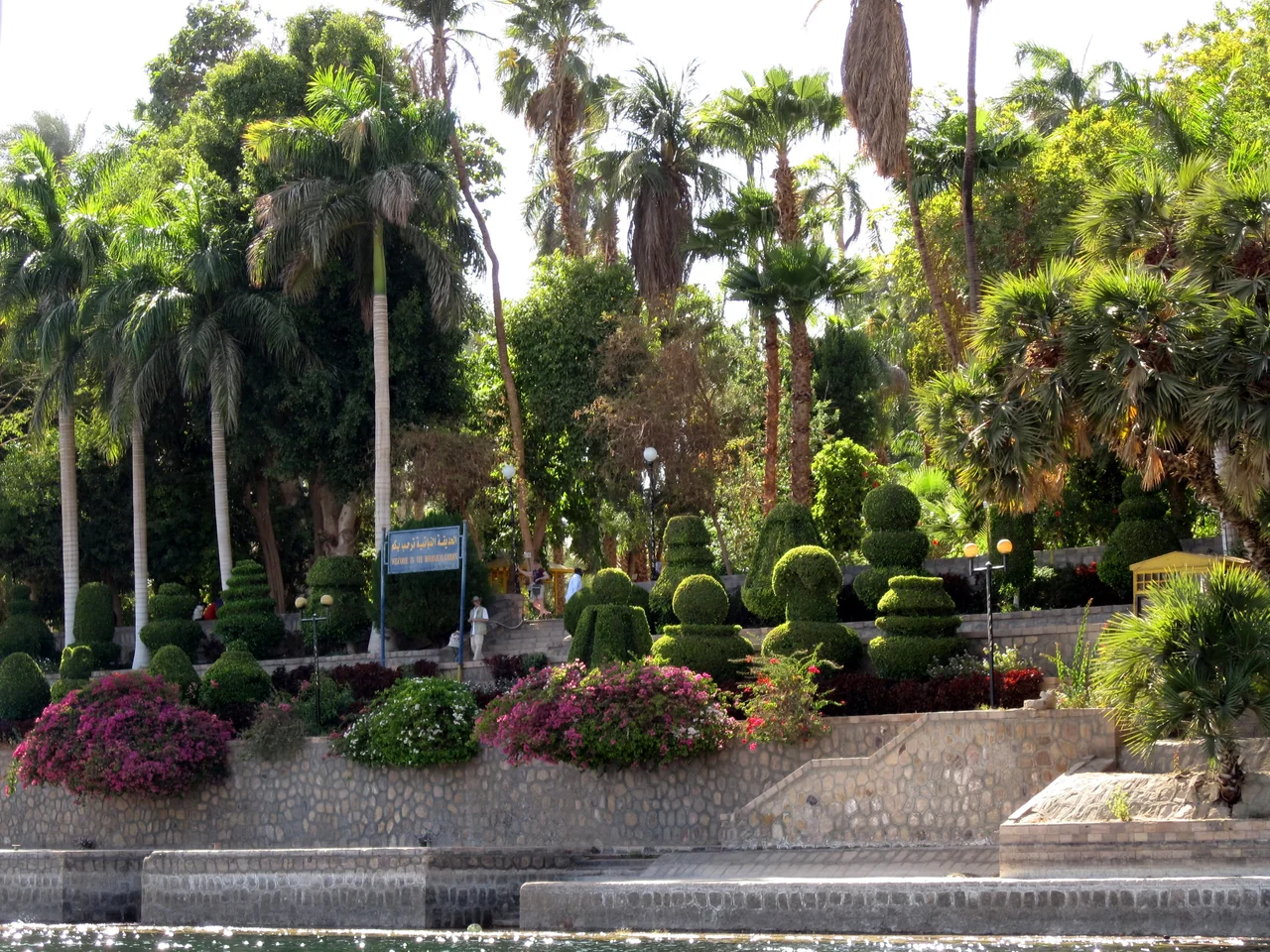
The Nile widens at Aswan and fills with islands, each holding a story. Elephantine, opposite the town center, was the ancient frontier settlement, layered with temples and ruins. El Nabatat Island is given over entirely to a botanical garden of rare trees gathered from across the tropics. On a barren plateau on the west bank stands the domed Mausoleum of Aga Khan III, the Ismaili leader who loved this stretch of river and chose to be buried above it. And just upstream, Philae's temples - dedicated to the goddess Isis - were themselves rescued from the rising water and reassembled on neighboring Agilkia Island. Few cities pack so much history, sacred and modern, into a few kilometers of water and rock.
From the Air
Aswan lies at 24.09 degrees N, 32.90 degrees E, on the east bank of the Nile just below the First Cataract. From altitude the river braids around a cluster of islands, with Lake Nasser's vast blue sheet spreading south behind the High Dam - both dams are unmistakable landmarks, the High Dam a broad sweeping arc. The pink granite quarries scar the hills east of the river. Aswan International Airport (ICAO HESN) sits about 16 km southwest of the city; the purpose-built Abu Simbel Airport (HEBL) lies roughly 240 km further south near the relocated temples. Skies are reliably clear and visibility excellent in this hyper-arid climate; expect strong thermals and dust over the desert in afternoon heat.
Nearby Stories
- Temple of Dendur 59 km away
- Edfu 61 km away
- Qasr Ibrim 144 km away
- Wadi Allaqi 168 km away
- Wadi El Gemal National Park 169 km away
- Lake Nasser 192 km away
- Temple of Seti I (Abydos) 199 km away
- Mersa Gawasis 245 km away