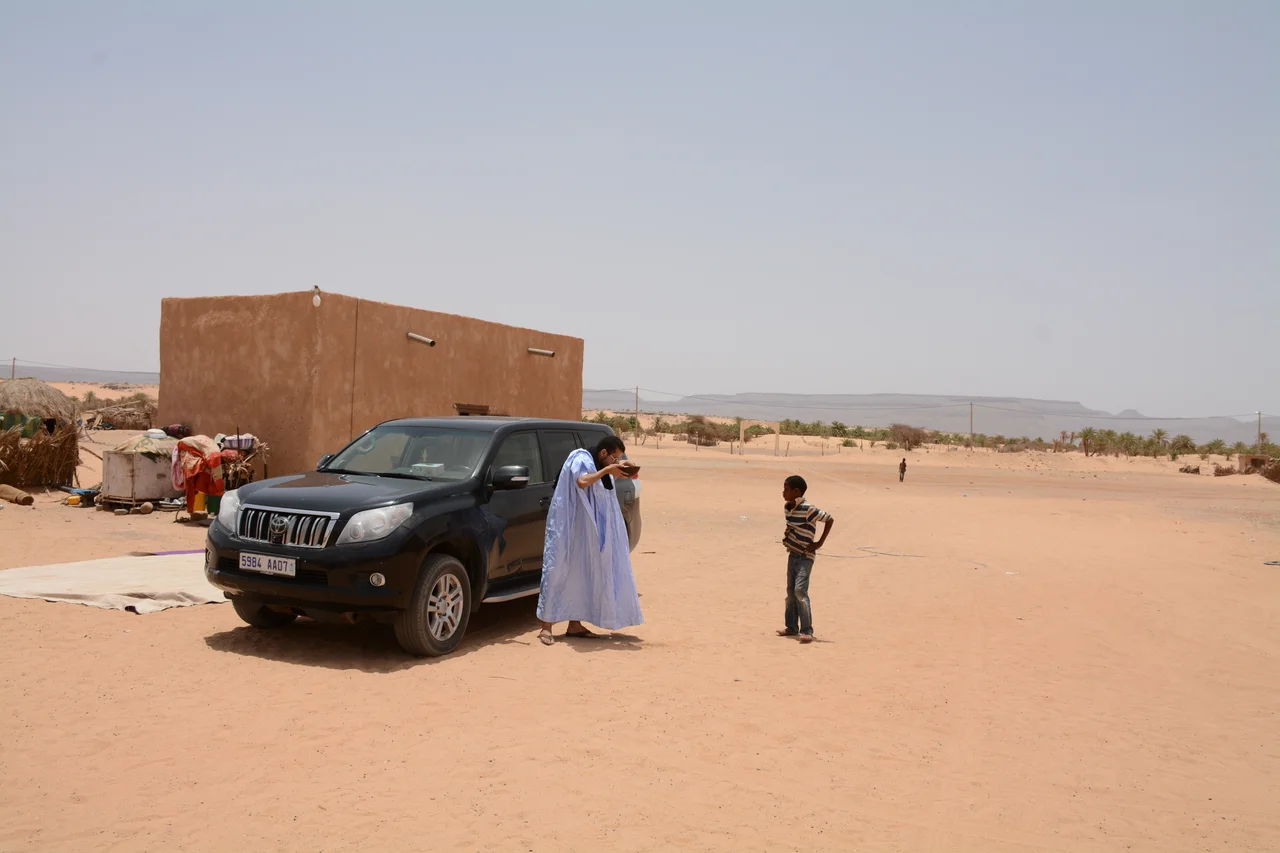

Atar
Its name means "mountain," but Atar sits in a hollow - strung along the bed of the Oued Seguellil, a river that runs only in memory, at the foot of the great sandstone plateau that gives the town and its whole region their Berber name. With around 35,000 people, Atar is the largest settlement on the Adrar and the capital of the surrounding region. It is a place defined by its position: the last real town before the desert closes in, the threshold you cross on the way to everywhere harder.
Stone Older Than Life
The geology around Atar runs deep into the planet's past. The Adrar's mountains date from the primary era, leaning against the far older Precambrian rock of the Tiris Zemmour to the north. Most remarkable are the stromatolites found near the town - layered mounds built by colonies of microbes, among the oldest evidence of life on Earth. To find them here, fossilized in the desert, is to stand on the record of a planet learning how to be alive, billions of years before anyone arrived to name the mountain.
The 1674 Mosque
At the heart of the old town stands the Atar Mosque, built in 1674 and counted among the oldest mosques in Mauritania. It has watched the town for three and a half centuries - through the heyday of the caravan trade, through French colonization, through drought and modern resettlement. In a region where Chinguetti and Ouadane draw the world's attention for their medieval libraries, Atar's mosque is a quieter monument, the steady spiritual anchor of a working town rather than a museum piece.
Gateway to the Lost Cities
Atar's importance has always come from where the roads lead. East of town, through the Amojjar Pass, runs the difficult route to Chinguetti and Ouadane - the ancient Moorish cities now reduced to magnificent ruins - and onward toward the astonishing Richat Structure, the vast bullseye of rock visible from orbit. To the north lies Choum, where the iron-ore railway crosses the desert. For travelers, scholars, and once the world's longest off-road race, the Paris-Dakar Rally, which made Atar a key January stop, the town has been the place where the easy traveling ends and the desert begins.
A Town That Makes Things
Atar is not only a doorway; it is a place with its own crafts and character. The town is known across Mauritania for its samaras - leather soles fitted with straps, the desert sandal whose name traces back to the Arabic word for sole. In 2019, the town made the medical literature for a less welcome reason, when researchers documented the first appearance of the Plasmodium vivax malaria parasite in its oasis. And in 2012 Atar gained a new institution suited to its wide, empty skies: an air force school, training pilots and crew for Mauritania's military.
The Heat That Never Leaves
Everything in Atar happens under a relentless sun. The town has a hot desert climate, sitting just south of the Tropic of Cancer, and the heat is the constant fact of life - the annual average temperature hovers near 30 degrees Celsius, and excessive heat persists the year round. Rain is almost a rumor, no more than 35 millimeters in a typical year, most of it crowded into August and September, while the sky pours down over 3,540 hours of bright sunshine annually. Two of the town's sons carried Atar's name outward: the filmmaker Med Hondo, a pioneer of African cinema, and Maaouya Ould Sid'Ahmed Taya, who became Mauritania's president.
From the Air
Atar lies at 20.52°N, 13.05°W in northern Mauritania, on the dry bed of the Oued Seguellil at the western foot of the Adrar Plateau. Atar International Airport (GQPA) serves the town directly. From the air, look for the urban grid in its hollow against the dark, gorge-cut plateau rising to the east, with the Amojjar Pass marking the route toward Chinguetti and Ouadane. The climate is hot and exceptionally sunny with over 3,540 hours of sunshine a year; visibility is usually excellent except during Saharan dust events.
Nearby Stories
- Chinguetti Mosque 30 km away
- Maaden El-Irvane 43 km away
- Choum 63 km away
- Geography of Mauritania 73 km away
- Akjoujt 88 km away
- Zug, Western Sahara 101 km away
- Inchiri region 108 km away
- Ancient Ksour of Ouadane, Chinguetti, Tichitt and Oualata 109 km away