
Australian Grand Prix
For fifty-one weeks a year, Albert Park is an ordinary inner-Melbourne reserve: a lake, joggers, families, ducks. Then once a year the public roads that loop around the water are sealed off, lined with grandstands and walls, and turned into a Formula One circuit where the fastest cars on Earth scream past at over three hundred kilometres an hour. The transformation is so complete, and so temporary, that creating the track from scratch each year is part of the legend. The Australian Grand Prix has become Melbourne's roaring autumn ritual, and in recent seasons close to half a million people have crowded in over a weekend to be there.
A Race That Never Sat Still
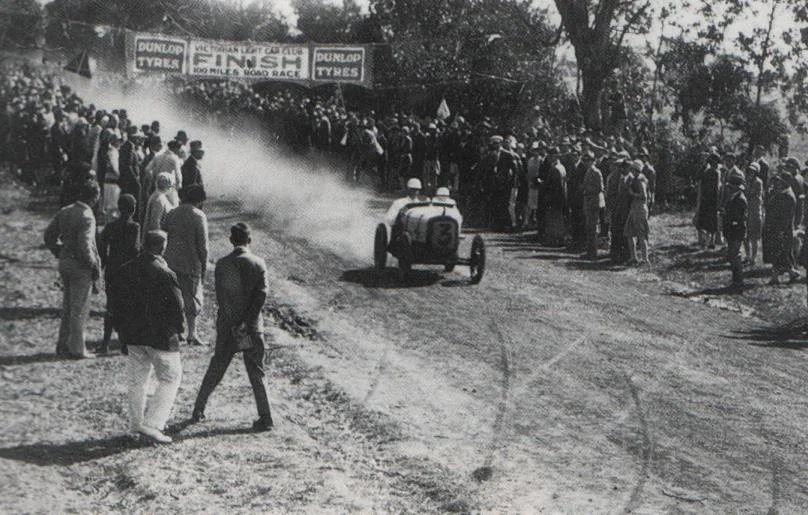
Few major races have wandered as far as this one. The Australian Grand Prix traces its origin to a 100 Miles Road Race held on the dirt of Phillip Island in 1928, won by Arthur Waite in a modified Austin 7, and only later did it take the Grand Prix name. From there it roamed the continent for decades, run at twenty-three different venues, on dirt circuits and the famous Mount Panorama at Bathurst, on converted airfields and city streets, surviving wars, petrol rationing and shifting fashions in motorsport. Through the 1960s the great names of Formula One, Jim Clark and Jackie Stewart and Graham Hill among them, came south each winter to race the locals in the golden age of the Tasman Series. The race was a survivor long before it was a spectacle.
The Adelaide Years
In 1985 the Grand Prix finally joined the Formula One World Championship, and it did so in style, as a street race through Adelaide that closed the season every year for over a decade. Drivers and teams loved Adelaide for its party atmosphere and its demanding, attritional circuit, and it produced unforgettable theatre. The 1986 title was decided there when Nigel Mansell's tyre exploded at high speed down the Brabham Straight, showering sparks as he wrestled the car to a stop and handed the championship to Alain Prost. The 1994 finale ended in a collision between Michael Schumacher and Damon Hill that settled the title in Schumacher's favour. When the race finally left in 1995, Adelaide sent it off with a crowd of 520,000 over the four days, a figure the event has never beaten anywhere since.
The Move to Melbourne
The shift to Melbourne in 1996 was pure hardball. The Victorian government, stung by losing the 2000 Olympics bid to Sydney, wanted a marquee event, and the deal to take the Grand Prix from Adelaide was struck so fast that Formula One's Bernie Ecclestone later said it took ten minutes. The choice of Albert Park was bitterly contested. A Save Albert Park campaign argued the race turned a public park into a private playground and cost taxpayers more than it returned, and the economics have been disputed ever since. But the new circuit, sixteen turns of public road and parkland car park beside the lake, proved fast and photogenic, and it made headlines within three corners of its first lap when Martin Brundle's car was launched into a spectacular airborne crash and he sprinted back to take the restart.
Melbourne's Modern Showpiece
For most of its Melbourne life the race has opened the Formula One season, the sport's first hello to the world each year, and the circuit has thrown up its share of drama: Mark Webber's fairy-tale fifth on debut for a tiny Australian team in 2002, Lewis Hamilton's podium on his very first Grand Prix start in 2007, and a fairy-tale 2009 win for the brand-new Brawn team. There has been tragedy too, including the death of a trackside marshal, Graham Beveridge, in 2001. In 2022 the track was significantly redesigned to encourage overtaking, and the crowds have surged: the 2025 weekend drew 465,498 spectators, a record for Albert Park, sealed when home favourite Oscar Piastri spun out of second place and Lando Norris held off Max Verstappen to win. Melbourne's contract now runs to 2037.
The Argument Under the Noise
Behind the spectacle runs a stubborn debate about whether the Grand Prix is worth what Victoria pays for it. Supporters point to tourism, jobs and global exposure; one assessment put the 2023 race's contribution to the state economy at 268 million dollars. Critics counter that the public cost has run far higher than the revenue, that the 2023 event cost taxpayers more than a hundred million dollars to stage, and that the Grand Prix Corporation has fought in tribunals to avoid revealing exactly how it counts its crowds. The race is, in the end, two things at once: a genuine carnival that brings a city together for a weekend, and an expensive civic gamble that Melbourne keeps deciding, loudly, to renew.
From the Air
The Albert Park Circuit lies at roughly 37.85 degrees south, 144.968 degrees east, around three kilometres south of central Melbourne and a short distance inland from Port Phillip Bay. From the air the venue is easy to read on race weekend: a ribbon of track wrapping a roughly oval lake, set in green parkland with the city skyline just to the north and St Kilda and the bay beaches to the south and west. Recommended viewing altitude is 2,500 to 4,500 feet AGL to frame the circuit, the lake and the central business district together, though this sits in busy controlled airspace beneath Melbourne's approaches. The nearest fields are Moorabbin (ICAO YMMB) to the southeast and Essendon (YMEN) to the north, with Melbourne Tullamarine (YMML) and Avalon (YMAV) the major airports. Expect mild, fast-changing early-autumn conditions and frequent sea breezes off Port Phillip Bay.
Nearby Stories
- Geelong 12 km away
- The Disappearance of Harold Holt: The Prime Minister Who Vanished Into the Sea 41 km away
- Eureka Rebellion 54 km away
- Yarra River 55 km away
- Sovereign Hill 65 km away
- Waterloo Plains massacre 73 km away
- Glenrowan, Victoria 142 km away
- Bass Strait 210 km away