
Australian Open
Every January, while much of the tennis world is still shaking off winter, Melbourne turns up the heat. Literally. The Australian Open opens the Grand Slam season in the thick of the Australian summer, on blue hard courts that can bake at the height of a heatwave, and somehow this has become its charm rather than its handicap. Players call it the happy slam, and the public agrees with their feet: more than 1.2 million people streamed through Melbourne Park in 2025, making this the best-attended major tennis tournament on the planet.
The Slam at the Bottom of the World
For most of its life, this tournament's defining problem was simply how far away it is. First held in 1905 as the Australasian Championships, it spent decades struggling to attract the world's best, because reaching Australia meant a sea voyage that could take forty-five days from Europe. The first players to arrive by aircraft were an American Davis Cup team in 1946. Even inside the country, distance bit: when the event was held in Perth, no one from the eastern states made the three-thousand-kilometre rail crossing to play. Great champions of the early game never once entered. The tournament has been staged in five Australian cities and even twice in New Zealand before Melbourne finally claimed it for good in 1972, chosen because it drew the biggest crowds.
From Grass to Blue
The modern Open was born in 1988, when the tournament left the cramped grass of Kooyong for a purpose-built complex then called Flinders Park and now known as Melbourne Park. The move changed the game underfoot: out went grass, in came hard courts, first the green Rebound Ace, then blue Plexicushion from 2008, and the blue GreenSet surface used since 2020. Only Mats Wilander managed to win the title on both grass and hard court, a quirk of timing as much as skill. The new home let the tournament grow into something the old grass club never could, and it kept growing, expanding its footprint along the Yarra and adding show court after show court over a decade of redevelopment.
Taming the Weather
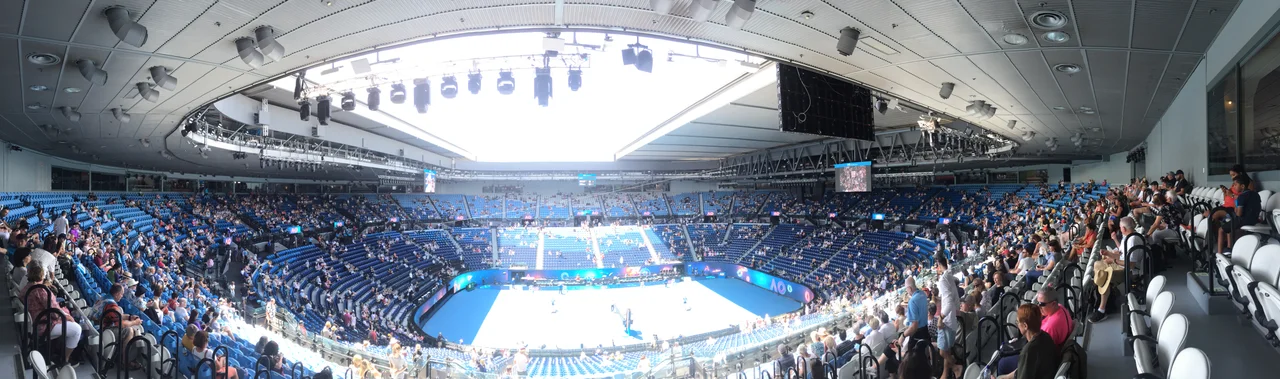
A summer tournament in a city famous for sudden weather needed a way to fight back, and Melbourne found one. The Australian Open became the first Grand Slam where play could continue indoors, sliding roofs shut over its three main arenas, Rod Laver Arena, John Cain Arena and the refurbished Margaret Court Arena, when rain swept in or the heat climbed too high. No other major can move three of its biggest courts undercover. It was an innovation born of necessity, the answer to a stadium full of fans and a forecast that might bring a thirty-nine-degree afternoon or a downpour with equal ease, and it quietly reshaped what a tennis major could promise its players and its crowds.
Names on the Cups
The two great trophies carry the names of the players who first put Australasian tennis on the map. The men's singles champion lifts the Norman Brookes Challenge Cup, named for the Australian who won this title in 1911 and twice conquered Wimbledon in an era when crossing the world to compete was itself an achievement. The women's champion receives the Daphne Akhurst Memorial Cup. Each cup is made by hand, the winners' names engraved year after year, and the trophies take more than 250 hours of craft to produce. To win in Melbourne is to be inscribed into a story that runs back well over a century, beside the rare few who made the long journey south when almost no one else would.
The Happy Slam Grows Up
The Open wears its modern ambitions openly. It was the first Grand Slam to abandon human line judges entirely for electronic calls, in the restricted 2021 tournament. It introduced a first-to-ten-points tiebreak to settle deciding sets, moved its start to a Sunday to ease the brutal late-night finishes that the heat and long matches can produce, and in 2025 even staged a pickleball event on a side court. All of it sits on a foundation of extraordinary popularity. The 2025 tournament not only set the overall attendance record but packed in 97,132 people on a single day. Some stars have grumbled that January comes too soon after the holidays, but the city has built its summer around the tennis, and the crowds keep proving Melbourne right.
From the Air
Melbourne Park sits at roughly 37.823 degrees south, 144.98 degrees east, on the south bank of the Yarra River just east of central Melbourne, within the Melbourne Sports and Entertainment Precinct. From the air the venue is a tight cluster of large roofed arenas immediately south of the Melbourne Cricket Ground, with the river curling past to the north and the city towers close at hand to the west. Recommended viewing altitude is 2,500 to 4,000 feet AGL to take in the tennis complex, the adjacent MCG and the central business district together; during the January tournament the precinct and riverbanks fill with crowds. This is dense controlled airspace beneath Melbourne approaches. The nearest fields are Essendon (ICAO YMEN) to the northwest and Moorabbin (YMMB) to the southeast, with Melbourne Tullamarine (YMML) and Avalon (YMAV) the major gateways. Expect hot, hazy high-summer conditions, occasional heat haze, and the chance of fast-moving afternoon storms and cool changes off Port Phillip Bay.
Nearby Stories
- Geelong 12 km away
- The Disappearance of Harold Holt: The Prime Minister Who Vanished Into the Sea 41 km away
- Eureka Rebellion 54 km away
- Yarra River 55 km away
- Sovereign Hill 65 km away
- Waterloo Plains massacre 73 km away
- Glenrowan, Victoria 142 km away
- Bass Strait 210 km away