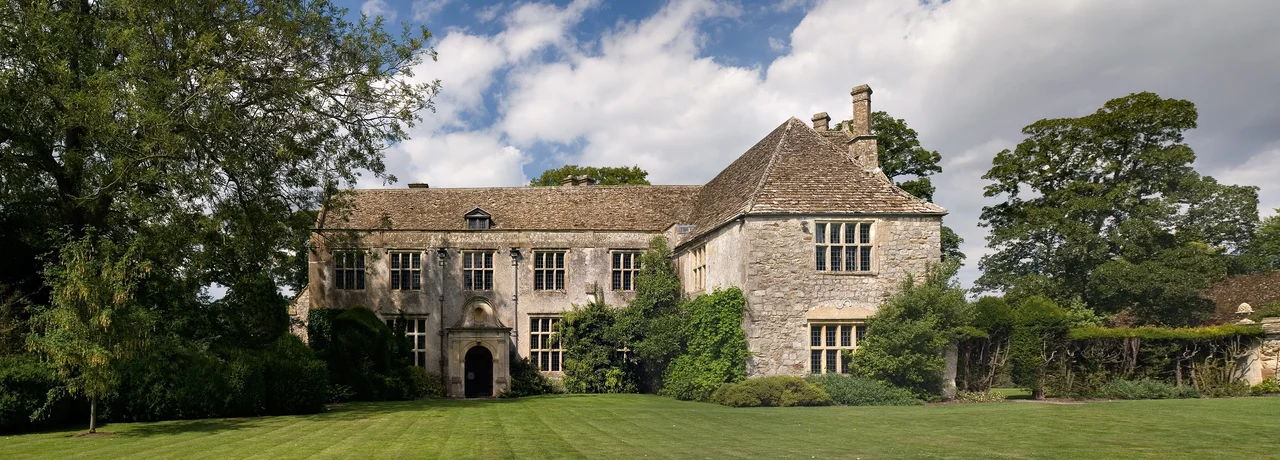

Avebury Manor and Garden
Most great English houses sit politely beside their landscape. Avebury Manor stands inside it. The early-Tudor building looks out across the largest prehistoric stone circle in Britain - the massive Avebury henge, predating Stonehenge by centuries - and the manor's own grounds occupy ground that may have been used by the same Neolithic farmers who raised those stones. Before the manor came a Benedictine priory founded in 1114 as a cell of the great Norman abbey at Saint-Georges, Boscherville. Before the priory, the stones. Avebury Manor is a Tudor house living on top of a medieval monastery built next door to a 4,500-year-old monument. Layered like this, the place hums.
Deborah Moody Sails for Brooklyn
By the 1580s the manor was passing through the Dunch family. William Dunch had bought the place partly because he was fascinated by ancient monuments - he wanted to live near the stones. He passed it to his son Walter, whose daughter Deborah grew up running around the henge as a child. When Walter died in 1594, the family kept the manor. Deborah inherited her father's restless streak. She became Lady Moody, fell out with the Church of England over baptism, and in 1645 emigrated to America. She bought a patent from the Dutch in New Netherland and founded the town of Gravesend in what is now Brooklyn, becoming the first woman in colonial America to receive a land grant in her own name. The girl who had grown up among Neolithic stones laid out the first planned town in the colony - on a precise grid, with a public square in the centre. You can still see her plan in the modern Brooklyn street grid.
Marmalade Money and Henge Archaeology
The house passed through hands for three centuries - Marvyns, Stawells, eventually the Jenner family in the early 20th century, who added a West Library and redesigned the gardens. Then in the late 1930s came Alexander Keiller, heir to the Keiller's marmalade fortune in Dundee. Keiller was an obsessive amateur archaeologist, and what obsessed him was Avebury henge. He had bought up the village stone by stone, literally - he purchased fields and farms so he could re-erect the toppled megaliths the way they had stood before centuries of farmers had pulled them down. He leased and restored the manor as his base. His excavations of the henge were ended by the outbreak of war in 1939, and they were never properly resumed. The Keiller Museum in the village still displays the finds. Without his determination, the Avebury henge you see today would be a much fainter shadow.
Saved from Demolition
In 1955 the rate of demolition of English country houses had reached a peak - one house was being torn down every five days. The owners couldn't afford to maintain them, the postwar economy didn't reward holding them, and the National Trust hadn't yet developed the capacity it has now. Keiller put Avebury Manor up for sale, and it sat there. Few buyers were interested in heritage. Sir Francis Knowles, a biologist and the kind of man The Times called 'a fundamental scientist of outstanding calibre,' bought it and set about restoring it himself. He claimed to have uncovered signs of Gothic arches in the north-east corner, blocked up in Elizabethan times. His family lived partly in cottages on the estate and partly in the house itself while the work progressed, with help from the Ministry of Works. In May 1956 the house was among the first smaller houses opened to the public. In 1958 it was designated Grade I. Knowles died suddenly in 1974 at 59, in the same year the Victoria and Albert Museum's Destruction of the Country House exhibition shocked Britain into protecting what was left. He is buried in the churchyard next door.
The Torture Chamber Years
His widow sold the house in 1976 to the 8th Marquess of Ailesbury. In 1988 it was bought by Ken King, a property developer who saw an opportunity in heritage tourism. He made changes without planning permission. He opened an 'Elizabethan experience' attraction. He installed a faux torture chamber in an old storeroom, which - even by the standards of 1980s English heritage attractions - struck the village as a step too far. King's bankruptcy in 1991 brought the manor to the National Trust, which has owned it since. In 2011 the BBC and the Trust collaborated on a four-part series called The Manor Reborn, presented by Penelope Keith - whose earlier sitcom To the Manor Born gave the show its punning title - and the antiques dealer Paul Martin, with the architectural historian Dan Cruickshank weighing in. Each of the manor's rooms was redecorated to represent a different period of its history, from Tudor to Edwardian.
Touch the Furniture
The unusual rule at Avebury Manor is that visitors are encouraged to touch. To sit on the chairs. To handle the objects. The rooms are arranged to represent periods from the 16th century through to the early 20th, and the philosophy is that the place should feel lived in rather than roped off. The garden has a stone dovecote dating to the 17th century, when the Marvyns extended the south range around 1601. The house is reputedly haunted - villagers report at least one ghost in the courtyard, but the National Trust has wisely not catalogued these claims too systematically. In January 2024 flooding damaged the manor and forced its closure. The National Trust has been working to reopen it by Christmas 2025. The Neolithic stones in the next field, of course, have weathered considerably worse and are entirely unconcerned.
From the Air
Avebury Manor sits at 51.429 degrees north, 1.859 degrees west, in the village of Avebury near Marlborough, Wiltshire. Best viewed from 2,500 to 4,500 feet. The manor lies inside the great Avebury henge, the massive circular bank and ditch enclosing roughly 28 acres with its ring of standing stones - by far the most prominent feature from the air. The A4 runs east-west just south of the village. Silbury Hill, the largest prehistoric man-made mound in Europe, is a mile to the south. Nearest airport is Bristol (EGGD) about 35 miles west. RAF Lyneham is 12 miles north-northwest.
Nearby Stories
- Donnington Castle 4.7 km away
- Glastonbury Festival 8.8 km away
- Bristol Temple Meads 9 km away
- Cotswolds 9.6 km away
- Old Sarum Cathedral 11 km away
- Hyde Abbey 11 km away
- Oxford Castle 13 km away
- St Briavels Castle 14 km away