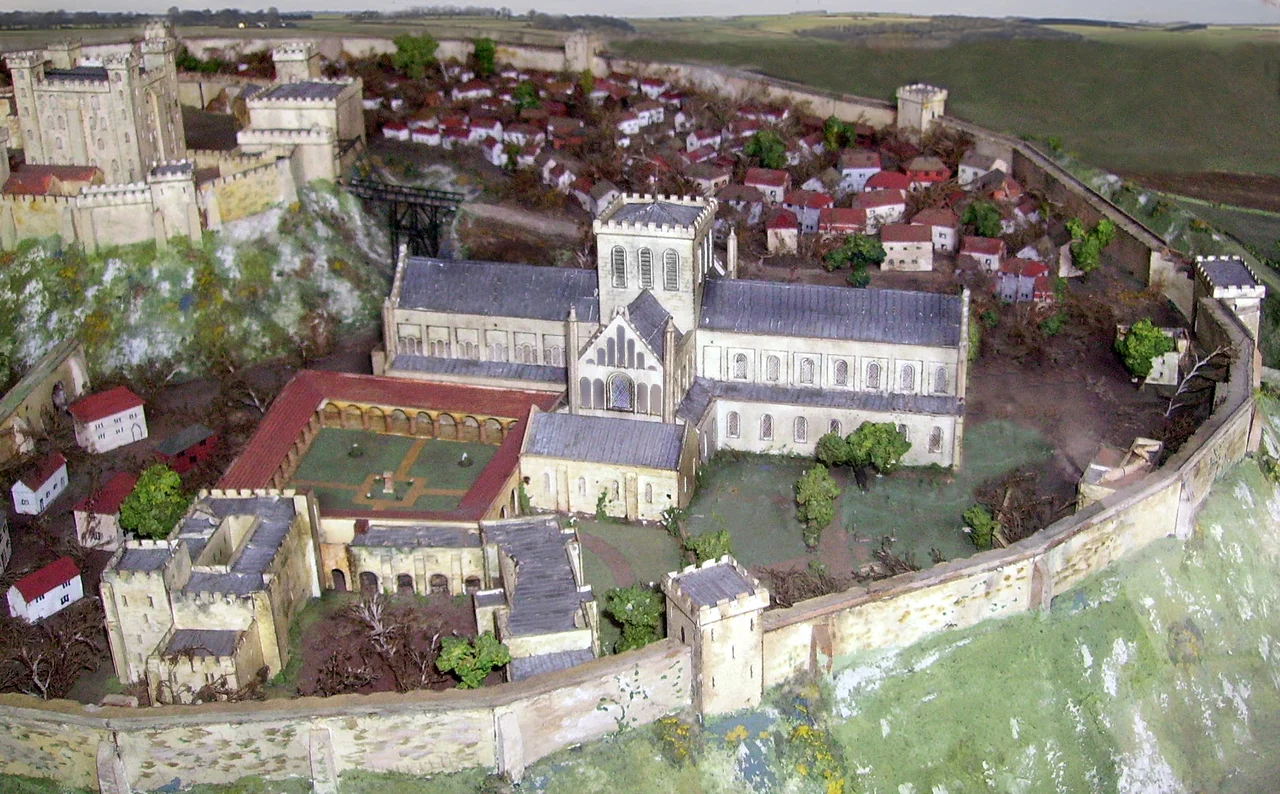

Old Sarum Cathedral
Stand on the windswept ramparts of Old Sarum and look down at the foundations laid into the grass. That cross-shaped outline is where a cathedral stood for 128 years. The Normans consecrated it on 5 April 1092 - and tradition holds that five days later a storm tore part of it apart. They rebuilt. They lived with the wind. In time, the bishops looked across the chalk hills toward a quieter site by the River Avon, decided enough was enough, and took their cathedral apart stone by stone to build the one we know today. Old Sarum Cathedral is the building that became Salisbury Cathedral. Its first home was up here, exposed and isolated, on a hill that had been a fortress for two millennia before the Normans arrived.
A New See, A New Hilltop
After his victory at Hastings in 1066, William the Conqueror used Old Sarum as a base of operations, walled by Norman fortifications built over the much older Iron Age hillfort. In 1075, the Council of London moved the bishop's seat here, naming Herman as the first bishop. The new see united the older dioceses of Sherborne and Ramsbury, with territory that covered Dorset, Wiltshire, and Berkshire. Herman had wanted his cathedral at Malmesbury, but the local monks and Earl Godwin blocked him. The cathedral that rose on Old Sarum's outer bailey was modest by the standards of its era: 185 feet from end to end, cruciform, with a nave of seven bays, an apse, a central crossing tower, and three eastward apsidal chapels. Six altars in all, including a parish altar in the nave and a high altar in the presbytery.
The Sarum Rite
Herman's successor was Osmund, count of Sees and Lord Chancellor of England - a cousin of the Conqueror and one of the better minds in the early Norman church. Under him, the cathedral developed the distinctive liturgical practice known as the Sarum Rite (or Sarum Use), which formalised the order of service in a way the rest of England soon copied. By the late medieval period, most English cathedrals followed Salisbury's example, and the Sarum Rite remained dominant until the Reformation. Osmund was eventually canonized in 1457; his relics were translated to the new Salisbury Cathedral the same year. Roger of Salisbury followed Osmund and rebuilt and enlarged the cathedral, finishing his work around 1120. Unusually, parts of his floors were patterned in green and white stone. The central apse was developed into a chapel, the altar moved into the chancel, and the building expanded into something more confident.
A Captive on the Hill
The cathedral on the hill was never a comfortable place. Peter of Blois, writing in the twelfth century, described the church as 'a captive on the hill where it was built, like the Ark of God shut up in the profane house of Baal.' The hill was 'barren, dry, and solitary, exposed to the rage of the wind.' The clergy lived in cramped quarters inside the fortifications, sharing the bailey with a sometimes hostile royal garrison. The shackles displayed in Salisbury Museum from this period - which a 2023 study connected to the 1139 'Arrest of the Bishops' - testify to the friction. Bishop Herbert was forced into exile in Normandy in 1198 after falling out with Archbishop Hubert Walter. By the early thirteenth century, the bishop, the dean, and the chapter had had enough. They petitioned for permission to move.
Stone by Stone, Downhill
In 1218 the bishop and chapter received papal authorisation. The new site, two miles south on the well-watered floor of the Avon valley, was consecrated in 1220. Over the next century the medieval cathedral we know now rose stone by stone - much of that stone literally carried down from the hill, salvaged from the Norman building above. In 1327 a further licence allowed stone from the ruins to build the wall of the new cathedral close, completed in 1331. The relics of Saint Osmund were translated to the new cathedral on 23 July 1457, the year of his canonization. Up on the hill, the cathedral foundations remained more or less undisturbed until the Society of Antiquaries of London started an excavation campaign in 1909. They worked through summers until the First World War interrupted them in 1915; the project's director, William Henry St John Hope, died in 1919 without publishing his findings. Many of the recovered artefacts now sit in the Salisbury Museum at the foot of the spire that replaced the building they came from. The foundations were Grade I listed in 1972.
From the Air
Old Sarum Cathedral's outline sits at 51.09 N, 1.81 W, inside the great earthwork of Old Sarum hill, two miles north of Salisbury. The nearest airfield is Old Sarum (EGLS), half a mile southeast at the foot of the hill; Boscombe Down (EGDM) is 5 nm northeast. From 1,500 to 2,500 feet, the cathedral foundations appear as a pale cross-shape inside the circular outer bailey. The towering 404-foot spire of the present Salisbury Cathedral two miles south is the visual answer to the question the bishops were asking when they decided to leave.
Nearby Stories
- Winchester Castle 6 km away
- Newbury, Berkshire 9.9 km away
- 1988 Poole Explosion 10 km away
- Norris Castle 10 km away
- West Kennet Long Barrow 11 km away
- Maiden Castle, Dorset 12 km away
- Glastonbury Festival 13 km away
- Bristol Temple Meads 16 km away