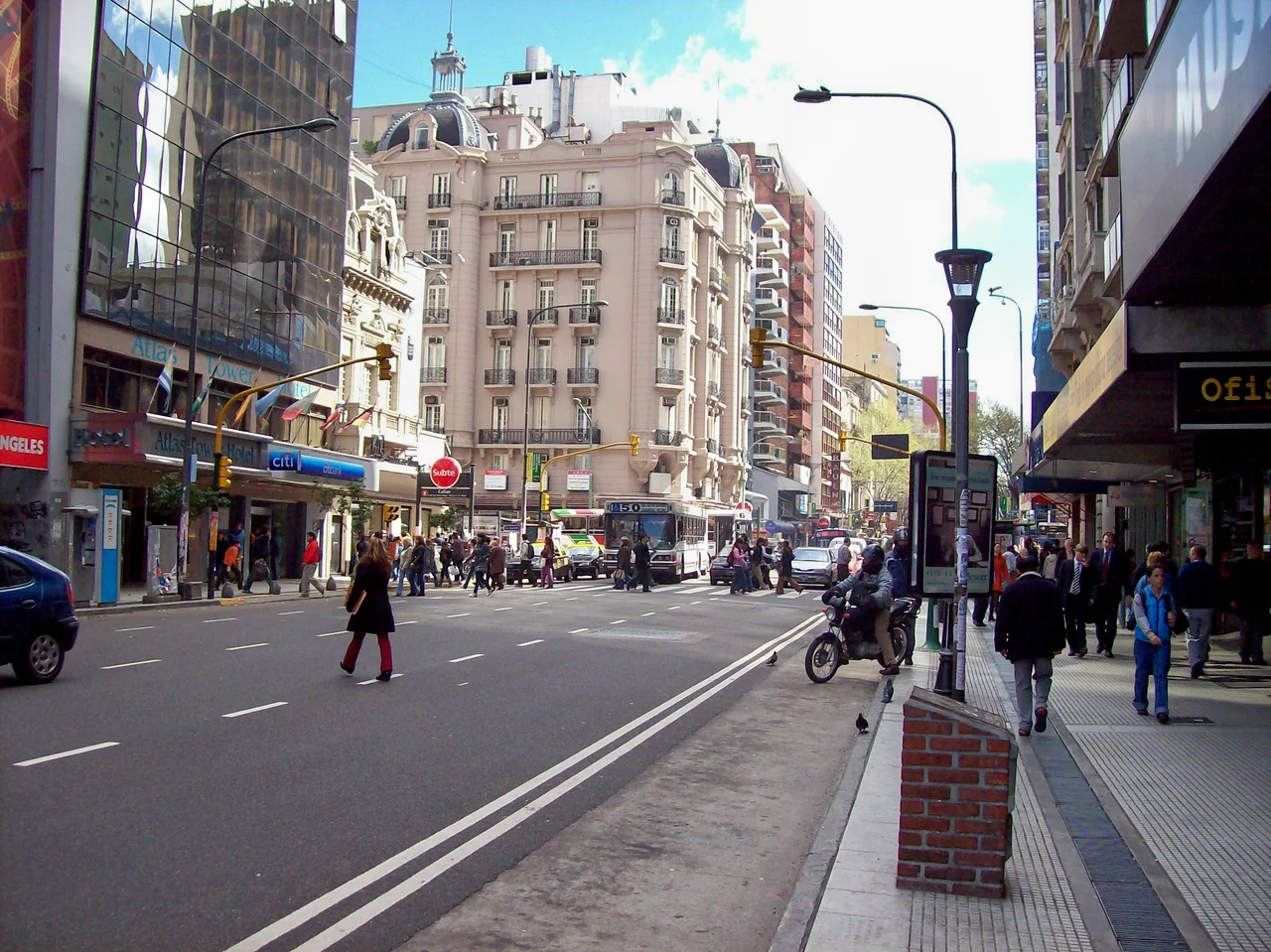

Avenida Corrientes
It is past midnight, and the lights are still on. Marquees blaze over a row of theaters, the smell of mozzarella and fugazza drifts out of pizzerias where men eat standing at the counter, and a bookshop stays open for browsers who have nowhere better to be. This is the Avenida Corrientes, the stretch that porteños have always called la calle que nunca duerme - the street that never sleeps. If the Avenida 9 de Julio is the city's broad backbone, Corrientes is its restless, glittering soul, Buenos Aires' own version of Broadway, tangled up with tango and theater and the particular romance of a city that stays awake.
The Cinema-and-Pizza Ritual
For generations, a night out in Buenos Aires meant Corrientes. In the ten or so blocks west of downtown, between Maipu Street and Avenida Callao, the avenue still holds the city's densest concentration of theaters and cinemas, alongside grand Art Deco movie palaces of the 1930s and '40s like the Teatro Gran Rex and the Teatro Opera. Independent theater here is simply called 'off Corrientes,' after off-Broadway. Between shows, the crowds spilled into legendary pizzerias - Guerrin, Los Inmortales - for a slice of thick-crusted pizza and a glass of moscato. The combination became a ritual so embedded in the city's life that it found its way into tango lyrics: pizza, cinema, and the long walk home under the lights.
From Narrow Street to Grand Avenue
Corrientes was not always so wide. For most of the nineteenth century it was an ordinary street, bearing older names - Del Sol, then San Nicolas - and never more than average width. As the city boomed and pushed westward in the 1880s, traffic overwhelmed it. A plan to widen it, authorized in 1910, met fierce resistance from the landlords and shopkeepers whose buildings stood in the way, and from writers like Roberto Arlt who mourned the loss of the old narrow street. Only after a 1930 coup cleared the political path did the demolitions proceed, relentlessly, until the widened avenue was finished in 1936 - just as the Obelisco rose at its new intersection with the 9 de Julio. Old-timers still speak of 'Corrientes Angosta,' the narrow Corrientes that was lost.
A Haunt for Poets and Night Owls
By day the avenue belonged to the intellectuals. Through the 1950s, '60s, and '70s, writers and artists held court in cafes like the Cafe La Paz, arguing over coffee for hours. Corrientes also became, and remains, the city's great street of bookshops - many of them secondhand, their shelves spilling toward the sidewalk, part of the reason Buenos Aires is sometimes called the bookshop capital of the world. Each year during Bookstore Night, the blocks between Callao and Uruguay turn into an open-air reading room. The avenue has worn many faces over the decades, from cabaret singers to lunch-hour wanderers to the bookish students who filled its cultural centers after democracy returned in the 1980s.
Where Tango Lives
Follow Corrientes far enough west and it carries you through the city's memory. It passes Once, a historically Jewish quarter of synagogues and clothing wholesalers, and reaches Abasto, where a vast Art Deco produce market once stood and where Carlos Gardel - Argentina's greatest tango singer, 'el morocho del Abasto,' the dark-haired man of Abasto - made his home. Tango is woven into the street itself: a local association has bolted commemorative plaques to forty street corners, each honoring a figure from the music's history, and Corrientes appears by name in song after song. The avenue ends, fittingly, beside La Chacarita, the largest cemetery in Argentina - the last stop on a street that, for everyone else, never sleeps.
From the Air
Avenida Corrientes runs roughly east-west through central Buenos Aires near 34.604S, 58.386W, crossing the Avenida 9 de Julio at the Obelisco - the simplest way to find it from the air, since the monument marks the intersection. The avenue then angles northwest across the city grid for sixty-nine blocks toward the Chacarita district. The nearest airport is Aeroparque Jorge Newbery (ICAO SABE) on the riverfront about 4 km to the east-northeast; Ezeiza/Ministro Pistarini International (ICAO SAEZ) lies about 30 km to the southwest. The downtown end of Corrientes sits beneath SABE's busy approach path, so keep clear of that corridor. By night, the theater district's lights make the central stretch glow brightest against the surrounding city.
Nearby Stories
- Ezeiza Massacre 1.9 km away
- Luján, Buenos Aires 5.1 km away
- Curutchet House 13 km away
- Colonia del Sacramento 17 km away
- Martín García Island 28 km away
- Atucha Nuclear Power Plant 37 km away
- Lobos 43 km away
- Cry of Asencio 87 km away