
Avenida de Mayo
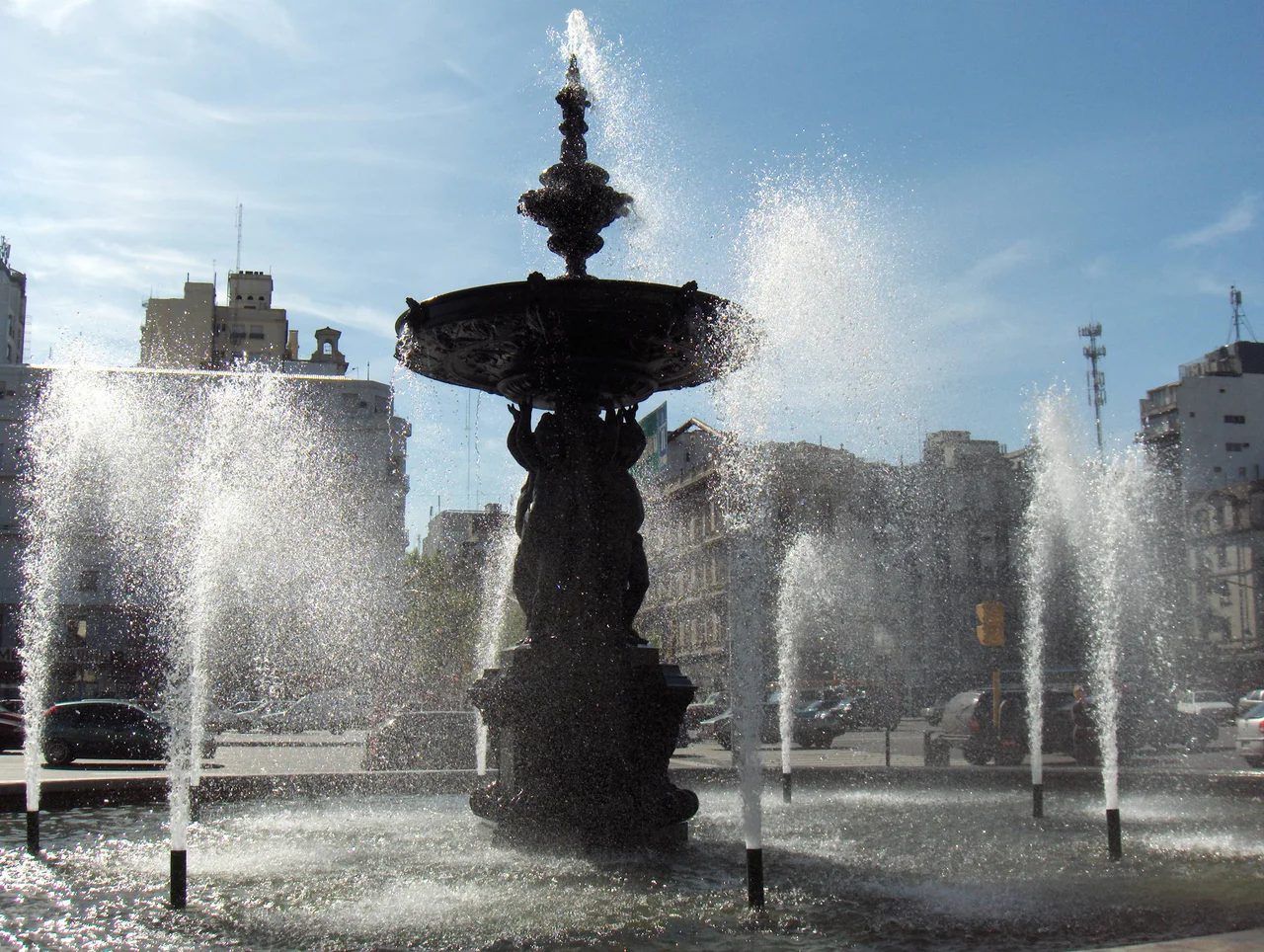
Walk the Avenida de Mayo and you could be forgiven for thinking you had wandered out of South America entirely. Wrought-iron balconies, Art Nouveau cupolas, and grand stone façades line both sides of the boulevard, and the cafés have the unhurried air of old Madrid. That was exactly the point. When Buenos Aires laid out this avenue in the 1880s and '90s, the city was rich, ambitious, and determined to look European - and it built itself a Parisian-style boulevard to prove it. The avenue connects two centers of power, the presidential Casa Rosada at one end and the National Congress at the other, in a straight, ceremonial line just a kilometer and a half long.
A Boulevard Cut to Order
Most grand avenues are made by widening a street that already exists. The Avenida de Mayo was different: it was driven straight through existing city blocks, a deliberate incision designed by the municipal public works director Juan Antonio Buschiazzo. Begun in 1885 under Mayor Torcuato de Alvear and completed in 1894, it required tearing down part of the historic Cabildo - the colonial town hall where, in 1810, the assembly that launched the May Revolution had met. That revolution gave the avenue its name. To keep the boulevard handsome, the city imposed strict architectural zoning, capping building heights and even commissioning Buschiazzo to design some of the structures himself. The financial Panic of 1890 forced a rollback of the most ornate plans, but the avenue that emerged was unlike anything else in the Americas.
The Skyscraper That Hides a Poem
Two-thirds of the way along stands the Palacio Barolo, and it conceals one of the strangest design secrets of any building in the world. Completed in 1923 by the Italian architect Mario Palanti, it was the first structure granted an exception to the avenue's height limits and briefly the tallest building in all of South America. Its proportions are not arbitrary: the whole tower is a model of Dante's Divine Comedy. It rises exactly 100 meters, one meter for each canto of the poem, across 22 floors. The basement and ground floor evoke Hell, the middle stories Purgatory, and the lighthouse-crowned summit Heaven. An immigrant's fortune, built into a vertical reading of medieval verse, standing over a Buenos Aires sidewalk.
Where the City Still Gathers for Coffee
At number 825 sits the Café Tortoni, the oldest café in Argentina. Founded in 1858 by a French immigrant and named for a famous café on the Boulevard des Italiens in Paris, it moved to the Avenida de Mayo in 1880 and never left. Beneath its stained-glass ceiling and marble-topped tables, generations of writers, musicians, and politicians have argued and dreamed - the tango singer Carlos Gardel, the writers Jorge Luis Borges and Julio Cortazar among them. To sit there with a coffee and a plate of churros is to share a room with the ghosts of Argentine culture, in a setting that has changed remarkably little in over a century.
A Street Preserved in Time
The Avenida de Mayo has barely changed since it was built, by design and by law. Its only major alteration came in 1937, when a single block was demolished so the colossal Avenida 9 de Julio could cross it - the two avenues now meet at a junction marked by a statue of Don Quixote, another nod to the Spanish heritage written into the street. Beneath the avenue runs a piece of history too: the first stations of the Buenos Aires subway, opened in 1913, were the first underground railway anywhere outside the United States and Europe. In 1997 the entire avenue was declared a National Historic Site, freezing its façades, marquees, and signs in place. To walk it now is to walk a preserved fragment of the optimistic, European-facing city that Buenos Aires once set out to become.
From the Air
The Avenida de Mayo runs east-west through downtown Buenos Aires near 34.609S, 58.379W, forming a short, straight axis between two landmarks easily picked out from the air: the Plaza de Mayo with the pink Casa Rosada at its eastern end, and the domed National Congress building at its western end. The Palacio Barolo, with its distinctive crowning lighthouse cupola, breaks the skyline midway along. The avenue crosses the broad pale ribbon of the Avenida 9 de Julio roughly at its center. The nearest airport is Aeroparque Jorge Newbery (ICAO SABE) on the riverfront about 3 km to the northeast; Ezeiza/Ministro Pistarini International (ICAO SAEZ) lies about 30 km to the southwest. This is the heart of the city and sits beneath SABE's approach corridor, so any low sightseeing pass should remain well clear of that traffic. Clear winter mornings give the crispest view down the boulevard from Casa Rosada to Congress.
Nearby Stories
- Ezeiza Massacre 1.9 km away
- Luján, Buenos Aires 5.1 km away
- Curutchet House 13 km away
- Colonia del Sacramento 17 km away
- Martín García Island 28 km away
- Atucha Nuclear Power Plant 37 km away
- Lobos 43 km away
- Cry of Asencio 87 km away