
Bailiffgate Museum
The Rothbury Football is about the size of a large handball, leather, stuffed with hay, scuffed by centuries of use. It was kicked between two Northumbrian villages, Thropton and Rothbury, in a contest with no clear rules and only two goals: the Thropton Bridge and the porch of the Rothbury Parish Church. The History of the North East in 100 Objects project named it one of its hundred items in 2013, and named it again on the renewed list in 2018, which is unusual for a hay-filled lump. You can see it on display in a converted church at the top of Bailiffgate in Alnwick, where a volunteer-run museum keeps the social history of north Northumberland in two thousand square feet.
A Church Becomes a Museum
The Bailiffgate Museum occupies St Mary's Church, a building completed in 1836 in one of the oldest quarters of Alnwick, a few steps from the Bailiffgate entrance to the castle. The original organ still sits where it always sat. The pews are gone. In their place, glass cases hold the everyday objects of the surrounding villages: agricultural tools, domestic items, railway memorabilia from the line that closed in 1968, coal-mining artefacts, printing presses, and hundreds of photographs of people whose names the museum has spent years gathering. A rare eighteenth-century fire pump occupies one corner. A display about RAF Boulmer, the nearby airfield that still tracks aircraft for the Royal Air Force, anchors another. The museum is staffed by volunteers and trustees, and it has the focused, slightly defensive quality of every small museum that has fought for funding.
The Davison Bible
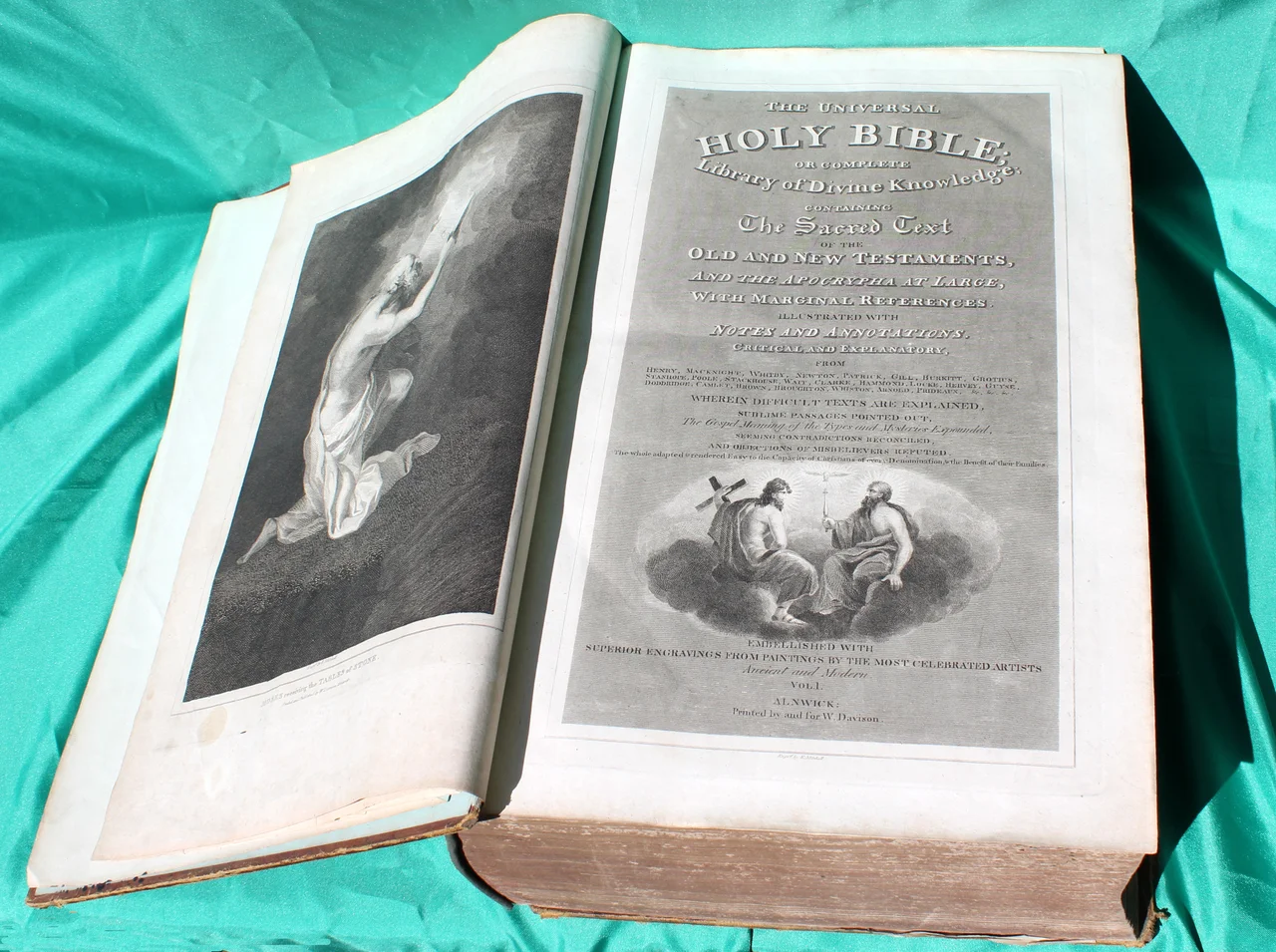
William Davison, born in Alnwick in 1781, was a pharmacist who became a publisher and a progressive reformer, and who set out to make the Bible affordable to working-class readers. His solution was the Universal Holy Bible or Complete Library of Divine Knowledge, published not as a single ruinous volume but in one hundred instalments at a shilling each. One of the surviving copies sits in a Bailiffgate Museum case, identified in 2013 as one of the Top 100 objects of north-east history. The thinking behind it was simple. Most working families could not afford a printed Bible. They could afford a shilling at a time. Davison's part-work edition, packed with footnotes and commentary, was one of the early experiments in selling books to people who had previously been priced out of them, and his press was one of the engines that made Alnwick briefly a centre of provincial printing.
Stella Vine Paints Her Past
Stella Vine, born in Alnwick in 1969, became one of Britain's most discussed contemporary artists in the early 2000s after Charles Saatchi began buying her paintings. In 2004 she donated three works to the Bailiffgate Museum, two of them autobiographical. The Rumbling Kern, painted in 2003, shows the rocky shoreline near Howick beach where Vine spent childhood holidays. 27 Clayport Gardens, from 2004, shows the painter herself as a baby in a pram outside her grandmother's house in Alnwick. The third painting, Belle, takes Catherine Deneuve from the 1967 Bunuel film Belle de Jour and surrounds her with collaged ribbon and a small cut-out bee. The Vine paintings make the museum unusual: a small local history collection that also holds work by an artist whose pieces have hung in the Tate.
A Town's Memory
Beyond the headline objects, the Bailiffgate runs a digital collection at bailiffgatecollections.co.uk that includes a searchable database of all 1,300 local men killed in the First World War. The numbers are deliberately not summarised. Each name has its own entry, its own street, its own surviving photograph where one exists. Hundreds of old portraits, including some of the earliest taken in the town, are scanned and posted. For a museum that fits inside a single converted church, the reach is large. It is the kind of small institution that does the patient, decades-long work of remembering a town's ordinary people, which is something the much larger castle next door has never really tried to do.
From the Air
The Bailiffgate Museum sits at 55.42 degrees north, 1.71 degrees west, in Alnwick's old quarter just north-west of the castle keep. From the air it is hard to single out the museum building from neighbouring nineteenth-century houses, but the church's small steepled roof and proximity to Alnwick Castle's outer wall make it findable. Newcastle International (EGNT) is roughly 35 miles south. The A1 trunk road runs just west of town. Best viewing at low altitudes in clear conditions, when the medieval street pattern of Bailiffgate and the castle's grey curtain walls are clearly visible.
Nearby Stories
- Ashington 1.8 km away
- Cheviot Hills 3.4 km away
- Battle of Nesbit Moor (1402) 12 km away
- Hadrian's Wall Path 18 km away
- Berwick-upon-Tweed Lifeboat Station 27 km away
- Saltburn Pier 68 km away
- German submarine U-2367 84 km away
- Alexander L. Kielland (Platform) 271 km away