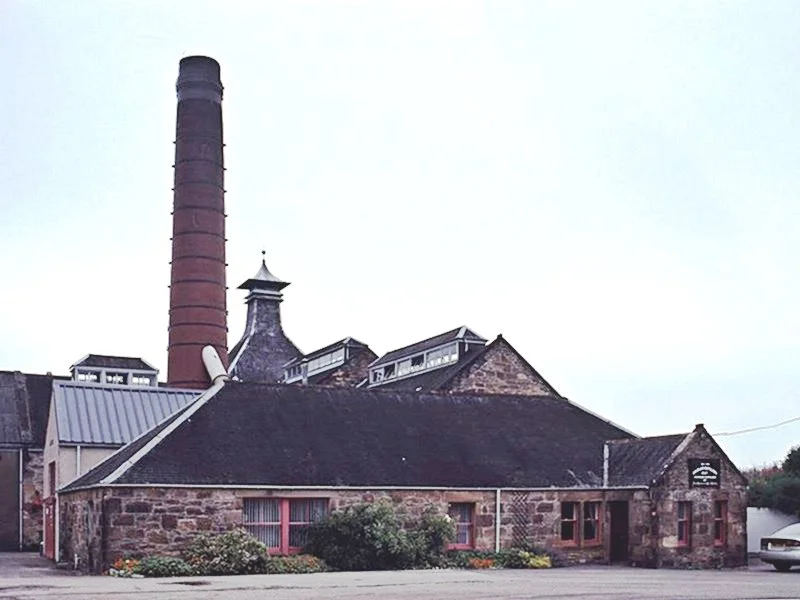

Balblair Distillery
The first entry in Balblair's ledger is dated 25 January 1800 and reads: "*Sale to David Kirkcaldy at Ardmore, one gallon of whisky at £1.8.0d*." John Ross himself wrote it. Ross had founded the distillery a decade earlier, in 1790, just outside Edderton at the edge of the Dornoch Firth, and he kept his books with the unfussy precision of a man who expected the operation to outlast him. It has. Two hundred and twenty-six years after that first sale to David Kirkcaldy, Balblair is still distilling whisky in the same village from water drawn from the same burn.
The Ault Dearg Burn
Almost every Scottish distillery has a water story, but Balblair's is unusually literal. The original site, established by Ross in 1790, drew its water from the Ault Dearg - Gaelic for "red burn" - which rises in the hills above Edderton and runs cold and peat-stained through the parish. By the late 19th century, the railway changed everything. In 1895, the famous distillery architect Charles C. Doig rebuilt Balblair on a new site, closer to the Edderton railway station on the Inverness and Ross-shire Railway line. There was a perfectly serviceable burn at the new site. The distillery ignored it. The water from the Ault Dearg was simply too good to abandon, and so the new buildings were plumbed back to the old source. That same water still feeds the mash tuns today.
Five Generations of Ross
John Ross ran the distillery until 1824, when his son Andrew joined him - the kind of quiet succession that defined most small Highland businesses of the era. The Ross family kept the tenancy until 1894, when Alexander Cowan took over. Decades of ownership changes followed: the Cumming family ran it until 1970, when they sold to Hiram Walker, the Canadian distilling giant. Today Balblair belongs to Inver House Distillers. What survived all the corporate transitions is the archive: one of the oldest distilling archives in Scotland, beginning with that 1800 ledger entry. For a small Highland distillery to have unbroken records going back to the Napoleonic Wars is itself an act of preservation.
Vintage, Then Age Statement
For most of its modern history, Balblair did something unusual in the whisky industry: it released its single malts by vintage, like wine, rather than by age statement. A bottle of Balblair would tell you the year the spirit was distilled, and you could calculate the age yourself. That changed in April 2019, when the distillery moved to a core range of age-statement whiskies: 12, 15, 18, 21, and 25 year olds. The vintage releases still surface occasionally on the secondary market and at the visitor centre. Whichever expression you choose, the character is recognisably Balblair - relatively light for a Highland malt, with apple-and-citrus brightness and a maritime salinity from the firth air that ages the casks.
The Angels' Share
In 2012, Ken Loach used Balblair as a filming location for *The Angels' Share*, his Cannes Jury Prize-winning comedy about a group of young Glaswegian offenders who plan a whisky heist. The film took its title from the portion of whisky that evaporates each year through the cask walls - roughly two percent, a tribute paid to invisible drinkers. After the film, Balblair opened a visitor centre in its former malting building. The tours begin there, walking through the mash tun and washbacks to the old still house, where you can see the copper pots that have been quietly turning Ault Dearg water and Highland barley into amber spirit for the better part of three centuries.
From the Air
Balblair Distillery sits at 57.84°N, 4.18°W in Edderton, about 4 miles west of Tain on the south shore of the Dornoch Firth. From cruise altitude, look for the distinctive double inlet of the Cromarty and Dornoch firths north of Inverness (EGPE), 40 miles to the south. Edderton is the small village inland from the firth shoreline, identifiable by the line of the disused Inverness and Ross-shire Railway running parallel to the A9. The distillery's white-painted buildings and pagoda-roofed kiln (now decorative) make it visible from 1,500-3,000 ft AGL. The Ault Dearg burn descends from hills to the south. Best viewed in clear weather; sea fog can roll in from the Moray Firth.
Nearby Stories
- North Coast 500 5.8 km away
- Pluscarden Abbey 7.7 km away
- Fort George, Highland 8.2 km away
- Conon Hydro Scheme 12 km away
- Caithness and Sutherland Peatlands 19 km away
- Moray Firth 19 km away
- Hill o' Many Stanes 24 km away
- Kylesku Bridge 28 km away