
Ballana
The archaeologists could not read the names of the kings they had found. When the British excavator Walter Bryan Emery opened Tomb 118 at Ballana in the early 1930s, the roof of the burial chamber had collapsed and the looters had never gotten in. On a wooden bier lay the body of a man wearing a silver crown on his head. Beneath him were a large gaming board, his weapons, and an iron folding chair. Nearby were the skeletons of a young male servant who had been killed for the burial and a cow that had been sacrificed with him. In the two side chambers lay the bones of more servants and piles of bronze lamps and Mediterranean trade pottery. What Emery had found was a royal Nubian grave from a culture that left almost no written records about itself. We know who built these tombs only because the objects inside describe a kingdom nobody today can quite name.
Between Two Kingdoms
The 122 tombs of Ballana belong to a specific gap in Nubian history. The old Kingdom of Kush, with its center at Meroe further upriver, had collapsed by the early fourth century CE. The Christian Nubian kingdoms of Nobatia, Makuria, and Alodia would not fully form until after 550 CE. For about two and a half centuries between these states, a culture flourished in Lower Nubia that archaeologists called the X-Group because they did not know what else to call it. After Emery's excavations at Ballana and nearby Qustul between 1929 and 1934, the culture was renamed Ballana Culture. It is widely assumed today that these tombs belong to the kings and court of Nobatia, the earliest of the three Christian kingdoms, but no inscription names anyone in them. The identification rests entirely on the grave goods.
Crowns of the Nameless Kings
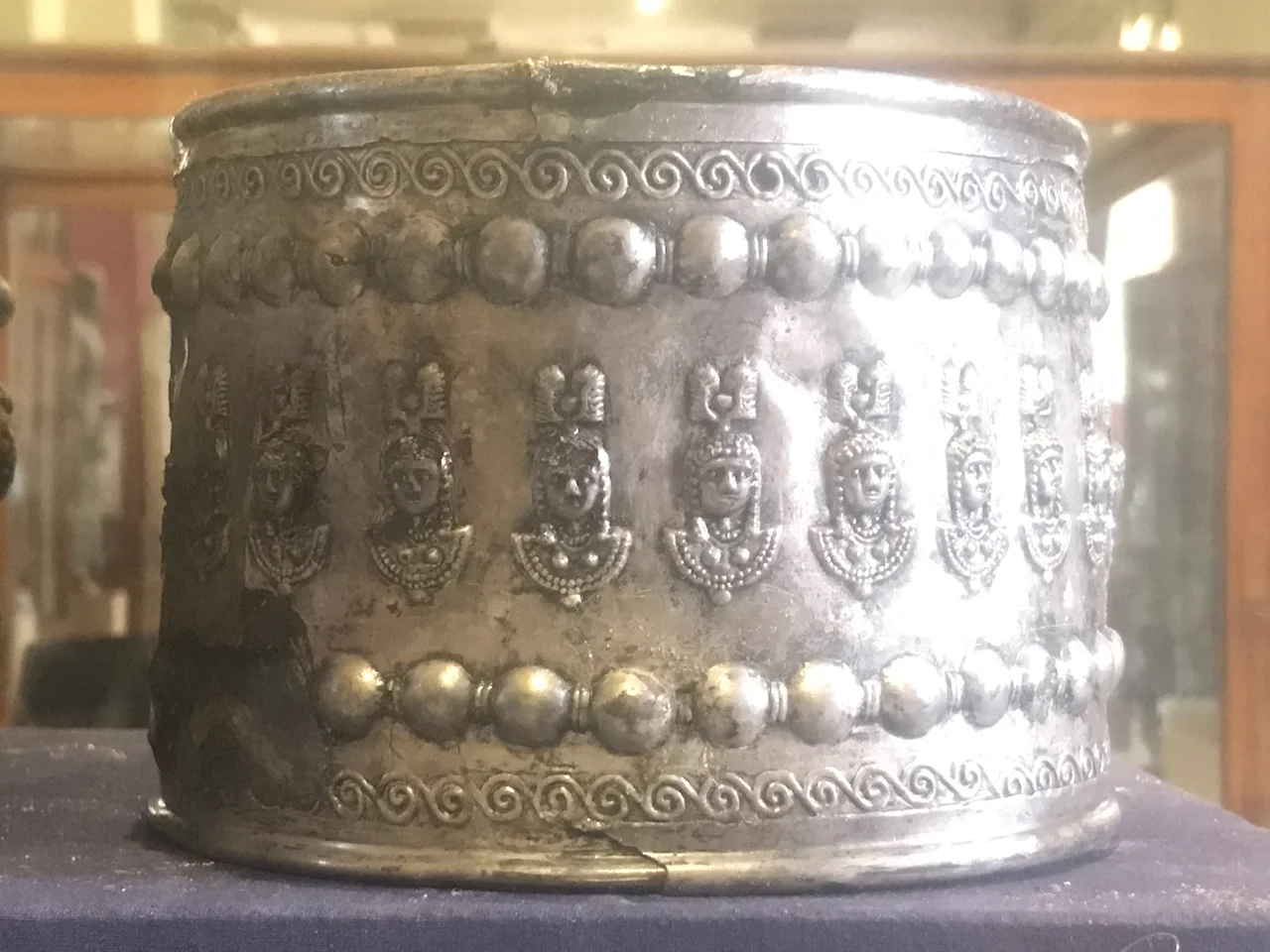
The most dramatic finds at Ballana were the crowns. Each royal tomb contained at least one, several tombs held multiple. Silver, inlaid with semiprecious stones, mounted with plumes and solar disks that echoed both pharaonic Egyptian iconography and the later Christian crowns of Nubia, these objects announced that the Ballana culture was ruled by something more than tribal chieftains. It had kings. It had queens, because some of the crowns were designed for female heads. The objects themselves mix Nubian forms with goods imported from Byzantine Egypt: bronze lamps from Alexandrian workshops, glass vessels from the eastern Mediterranean, pottery from across the late Roman world. The Ballana rulers were participants in international trade even as they built tombs in the old Nubian royal tradition.
Buried Companions
The tombs contain a grim detail that complicates the picture. Servants were killed and buried alongside their rulers. Horses were killed and buried with their riders. This was a practice that had been common across the ancient Near East and parts of Africa but had fallen out of use in most places centuries before Ballana. The servants, most of them young men, were real people with families and futures who were chosen to die because of the position they held in life. Their deaths give us information about the Ballana kings that the crowns do not: these were rulers who commanded not just the loyalty of their subjects but their lives. The bones of the servants lie now in museum archives, but the people themselves should be remembered as people, not just as grave goods that happened to be human.
Saved and Lost
Walter Bryan Emery dug at Ballana and Qustul between 1929 and 1934 as part of a rescue project before the Aswan Low Dam was raised. The raising of the dam would partly submerge the Nubian archaeological landscape, and the team worked to document and remove what could be saved. Everything Emery published, he published in Cairo in 1938 in a book called The Royal Tombs of Ballana and Qustul. What he could not remove was eventually buried by Lake Nasser, which rose still higher when the Aswan High Dam was completed in 1970. The Ballana tombs themselves are now submerged. The crowns are in the Cairo Egyptian Museum and the Nubian Museum in Aswan. The landscape that shaped these kings is invisible from the surface of the water.
What the Empire Forgot
There is a tendency in ancient history to treat Nubian civilizations as Egypt-adjacent, as provinces or frontier zones or tributaries. Ballana argues against that reading. This was a kingdom that produced its own distinct royal crowns, ran its own economy, buried its dead in its own traditions, and traded on its own terms with the Byzantine world. The fact that we know its rulers only from objects is not evidence of insignificance. It is evidence of erasure. Nubian writing systems have survived poorly. Later Christian and Islamic periods built over older layers. What Emery pulled from the desert in three seasons of frantic excavation is most of what we have left of the Ballana kings. Their tombs, and the silver that marked them as sovereign, now sit behind museum glass at 22.27 north, the coordinates of a cemetery that no longer exists.
From the Air
Located at 22.27 N, 31.57 E on what was the west bank of the Nile in Lower Nubia, now fully submerged beneath Lake Nasser. Nearest airport: Abu Simbel Airport (ICAO HEBL), approximately 10 km to the south. From cruise altitude the site is visible only as open reservoir water; the excavated tombs and their grave goods are now in museums in Cairo and Aswan.
Nearby Stories
- Buhen 20 km away
- Qasr Ibrim 57 km away
- Kulb 105 km away
- Kulubnarti 135 km away
- Temple of Dendur 139 km away
- Bi'r Tawīl 180 km away
- Bir Tawil 184 km away
- Kharga Oasis 308 km away