.jpg)
Buhen
The horse was the surprise. When the British Egyptologist Walter Bryan Emery was excavating the Middle Kingdom fortress at Buhen in 1958 and 1959, his team uncovered a skeleton that changed what we thought we knew about the ancient Near East. A horse, buried carefully under what had been a stable in the fortress compound, and dated to somewhere before 1650 BCE, before the Hyksos were supposed to have introduced horses to Egypt. The Buhen Horse is now on loan from the Khartoum Museum to the Department of Egyptology at University College London. It is the oldest horse skeleton found in Egypt or Sudan, and it sat inside the walls of a fortress that had already been old for hundreds of years when someone dug its grave.
A Copper Town Before It Was a Fort
Long before the fortress, Buhen was a colonial Egyptian town built for copper production. In the Old Kingdom, roughly between 2686 and 2181 BCE, Egyptian workers under pharaohs of the Fourth and Fifth Dynasties came here to smelt copper at what archaeologists describe as an ancient copper factory. Excavators in 1962 found furnace slag containing iron impurities from ferruginous flux, plus crucibles, andirons associated with smelting, atacamite copper ore, and later atacamite laced with gold. The workers probably came with Egypt's expansion under Sneferu of the Fourth Dynasty, though evidence shows earlier Second Dynasty occupation. They stayed about two hundred years. Graffiti and inscribed objects suggest the Egyptians were pushed out late in the Fifth Dynasty, probably by immigration from the south. After that, Buhen was Nubian again for the better part of a thousand years.
A Chain of Signal Forts
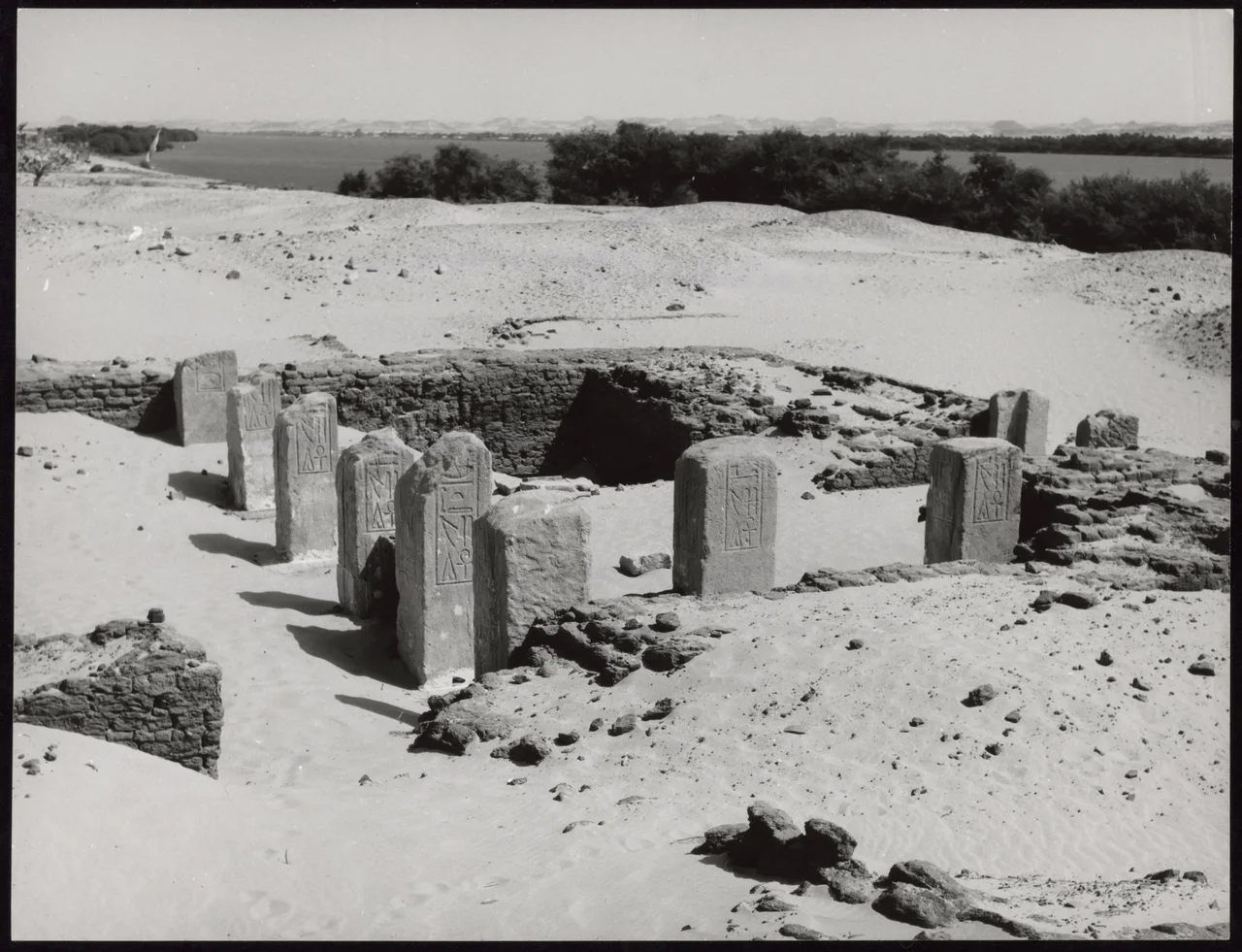
Around 1850 BCE, during the Middle Kingdom, pharaoh Senusret III conducted four campaigns into Kush and built a line of fortresses along the Second Cataract of the Nile. Each fort was placed within signaling distance of the next. Buhen was the northernmost. Heading south, the chain ran through Mirgissa, Shalfak, Uronarti, Askut, Dabenarti, Semna, and Kumma. Buhen's walls were massive by any standard, with a primary wall three to five meters thick set on a natural rock foundation that amplified the defensive advantage. Inside sat a single entrance in the western corner, leading through anterooms to a grand hall of fifteen pillars, a second hall of six pillars, and a series of smaller chambers. Unlike most Egyptian fortress walls, which were timber and mud brick, Buhen's were substantial stone.
Captured and Recaptured
Egypt did not hold Buhen forever. During the Thirteenth Dynasty, when Egyptian central power collapsed into the Second Intermediate Period, the Kushites captured the fortress and held it as part of their own kingdom. Buhen became a Kushite garrison, and Nubian leaders like Nedjeh are documented in stelae found at the site. Only when Ahmose I expelled the Hyksos from Lower Egypt at the beginning of the Eighteenth Dynasty, around 1550 BCE, did Egyptian power return to Buhen and to the Second Cataract more broadly. The new Egyptian administration rebuilt the fortress and added temples. A Horus temple that later stood at Buhen is now in the Sudan National Museum in Khartoum, having been relocated during the UNESCO salvage campaigns of the 1960s.
Workers and Metal
The most striking thing about Buhen is how much it tells us about ancient labor. In the Middle Kingdom, the people occupying the fort were mostly Egyptians directed south from Lower Egypt on rotating assignments. They cycled through rather than settling permanently. But they needed skilled metallurgists. Samples of copper ore fragments, crucible pieces, smelted copper metal, and slag collected at Buhen were sent to the Petrie Museum of Egyptian Archaeology at University College London for analysis. El Gayar and Jones at the Royal School of Mines conducted the work. What they found indicates that Egypt imported both workers and technique to Buhen to extract the copper that was driving the economy of Senusret's reign. The Nile Valley had iron oxide in abundance to serve as flux. Local timber in the Old Kingdom supported charcoal production for furnaces, though by the Middle Kingdom the forests had thinned. Copper from Buhen moved back down the Nile into the Egyptian economy as household tools, knives, and hoes.
Under Lake Nubia
Buhen is now underwater. The Aswan High Dam, completed in 1970, flooded the entire Second Cataract region and all of Lower Nubia along with it. The fortress that had guarded Egypt's southern frontier for nearly two thousand years, that had been captured by Kushites and recaptured by Ahmose, that had hosted the oldest known horse in Egypt, now lies beneath the waters of what Egypt calls Lake Nasser and Sudan calls Lake Nubia. What could be saved was removed before the flood. The Horus temple is in Khartoum. The horse is in London. A funerary stele of Sebek-dedu and Sebek-em-heb sits in the Egyptian Museum in Leipzig. What remains at the coordinates 21.92 north, 31.28 east is open water, and the knowledge that nearly four millennia of Nubian-Egyptian history is now silent beneath it.
From the Air
Located at 21.92 N, 31.28 E on what was the west bank of the Nile near the Second Cataract, now submerged beneath Lake Nubia (the Sudanese name) / Lake Nasser (the Egyptian name). Nearest airport: Wadi Halfa Airport (ICAO HSSW) in Sudan, or Abu Simbel Airport (ICAO HEBL) across the border in Egypt. From cruise altitude the site is open reservoir water; the excavated temple and grave goods are now in the Sudan National Museum, Khartoum.
Nearby Stories
- Nabta Playa 16 km away
- Uronarti 17 km away
- Lake Nasser 45 km away
- Meinarti 68 km away
- Qasr Ibrim 93 km away
- Battle of Ginnis 119 km away
- Dar al-Manasir 304 km away
- Kharga Oasis 345 km away