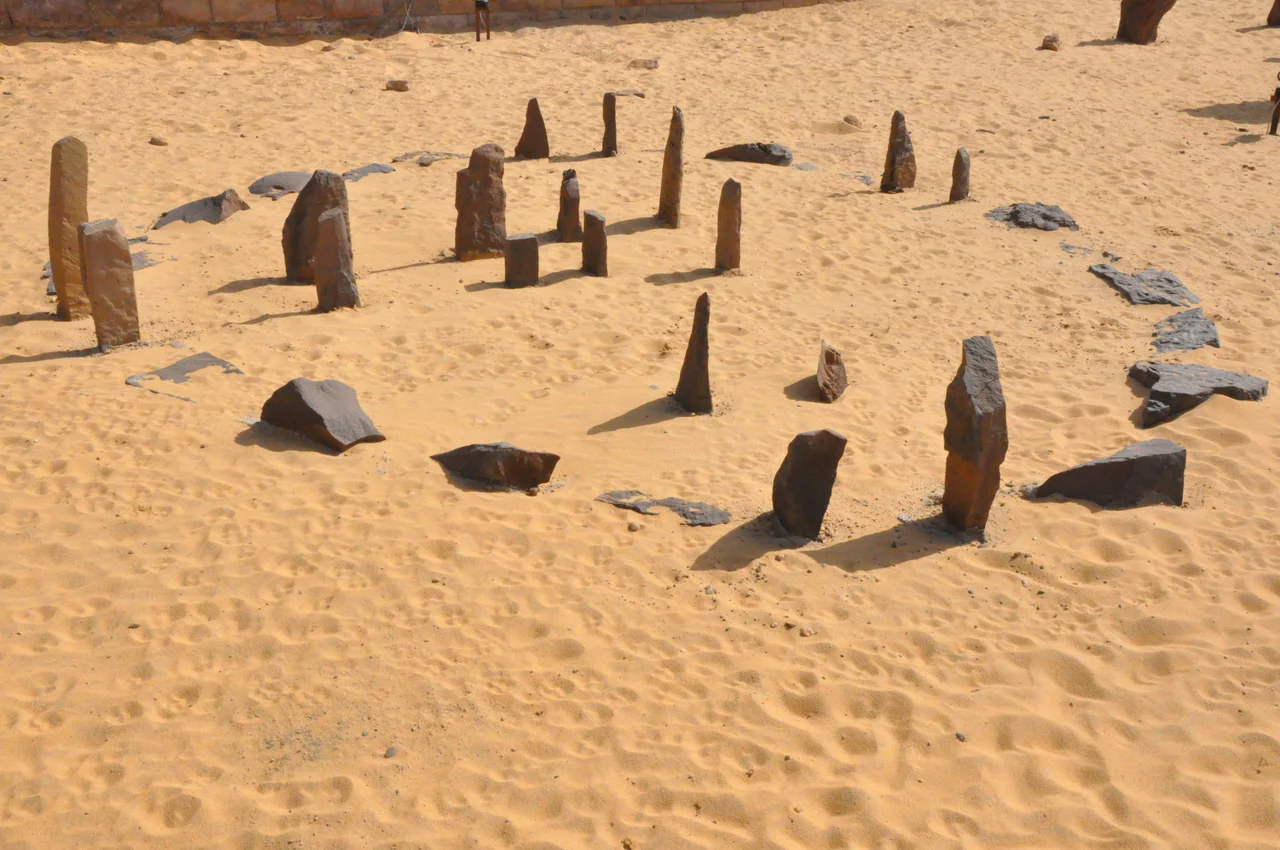

Nabta Playa
The stones are not spectacular. You could walk past them thinking they had rolled off a truck. But arrange them as the builders did around 4800 BCE and some of the slabs line up approximately with the sunrise on the summer solstice -- which was also, at this latitude, the beginning of the rainy season that filled the playa and brought the herds. Nabta Playa sits about 100 kilometers west of Abu Simbel in what is now the most desolate stretch of Egypt's Nubian Desert. When the stones were raised, this was grassland. Cattle grazed where now there is nothing but sand. The people who moved these stones had been organizing their lives here for thousands of years already, and they were African herders, most likely Nilo-Saharan speakers, building what may be among the earliest known astronomical structures of any culture anywhere in the world.
When the Sahara Was Green
The Sahara has oscillated between wet and dry for hundreds of thousands of years. Between roughly 10,000 and 6,000 BCE, during what scientists call the African Humid Period, monsoon rains reached far north into what is now hyperarid desert. Savanna grasses, trees, lakes, and the animals that depended on them occupied lands that today receive essentially no rainfall. Buffalo, giraffes, antelope, and gazelle ranged where nothing larger than a beetle lives now. By the tenth millennium BCE, Nabta Playa was a temporary lake -- a playa, an endorheic basin that filled during seasonal rains and held water for weeks or months before drying again. Human settlement followed the water. By the seventh millennium BCE, larger communities had established themselves here, drilling deep wells to supplement the playa, building large hearths, and producing pottery decorated with elaborate combed patterns that are diagnostic of an early Saharan artistic tradition.
Cattle and the Sacred
Michael Brass's research indicates that the earliest cattle remains at Nabta were wild aurochs, hunted by the Neolithic inhabitants. Domesticated cattle arrived in northeast Africa later, in the late seventh millennium BCE, originating from herds first domesticated in the Euphrates valley. Cattle at Nabta were not just food. They were buried. Starting around 5500 BCE, a new and more organized group began placing cattle in clay-lined burial chambers and building tumuli over them -- mounds of earth and stone marking specific animals as significant enough to merit mortuary treatment. The parallel with later Egyptian religious practice is striking. Cattle cults run through East African and Nile Valley traditions across millennia. The Egyptian historian H.A.A. Ibrahim has examined Nabta's megalithic complex and concluded that the structures resemble comparable stone arrangements in the Sahel and sub-Saharan Africa, linking Nabta to broader African religious traditions rather than isolating it as a precursor to dynastic Egypt alone.
The Calendar Circle Debate
The most famous feature at Nabta is a small stone circle arranged with what appear to be narrow upright slabs. Some researchers have argued it functioned as a calendar -- specifically that certain sight lines align with the summer solstice sunrise. Thomas Brophy went further, proposing correspondences with Orion's Belt at two separate epochs and ambitious alignments with Sirius, Arcturus, and Alpha Centauri. The astronomer J. McKim Malville and archaeologist Romuald Schild, who led the main excavations, pushed back hard. They argued that the dates Brophy proposed -- around 6270 BCE -- were roughly 1,500 years earlier than the best archaeological estimates for the megalithic construction. Close inspection revealed that some alignments Brophy identified consisted of stones resting on dune surfaces that had shifted since placement. Malville and Schild proposed more modest conclusions: a regional ceremonial center around 6100 to 5600 BCE, a stone circle approximately aligned with the summer solstice built around 4800 BCE, and a period of more complex construction between about 4500 and 3600 BCE featuring possible alignments with bright stars.
The Necropolis Function
Whatever else Nabta was, it functioned as a sacred space where people gathered from considerable distances. The cattle bones accumulated around the dunes surrounding the playa indicate slaughter on a scale consistent with ceremonial feasts rather than ordinary consumption. Cattle were normally killed only on important occasions. The repetitive orientation of megaliths, stele, human burials, and cattle burials reveals what Malville called a very early symbolic connection to the north -- a consistent directional awareness encoded in how the community organized its landscape. This was a regional gathering place, a necropolis, a ceremonial center, and possibly an astronomical observatory. It was built by African herders whose descendants, whose language, and whose cattle would shape the civilizations of the Nile Valley in the millennia that followed.
Older Than Stonehenge
The claim most often attached to Nabta Playa is that it predates Stonehenge by almost 2,000 years. The comparison matters not because Stonehenge is the measure of anything but because the ancient monumental astronomy of Europe has for centuries been treated as the standard against which other traditions are judged. Nabta upends that framing. African peoples watched the sky, tracked the solstices, and built stone arrangements to mark celestial rhythms long before most of the world's more famous examples. The site is currently assessed by UNESCO as one of Egypt's archaeoastronomical locations, with hypothetical solar and stellar alignments. When the monsoon retreated after 3500 BCE and the Sahara dried into the desert it is today, the cattle-herders left. The stones remained, waiting to be found. The people who built them are often described as the ancestors, biologically and culturally, of the dynastic Egyptians who would eventually carve temples into cliffs a hundred kilometers to the east.
From the Air
Located at approximately 22.25 degrees north, 31.22 degrees east in the Western Desert of Egypt, about 100 km west of Abu Simbel and 800 km south of Cairo. Best viewed at 15,000 to 30,000 feet to appreciate the vast scale of the surrounding desert and the subtle topographic basin of the former playa. Nearest airports: Abu Simbel Airport (HEBL) to the east and Aswan International (HEBA) further north. Extreme desert conditions with intense heat, occasional dust storms, and essentially no infrastructure. The site itself requires 4WD ground access.
Nearby Stories
- Mirgissa 18 km away
- Lake Nasser 37 km away
- Qasr Ibrim 40 km away
- Meinarti 107 km away
- Battle of Ginnis 158 km away
- Temple of Dendur 212 km away
- Bi'r Tawīl 217 km away
- Kharga Oasis 306 km away