
Meinarti
The archaeologists had three years. William Yewdale Adams and his team began excavating in 1962, working against a deadline set by concrete: the Aswan High Dam was rising, its reservoir already creeping south, and the entire Nile valley north of the Second Cataract was scheduled to disappear. Meinarti was a small island near Wadi Halfa with an artificial mound rising twelve and a half meters above its surface, 175 meters long. Inside that mound were eighteen distinct occupation layers, each one the ruin of the village that preceded it, each one reduced to sand and built over. When Adams finished in 1964, his team packed the finds onto boats. By the end of the decade, Meinarti was underwater.
Six Lives in Mud Brick
The pattern was remarkably consistent: build a village from mud brick, live in it for a generation or two, abandon it when flood or dynastic upheaval made staying impossible, let the desert wind cover it, then build again on top. Six distinct phases of occupation emerged. The oldest, beginning around 30 BCE during the late Meroitic period of the Kushite empire, contained no houses at all -- just three substantial public buildings. One was a walled market compound with shops flanking a plaza. Another turned out to be the best-preserved wine press ever discovered in Nubia. The press was used only briefly before being filled with trash and covered over, probably after a devastating flood. Two centuries later, when Kush itself had collapsed, Meinarti was reoccupied -- this time as a cluster of small peasant dwellings belonging to the impoverished remnant kingdom of Ballana.
A Church With a Crooked Foundation
Around 650 CE, after Christianity had been introduced to Nubia, the island was resettled once more. Most of the new village was poorly preserved -- repeated flooding had eaten most of the walls down to 40 centimeters. But the foundations of Meinarti's first church emerged clearly: red cobblestone flooring with a white cross pattern at the center. The builders had somehow gotten the orientation wrong. The corners deviated from right angles by more than fifteen degrees. Almost immediately they rebuilt it on a corrected plan. That church became the only structure at Meinarti that persisted across multiple phases of occupation, modified repeatedly as sand accumulated around it, standing while everything around it was rebuilt, abandoned, and rebuilt again.
Prosperity Under the Fatimids
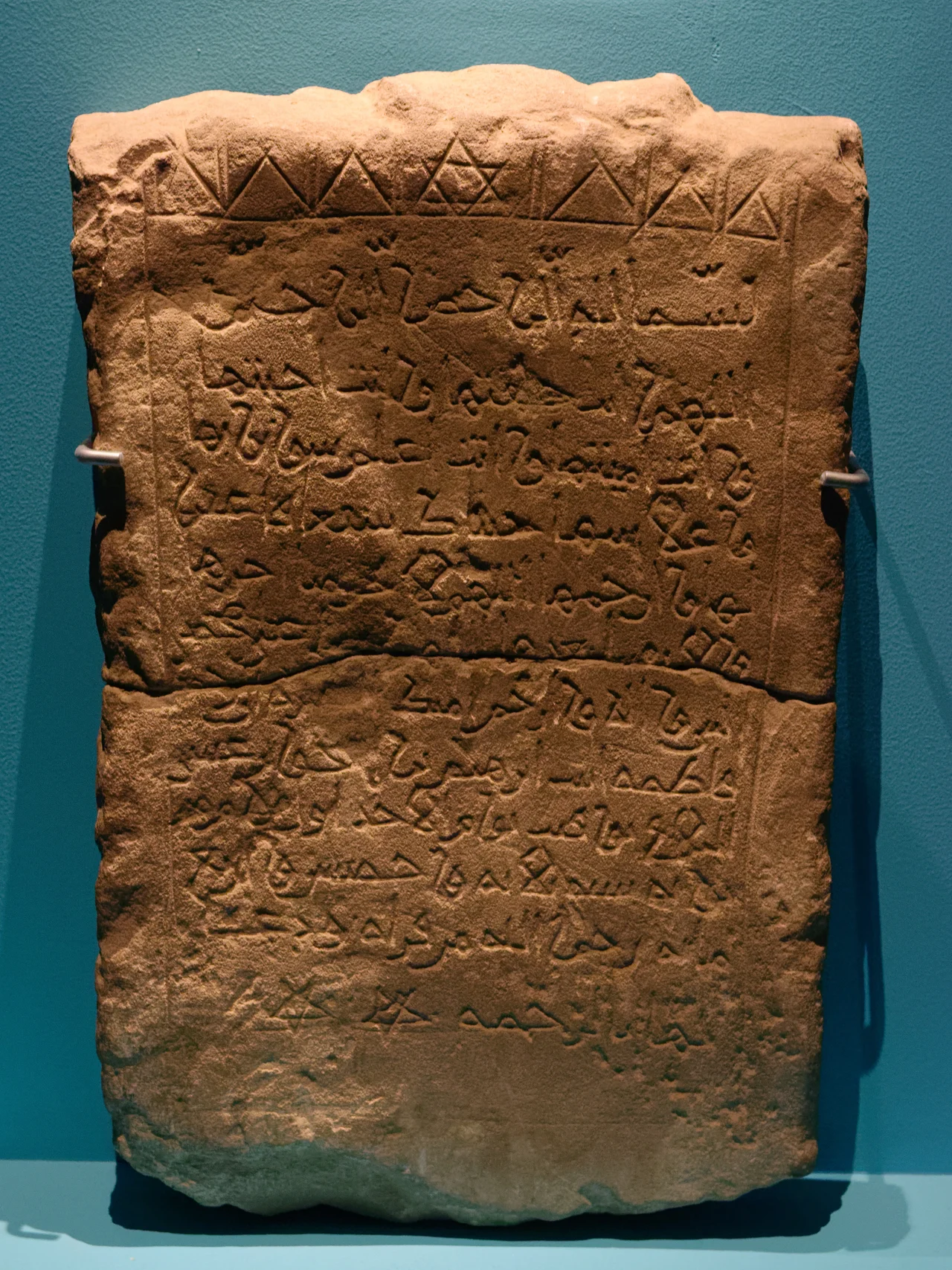
Phase 4 began around 950, during a period when Christian Nubia enjoyed unusually warm relations with Fatimid Egypt. The archaeological record reflects the prosperity directly. Houses were substantially larger than anything earlier. The typical dwelling had a sizable front room, one or two storerooms behind it, an L-shaped passageway, and at the back of the house -- this is what marks Meinarti as something special -- a latrine with a ceramic toilet fixture. No earlier Nubian site has produced anything comparable. One house, probably belonging to a local official, had whitewashed walls inscribed with protective prayers and a suite of four storerooms. These were the best-preserved buildings on the mound, some with original roofs still intact when excavation began. A century or two later this village too was abandoned, buried, and sealed away.
The Eparch's Residence
Around 1200, Meinarti took on strategic importance during a turbulent period that saw Crusader armies reshape the Eastern Mediterranean and Egyptian raids threaten northern Nubia. The Eparch of Nobadia -- the viceroy who governed the northern reaches of the Makurian kingdom from his usual capital at Qasr Ibrim -- began using Meinarti as a secondary residence. What Adams found from this phase was unlike anything earlier: a sprawling complex of more than eighty contiguous rooms, most of them small, built around a core of larger chambers with whitewashed walls and murals in red, yellow, and black. The paintings were abstract in a way the ones in Nubian churches were not. None of the rooms showed signs of daily residence. The entire complex was probably storage space for goods in transit through the cataract, plus chambers where the eparch could stay when he came downstream. In 1365, when a Mamluk invasion loomed, that same eparch ordered the evacuation of all of northern Nubia.
The Castle-House and the Drowning
The final occupation, beginning around 1400, left one massive building: a mud-brick castle-house with vaulted chambers, originally two stories tall. The upper floor held living space including toilets; the ground floor was pure storage, with some rooms accessible only through the roof. A Greek inscription on one wall read MICHAEL RAPHAEL GABRIEL, the archangels' names repeating around the chamber, attesting a Christian origin for a type of building that scholars had long assumed was Ottoman. Most castle-houses stood on islands, presumably for defense. Around 1500, Christian Nubian civilization ended. The building stayed in use into the Ottoman period. Around 1890 the Anglo-Egyptian garrison at Wadi Halfa cleared off the upper floor and installed a gun emplacement. That layer became Level 1 in Adams' system -- the top of the mound, the last thing built before the water came. The island, the mound, and eighteen centuries of stratified human presence now lie beneath Lake Nubia, preserved in detail only by the race that Adams and his team ran against the rising reservoir.
From the Air
Meinarti's location is at approximately 21.01 degrees north, 30.58 degrees east in the present Lake Nubia reservoir, just north of the former Second Cataract and upstream of Wadi Halfa. The island itself is now submerged. Best viewed at 10,000 to 20,000 feet to see the broad expanse of Lake Nubia / Lake Nasser. Nearest airports: Wadi Halfa Airport (HSSW) to the south; Aswan International (HEBA) far to the north across the Egyptian border. Clear desert flying conditions with occasional dust haze; extreme heat year-round.
Nearby Stories
- Semna (Nubia) 26 km away
- Soleb 35 km away
- Uronarti 58 km away
- Selima Oasis 60 km away
- Askut 82 km away
- Nubia 219 km away
- Northern State (Sudan) 350 km away
- Lake Ptolemy 438 km away