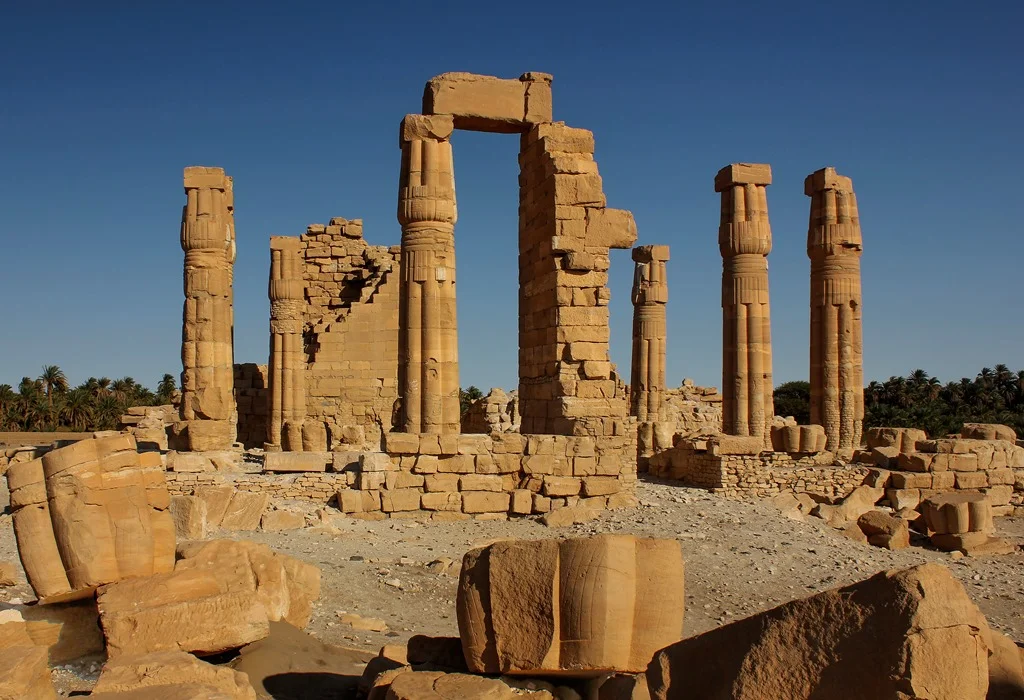

Soleb
On one of the columns in the hypostyle hall at Soleb, an Egyptian scribe around 1370 BCE carved three hieroglyphs that read, in transcription, ta shasu Yhwa - the land of the Shasu, those of Yhwa. The phrase became one of the most argued-over inscriptions in Egyptology. Some scholars, noting the resemblance of Yhwa to Yahweh, have suggested this is the earliest known reference to the Israelite god. Others consider the evidence too scanty. What is not in dispute is the temple itself: Soleb was the southernmost monumental temple Amenhotep III ever built, and its decorated columns were once covered with lists of all the peoples Egypt claimed to have conquered.
The Southernmost Temple
Soleb lies on the western bank of the Nile, north of the Third Cataract, in what is now Sudan. The German Egyptologist Karl Richard Lepsius first described the ruins scientifically in 1844, but his description rested on ground that had been visited for centuries before - the Italian Major Felix ran an expedition in 1829 and recognized the prisoner inscriptions on the columns as commemorations of Amenhotep III's victories. A large sandstone temple was founded here by Amenhotep III, probably with the architect Amenhotep, son of Hapu - the same figure who helped design the Colossi of Memnon at Thebes. The temple was consecrated to the god Amun-Re and also, crucially, to the pharaoh himself, shown deified with ram's horns. It was the southernmost temple Amenhotep built, marking the far reach of his religious and political ambition. Companion temples at Sedeinga, just downriver, honored his queen Tiye as a manifestation of the Eye of Ra.
When the Gods Changed
The story of Soleb is the story of Egyptian religion changing, mid-construction. Amenhotep III's son, Amenhotep IV, was initially shown at the temple worshipping his father alongside Amun. Then he changed his name to Akhenaten and launched one of the most radical religious revolutions in ancient history: he tried to abolish the cult of Amun and replace it with a single god, Aten, the sun-disk, who was to be worshipped in open-air sanctuaries. The Soleb temple was rededicated to Aten. Roofless chapels and open courtyards replaced covered sanctuaries. When Akhenaten died, his young successor Tutankhamun reversed all of this, restoring the old gods and returning the temple to Amun-Re. Tutankhamun finished a second granite lion at the site - one of the famous Prudhoe Lions, guardian figures originally set up as a pair by Amenhotep III. Tutankhamun inscribed his name on them. So did the next pharaoh, Ay. The lions now sit in the British Museum, where they have presided since 1835.
The Prisoner Lists
On the columns of the hypostyle hall, Amenhotep III's scribes carved lists of foreign peoples that Egypt claimed to have conquered. Three lists are preserved. Each shows a figure of a prisoner with his arms bound, carrying a shield inscribed with the name of his town or people. Historian Jude Flurry has pointed out that these lists may be exaggeration or outright propaganda - records of victories that did not happen the way the monument claims. But even if the conquests are fictional, the people named are real: the Shasu nomads, and specific Shasu groups associated with particular lands. The prisoners depicted are ordinary people, soldiers from Nubian towns and Levantine territories, reduced to bound figures on a decorative column. Each bound prisoner on the wall of Soleb stood for a real community the pharaoh wished to claim dominion over. The architecture insists on Egyptian triumph. The inscriptions insist the scribes knew who, specifically, they were talking about.
A Name in the Column
Among those Shasu names - ta shasu Trbr, ta shasu Smt - sits the contested ta shasu Yhwa. Thomas Schneider vocalizes the name as Yahwa. Fleming places the community in Palestine or Syria. Kennedy argues it logically follows that the Shasu of Yhwa might be identified with the Israelites, given the similarity to the name of their god Yahweh. Shalomi Hen considers the evidence thin. The Soleb inscription is not proof of anything about biblical history; it is a fragment, damaged and reused, in a temple that was itself partially torn apart and rebuilt by later pharaohs. But the fact that the name appears here, on a Nubian temple column carved more than three millennia ago, is one of those archaeological quietnesses that makes scholars' hands shake a little. The sand-covered sector IV of the hypostyle hall was only reconstructed during Michela Schiff Giorgini's 1957-1963 expedition, piece by piece, and its reassembled stones keep asking their questions.
From the Air
Located at 20.43N, 30.33E on the west bank of the Nile in Sudan's Northern State, north of the Third Cataract. Recommended viewing altitude: 2,000-4,000 feet AGL for views of the temple ruins on the Nile's west bank. The surviving columns and reconstructed sections of the temple are visible as rectangular stone features against the greenery of the floodplain. Nearest major airport is Dongola (HSSW), roughly 80 km to the southeast. The site sits at a bend where the Nile makes one of its signature elbows - a useful VFR landmark. Expect clear dry desert air year-round.
Nearby Stories
- Battle of Ginnis 12 km away
- Sabu-Jaddi 35 km away
- Semna (Nubia) 84 km away
- Selima Oasis 91 km away
- Uronarti 117 km away
- Nubia 163 km away
- Northern State (Sudan) 292 km away
- Lake Ptolemy 420 km away