
Askut
The pots tell you who lived here. Askut was built as an Egyptian military fortress on an island in the Nile, part of a chain of forts strung like signal beacons through Nubia by pharaoh Sesostris III around 1850 BCE. It was supposed to be a garrison, a way to hold a conquered frontier against the people whose land had just been taken. Inside the seventy-seven-by-eighty-seven-meter walls, you would expect to find evidence of Egyptian men doing Egyptian things. Instead, the excavators found Nubian cookpots. They found Nubian women making the food. They found, in the most intimate artifacts a community leaves behind, the story of how two peoples ordered to be enemies ended up sharing a kitchen.
A Chain of Forts
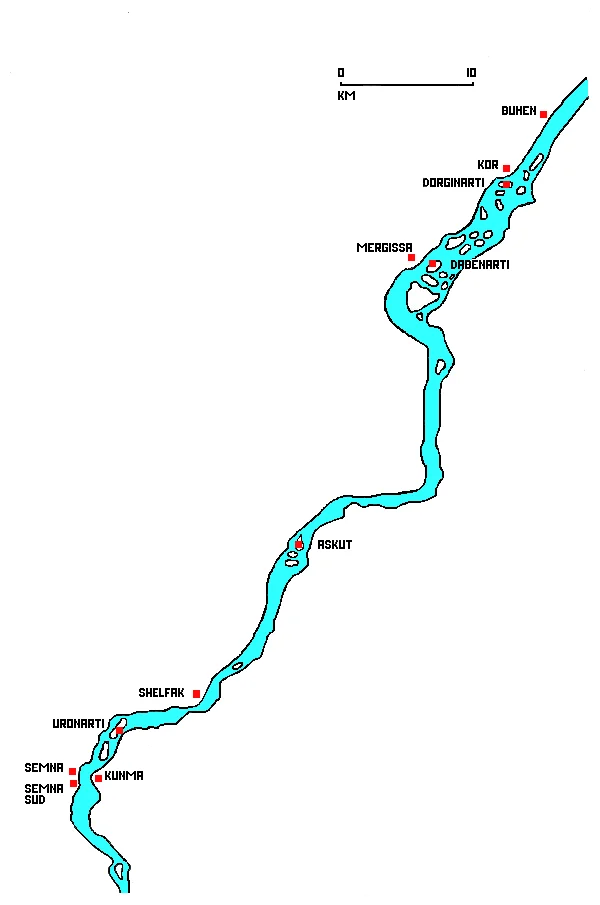
Sesostris III pushed Egyptian power deep into Nubia during his four campaigns south of the Second Cataract. Along the way he built a string of fortresses close enough that each could signal the next: Buhen at the northern end, then Mirgissa, Shalfak, Uronarti, Askut, Dabenarti, Semna, and Kumma. Askut was 351 kilometers south of Aswan, perched on a rocky island where the Nile ran narrow enough to make crossings controllable. The walls were five and a third meters thick, bristled with spur bastions, and funneled any approach through a single fortified entrance that screened a temple and warehouses from the harbor. Inside were a commander's house and barracks. Pottery dated to the early Thirteenth Dynasty shows the fortress was still occupied generations after its founders died. It was excavated in the 1960s by Alexander Badawy as part of the Aswan High Dam Salvage Campaign, a rescue operation before Lake Nubia drowned the site.
Life Inside the Walls
Over time the Askut garrison stopped looking like a garrison. The three-room barracks of the early Middle Kingdom were rebuilt into more individualized floor plans that could accommodate different sizes of families. Old military buildings turned into houses with central courtyards. The granary complex was abandoned and used as a trash dump. By the New Kingdom, a large part of Askut had transformed into a single dominant residence surrounded by rooms, suggesting that the community rearranged itself around an elite household rather than a military command. People wanted access to the riverbank. They rebuilt their walls to get it. Small finds like ceramic buttons that make whirring noises when spun, and gaming pieces carved in the shapes of children's toys, say that people were not just holding the line here. They were raising kids.
The Women and Their Cookpots
Nubian and Egyptian women appear almost nowhere in the written record of either culture, but the archaeology of Askut preserves their lives with surprising specificity. The excavators found a consistent population of Nubian-style cookpots, the kind that women in Nubian households used to prepare regional foods, inside a fortress built by Egyptians. These pots were not trade goods. They were the domestic equipment of women who had married into the community and kept cooking the food they grew up eating. Some of the pots themselves bear fingerprints archaeologists believe were left by children helping to shape the clay before firing. A Nubian-style female figurine found inside a household shrine suggests a faith practice centered on women and fertility that coexisted alongside whatever official religion the fortress was built to protect.
Who Counts as Egyptian
The nearby cemetery of Tombos gave researchers a way to test the story the cookpots were telling. Strontium isotope analysis on the teeth of burials there tracked where individuals had grown up, because childhood water sources leave signatures in dental enamel. Combined with craniofacial measurements, the data showed a community at Askut and Tombos that was not rigidly Egyptian or Nubian but a genuine blending across generations. Some of the people buried as Egyptians had grown up on Nubian water. Their children were mixed. Their grandchildren made pots that fused both pottery traditions. In the southern workshop where potters worked, the Egyptian potters were probably men who used a narrow set of clay sources, while Nubian potters were probably women who worked at home and drew clay from varied local deposits. Material culture at Askut was not a wall between peoples. It was a conversation.
Submerged at the Bottom of Nasser
When the Aswan High Dam was completed, Lake Nubia rose over Askut and the island fortress vanished beneath the water. Every material the excavators could rescue now sits in museums and archives. The site itself is gone, along with so many other Nubian places that were drowned to power modern Egypt. But the pots and the bones and the fingerprints still speak. They describe a community at the Egyptian empire's edge that built walls to keep people out and then spent centuries quietly blending with the people it had tried to exclude. The Kushite kingdom to the south would one day become so powerful it conquered Egypt itself, in the Twenty-fifth Dynasty. In a sense, that conquest was simply the second act of what had already been happening at Askut for a thousand years: Nubia and Egypt were always part of the same continuous world, and the border never held.
From the Air
Located at 21.63 N, 31.10 E in what is now Lake Nubia (the Sudanese side of Lake Nasser), approximately 351 km south of Aswan. The original island fortress is submerged; its coordinates mark a stretch of open reservoir. Nearest airport: Wadi Halfa Airport (ICAO HSSW) in Sudan, or Abu Simbel Airport (ICAO HEBL) in Egypt. Visible from cruise altitude only as featureless blue reservoir above the submerged archaeological site.
Nearby Stories
- Jebel Sahaba 23 km away
- Meinarti 49 km away
- Lake Nasser 63 km away
- Kulb 63 km away
- Battle of Ginnis 99 km away
- Qasr Ibrim 111 km away
- Dar al-Manasir 286 km away
- Kharga Oasis 364 km away