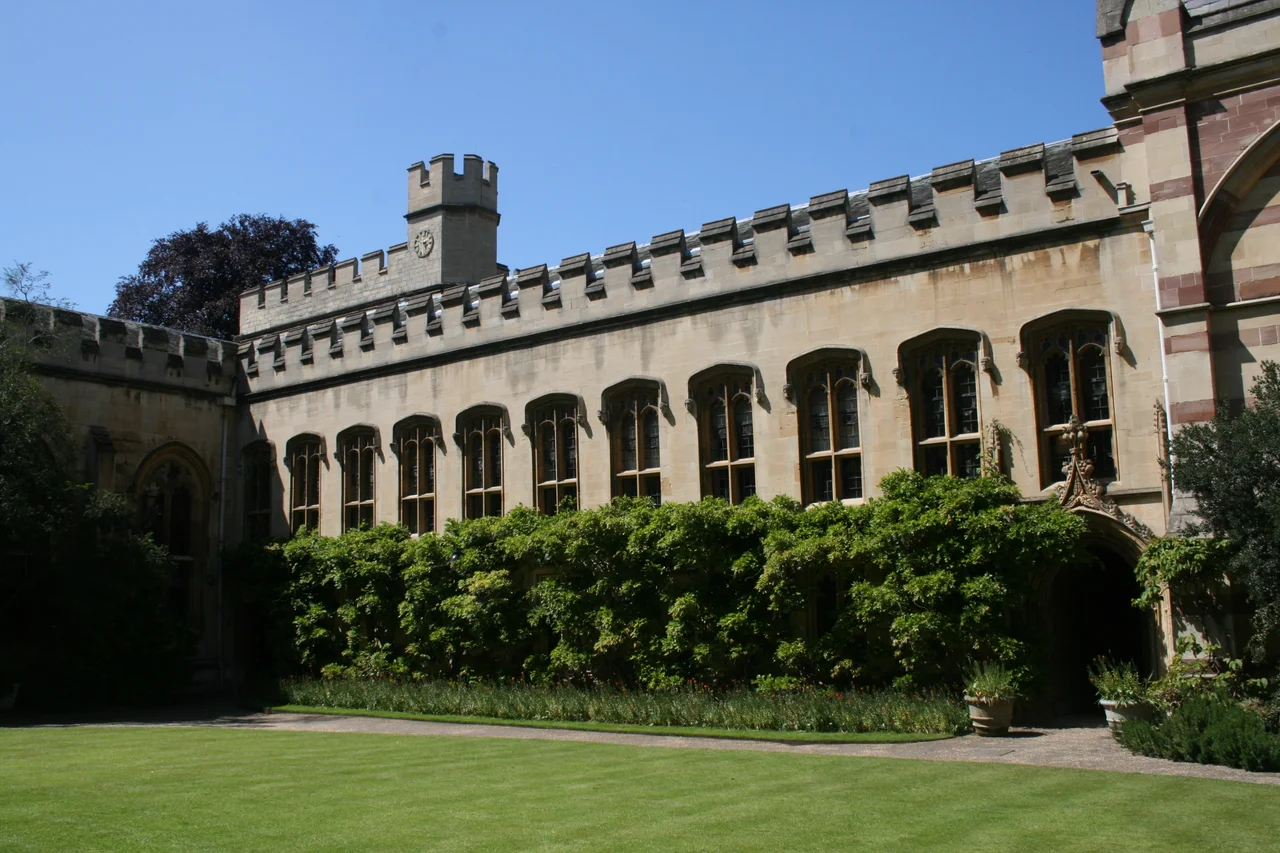

Balliol College, Oxford
According to college legend, Balliol exists because John I de Balliol kidnapped a bishop. The land dispute went badly. The Bishop of Durham, Walter of Kirkham, had de Balliol publicly beaten as penance and required him to support a group of scholars at Oxford in perpetuity. Whether the abduction story is literally true or not, the result around 1263 was the same: a house of poor scholars on Broad Street that has been there ever since, making Balliol one of three colleges that claim, with varying degrees of plausibility, to be the oldest in the English-speaking world.
The Widow Who Made It Permanent
John de Balliol died in 1268, and the college might have died with him. His widow, Dervorguilla of Galloway, kept it alive. She provided capital, and in 1282 she wrote the college statutes - documents that still survive. Her son, another John Balliol, became King of Scotland, which made his mother the matriarch of two ambitious institutions at once. Dervorguilla never lived to see what her foundation became. She would have struggled to imagine it: a community of around 400 undergraduates and graduates today, governed by a master and roughly 80 fellows, occupying buildings on Broad Street and stretching east through Jowett Walk to the medieval complex at Holywell Manor. Her portrait hung in the dining hall as the only woman represented there for centuries. In 2012 it was finally joined by another - Dame Stephanie Shirley, the technology entrepreneur and benefactor of the Oxford Internet Institute.
Stone Layered Over Stone
Walk into the front quadrangle and you are looking at construction that began in 1431 - the medieval hall on the west range, the library above it on the north. Bishop William Grey of Ely poured manuscripts into the place in the 15th century, employing scribes wherever he traveled to copy books he could not buy, and commissioning a Florentine artist to illuminate the most prized volumes. Edward VI's commissioners destroyed many of these in the Reformation, and the English Civil War destroyed more, but 152 of Grey's codices were still on the shelves by 1890. The chapel you see now is the third or fourth on the site - William Butterfield designed it in 1857, all banded stone and Victorian high-church ambition. Alfred Waterhouse rebuilt the Broad Street frontage in 1867 with the money of Hannah Brackenbury, a philanthropist who never set foot in the college. The Brackenbury gateway is what tourists photograph today.
Four Prime Ministers and a Limerick
Balliol has produced four British prime ministers - H. H. Asquith, Harold Macmillan, Edward Heath, and Boris Johnson - and the list of other alumni reads like a syllabus for the modern world. Adam Smith arrived in 1740 as a Snell Exhibitioner from Glasgow. Gerard Manley Hopkins and Matthew Arnold wrote here. Aldous Huxley left to write Brave New World. Graham Greene was nominated for the Nobel and never won it. Richard Dawkins studied zoology from 1959 to 1962. Empress Masako of Japan and King Harald V of Norway both lived in the same medieval rooms as several future heads of government. The Garden Quad is the setting for the most famous Oxford limerick - the one beginning 'There was a young man who said, God / Must think it exceedingly odd' - which parodies Bishop Berkeley's idealism. Ronald Knox, a Balliol man and Bible translator, wrote the equally famous reply in God's voice.
About Time
For more than 700 years, Balliol admitted only men. The college voted in 1971 to change that - 26 to 2 in favor - but the Privy Council did not approve the new statutes until 1977. The first cohort of female undergraduates arrived in October 1979. Among them was Cressida Dick, who would later become the first woman to lead the Metropolitan Police. In 2010 the college installed a sundial in the Garden Quad to mark thirty years of co-education. The inscription reads, with characteristic Balliol dryness, 'About Time.' In 2018, Dame Helen Ghosh became the first female master in the college's history. The same year, Dame Frances Kirwan became the first woman to hold the Savilian Professorship of Geometry, a chair endowed in 1619.
Tortoises, Coffee, and the Gordouli
Some of the most beloved Balliol traditions concern a tortoise. The original, Rosa, lived at the college for at least 43 years and competed regularly in the inter-college tortoise race held each June at Corpus Christi. She won often. She disappeared in spring 2004 and conspiracy theories still circulate. A first-year student each year takes on the duties of Comrade Tortoise. Across the dividing wall to the east lies Trinity College, and the rivalry between the two is fierce, ancient, and largely conducted through shouted songs called Gordoulis - chants that Balliol and Trinity men reportedly continued to sing at each other from opposing trenches in Mesopotamia during the First World War. A more obscure first belongs to Nathaniel Canopius, a Cretan student here from 1637 to 1648, who is the first person documented to have brewed coffee in England. The drink was new and strange. Most students preferred beer.
From the Air
Located at 51.7547N, 1.2578W in central Oxford. The college occupies a city-block site on the north side of Broad Street, with Trinity College immediately to the east. Best viewed from low altitude (1,500-3,000 feet AGL). Nearest airports: London Oxford Airport (EGTK, 6 nm north-northwest) and RAF Benson (EGUB, 12 nm south). London Heathrow (EGLL) lies 38 nm southeast. Oxford's spires - including the chapel of Balliol, Magdalen Tower, and Tom Tower at Christ Church - are a clear visual landmark on approach to either Oxford or Benson.
Nearby Stories
- St George's Chapel, Windsor Castle 7 km away
- RAF Honeybourne 7.8 km away
- Sulgrave Manor 8.9 km away
- Cotswolds 9 km away
- Chesham 9.4 km away
- Avebury 11 km away
- Donnington Castle 12 km away
- Ampthill Park 14 km away