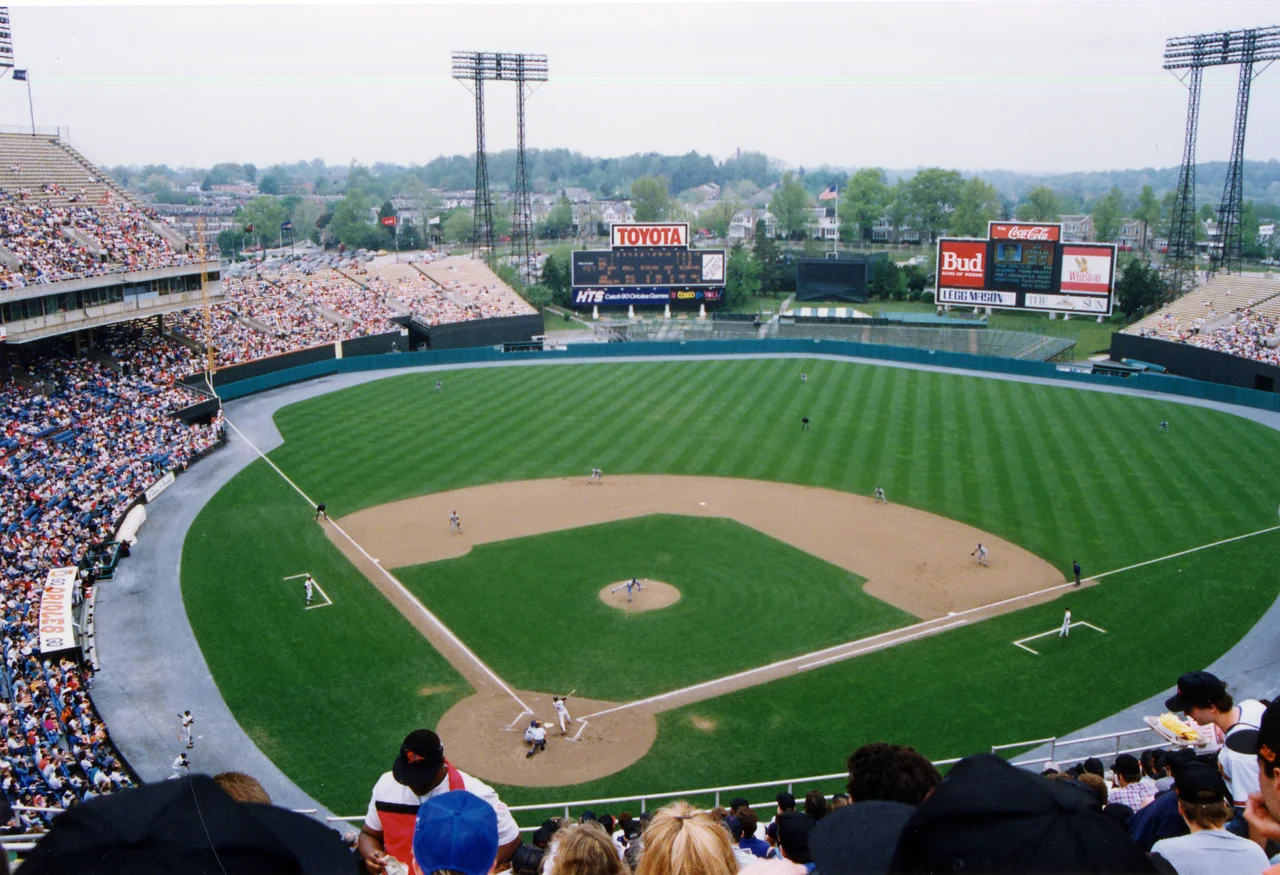

Baltimore Memorial Stadium
When Robert Frost was asked to describe what made Baltimore Memorial Stadium special, he reportedly called it the world's largest outdoor insane asylum - a place where 30,000 people screamed in unison about a game. The stadium stood on 33rd Street in north Baltimore from its 1954 reconstruction until its demolition in 2001-2002. Before the rebuild, the site was Municipal Stadium - a 1922 horseshoe-shaped football venue that became the temporary home of the minor league Baltimore Orioles in 1944 when their original Oriole Park burned down. The reconstructed version was rechristened Baltimore Memorial Stadium in honor of the city's dead from World War II. For 47 years it hosted some of the most beloved teams in American sports: the Baltimore Colts of the NFL, the Baltimore Orioles of the American League, the Baltimore Ravens for two seasons in the late 1990s, and a remarkable single Canadian Football League team that won the Grey Cup.
Municipal Stadium
The original 1922 stadium was a Greek-revival horseshoe with an earthen-mound exterior, designed by Pleasants Pennington and Albert W. Lewis. It seated between 70,000 and 80,000 people. The open south end faced 33rd Street, framed by a colonnade and porticoes of pale stone. It hosted high school football - the City-Poly game on Thanksgiving Day was a Baltimore institution - and major college matchups, including Army-Navy in 1944. When Oriole Park burned in July 1944, the minor league Orioles relocated to Municipal Stadium and improvised a baseball diamond in the football horseshoe. The team responded by winning the International League pennant and the Junior World Series, attracting postseason crowds that exceeded the attendance at Major League Baseball's own 1944 World Series. The performance announced to major league owners that Baltimore was a viable city for relocation.
Rebuilt as Memorial
Mayor Thomas D'Alesandro Jr. pushed through the rebuilding, framing the new stadium as a memorial to Baltimore's World War II dead. Construction began in 1949 and proceeded in stages, with the old Municipal Stadium stands slowly demolished even as the minor league Orioles and the original Baltimore Colts of the All-America Football Conference continued playing on the active field. The first phase of the new horseshoe was completed by the 1950 season. The lower deck was finished by 1954, with capacity of about 31,000. The original Colts franchise folded after the 1950 season, but a Bring Back the Colts ticket drive in December 1952 generated 15,000 season ticket presales in six weeks and convinced the NFL to award Baltimore a new franchise in 1953. The St. Louis Browns moved to Baltimore as the modern Orioles for the 1954 season, and the second deck was added between 1953 and 1954, bringing capacity to about 47,000. By the 1960s Memorial Stadium had hosted a World Series, an NFL Championship game, and a Major League Baseball All-Star Game - one of very few venues in the country to do so.
The Glory Years
The Colts of the late 1950s and 1960s, led by Johnny Unitas, became one of the most successful franchises in professional football. The 1958 NFL Championship game between the Colts and the New York Giants, sometimes called the Greatest Game Ever Played, was an overtime victory for Baltimore that television audiences watched in numbers that helped make professional football into a major American sport. The Colts sold out every home game from the start of the 1964 season through the end of 1970. Cal and Billy Ripken, the brothers from Aberdeen who would both play in the major leagues, learned baseball partly by watching their father Cal Ripken Sr. coach Orioles games at Memorial Stadium. Cal Jr. broke Lou Gehrig's consecutive-games record at Camden Yards in 1995, but his career began at Memorial Stadium in 1981. Brooks Robinson played his entire 23-year career at Memorial. Frank Robinson, Boog Powell, Jim Palmer - the players who carried the Orioles to two World Series titles in the 1960s and 1970s all worked at the 33rd Street ballpark.
Tragedy and Departure
On May 2, 1964, the Orioles held Safety Patrol Day, offering free admission to 20,000 Maryland schoolchildren who had served as school safety patrol officers. As the national anthem played before the game, hundreds of children crowded onto an escalator from the lower deck to the upper deck on the third-base side. A narrow metal gate at the top allowed only one person to pass through at a time, but children continued to load onto the escalator at the bottom. The mass at the top collapsed back onto the steps. The moving escalator continued to cut and mutilate the trapped children until 65-year-old usher Melville Gibson reached the emergency shutoff switch across the corridor. Annette S. Costantine, age 14, was killed. Forty-six other children were injured. The Colts left for Indianapolis in March 1984, in a literal moving-truck convoy in the middle of the night - one of the most bitter relocations in NFL history. The Orioles left for the new Oriole Park at Camden Yards in 1992.
The Memorial That Remains
Memorial Stadium hosted the Bowie Baysox in 1993 while their permanent ballpark was being built, and the Baltimore Stallions of the CFL in 1994 and 1995 - the team that won the Grey Cup in 1995, becoming the only American franchise ever to win the Canadian championship. The Baltimore Ravens of the NFL used Memorial Stadium for the 1996 and 1997 seasons before moving to the new M&T Bank Stadium. After all the teams had left, demolition began in February 2001 and was completed by April 2002. The original plan was to preserve the colonnade as a monument to the city's war dead, but structural assessments determined the freestanding facade was unsafe and it too was demolished. The site is now Stadium Place, a mixed-income senior housing development with four apartment complexes and a YMCA. The Cal Ripken Senior Youth Development Field, opened in December 2010, sits where Memorial Stadium stood, with home plate located on the exact spot it occupied for nearly half a century. Cal Jr. and Billy Ripken cut the ribbon.
From the Air
Baltimore Memorial Stadium formerly stood at approximately 39.3275 N, 76.6021 W on 33rd Street in north Baltimore, bounded by Ellerslie Avenue to the west, 36th Street to the north, and Ednor Road to the east. The site is now Stadium Place and the Cal Ripken Senior Youth Development Field. The location is well outside the Washington Flight Restricted Zone and Special Flight Rules Area. BWI Marshall (KBWI) is 12 miles southwest. Martin State Airport (KMTN) is 4 miles east. From altitude, the youth field at Stadium Place is identifiable as a small baseball diamond surrounded by residential apartment buildings in the gridded street pattern of north Baltimore.
Nearby Stories
- Takoma Park, Maryland 5.2 km away
- Annapolis 5.5 km away
- Adkins Arboretum 7.8 km away
- Murders of Katherine and Sheila Lyon 28 km away
- Fort Delaware: The Island Prison Where 33,000 Confederates Waited Out the War 32 km away
- Battle of Gettysburg 35 km away
- Memorial Hall (Delaware State) 36 km away
- Three Mile Island: The Accident That Stopped Nuclear America 71 km away