,_10_Art_Museum_Drive,_Baltimore,_MD_21218_(40330853244).jpg)
Baltimore Museum of Art
When the Baltimore Museum of Art was incorporated on November 16, 1914, it consisted of a single painting - William Sergeant Kendall's Mischief - donated by the man who had just declared, on behalf of a post-fire city congress, that Baltimore desperately needed an art museum. The Great Baltimore Fire of February 1904 had destroyed most of the downtown business district. The recovery plan that emerged from the city's response identified the absence of a major art museum as a cultural failing. Ten years later the museum had a charter and a single painting. By 1949, when the Cone sisters donated their collection of approximately 3,000 modern artworks - including more than 600 by Henri Matisse, the largest single concentration of Matisse's work anywhere in the world - the BMA had become one of the most significant art museums in the country. Today its collection holds 95,000 objects.
Claribel and Etta
Claribel Cone, born 1864, became a physician at a time when very few women practiced medicine. Etta, born 1870, kept the household and managed the family finances. The Cones were unmarried sisters from a wealthy German-Jewish Baltimore family whose brothers owned textile mills. In 1898 Etta bought five paintings by American Impressionist Theodore Robinson to decorate the apartment the sisters shared on Eutaw Place in Baltimore. The five paintings became the start of one of the great private collections of modern art. The sisters began making annual trips to Paris, where their college friend Gertrude Stein introduced them to her brother Leo and his circle of avant-garde artists. In 1906, Etta met Henri Matisse for the first time, in a studio visit arranged by Sarah Stein. The Cones became among Matisse's first patrons. Etta in particular kept buying his work until her death in 1949, when the entire collection - 500 Matisses, plus major works by Picasso, Cezanne, Van Gogh, Renoir, and Gauguin - went to the museum the sisters had quietly supported for decades.
John Russell Pope's Building
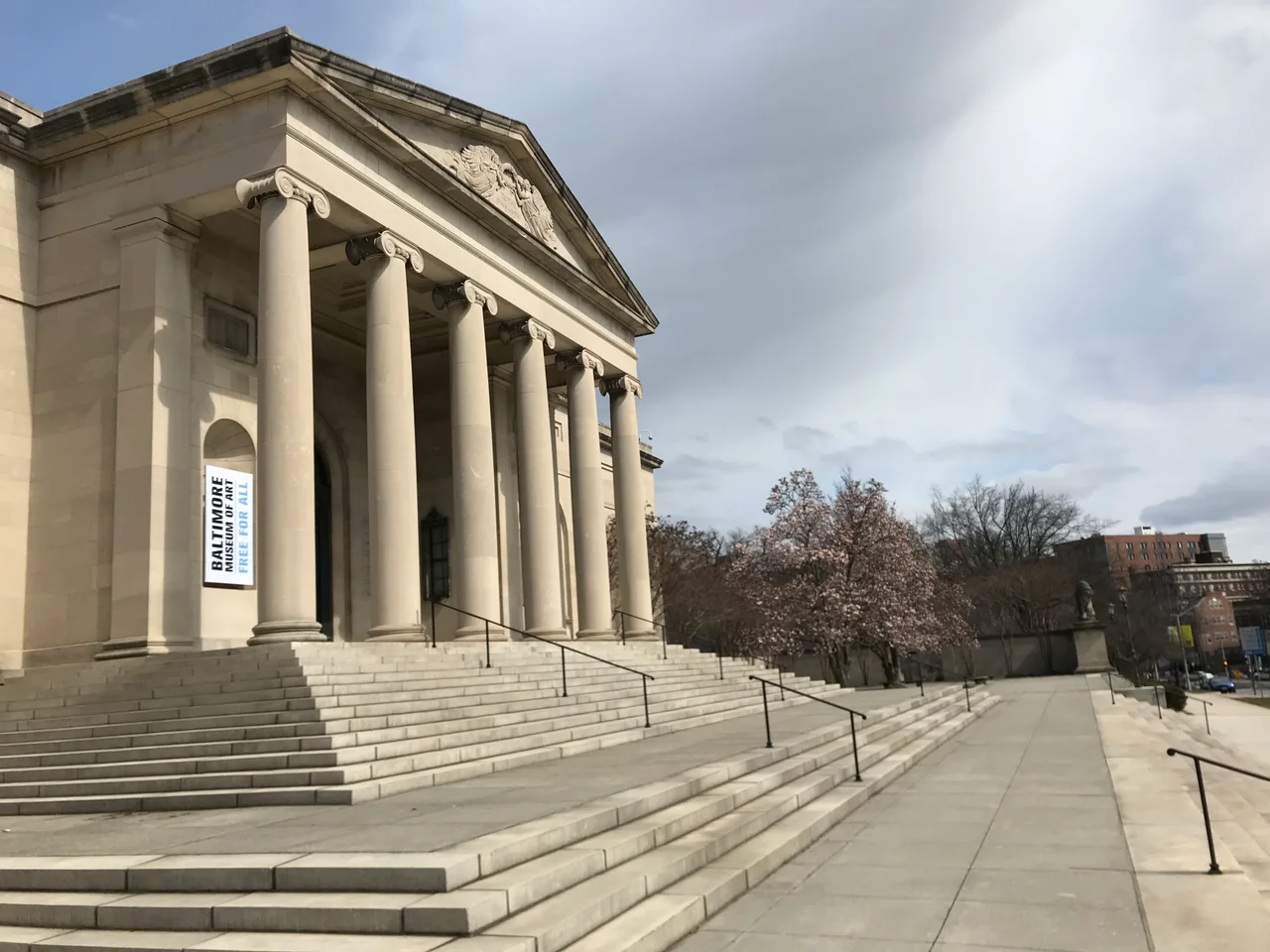
After more than a decade of using temporary quarters - a downtown house, then the Garrett Mansion at Mount Vernon Place - the museum hired John Russell Pope to design a permanent home in Wyman Park. Pope was the master of American classical-revival architecture, the architect who would later design the National Archives Building, the Jefferson Memorial, and the National Gallery of Art's West Building in Washington. His Baltimore design was serene and monolithic, a Greek-temple front facing Art Museum Drive. The cornerstone was laid on October 20, 1927. The building opened on April 19, 1929, with Rodin's Thinker presiding over the Sculpture Court. The original galleries included rooms reconstructed from six historic Maryland houses before they were lost or demolished. Average attendance was 584 people a day during the first two months.
Morris Louis's Letter
By the late 1930s, the museum was succeeding by its own measure but failing by another. A 1937 Carnegie Corporation report found that Baltimore's cultural institutions, the BMA among them, had appealed mostly to a small, privileged, white minority. Local artists felt overlooked. In 1937, the president of the Artists' Union of Baltimore wrote to The Evening Sun complaining that the living were left to work in indifference while the museum exhausted the dead past. The letter writer was Morris Louis, who would later become a foundational figure of color field painting and whose work the museum would proudly own. Board chairman Henry Treide responded to the broader criticism by commissioning a community outreach survey. In 1939, the BMA presented one of the country's first major exhibitions of African American art. The show drew over 12,000 visitors in two weeks. The museum's collecting of African American art continued from that point - Joshua Johnson, Edmonia Lewis, Henry Ossawa Tanner, Horace Pippin, Jacob Lawrence - building one of the strongest such collections in any American art museum.
The Antioch Mosaics
In 1932, with the support of BMA trustee Robert Garrett, the museum joined Princeton University, the Worcester Art Museum, and the Musees Nationaux de France in an excavation of the ancient city of Antioch, near present-day Antakya in southeastern Turkey. The seven-year dig uncovered 300 Roman and early Byzantine mosaic pavements from the affluent suburbs of Daphne and the port city of Seleucia Pieria. The BMA received 34 of those mosaics in the post-excavation distribution. Twenty-eight are now displayed in the museum's sunlit atrium court. They span from the second century AD reign of Hadrian to the sixth-century empire of Justinian, bridging the Classical and early Christian worlds. They show how the geometric and figural traditions of Greek and Roman mosaic work transformed into the gold-grounded religious art that would dominate the Middle Ages. The mosaics survive at all because two earthquakes in 526 and 528 AD buried the houses they decorated under collapsed walls and roof tiles.
Renoir, Recovered
In November 2012, a small Renoir landscape called Paysage Bords de Seine surfaced at a Virginia auction house. The painting had been stolen from the BMA in 1951 and had been missing for 63 years. A woman claimed she had bought it at a West Virginia flea market for seven dollars. The FBI got involved. So did the insurance company that had paid the museum about $2,500 for the loss in 1951. In 2014, a federal judge ruled that the painting belonged to the BMA, citing documentation in the museum archives showing that the original owner, Saidie May, had lent the painting to the museum permanently in 1937. The painting now hangs in the European galleries. The museum's recent decade has been less peaceful. In 2018, the BMA announced it would sell several works by already well-represented artists to fund acquisitions by women and artists of color - a program that brought in works by Amy Sherald, Carrie Mae Weems, Mark Bradford, and Jack Whitten. In October 2020, a proposed deaccessioning that included Andy Warhol's The Last Supper drew enough outcry that the museum canceled the sale. In 2023, Asma Naeem became the first person of color and the first person raised in Baltimore to lead the museum.
From the Air
The Baltimore Museum of Art is located at approximately 39.3267 N, 76.6181 W on Art Museum Drive in north-central Baltimore, immediately adjacent to the Homewood campus of Johns Hopkins University. The 210,000-square-foot neoclassical building anchors a campus that includes two outdoor sculpture gardens and Gertrude's Chesapeake Kitchen restaurant. The site sits well outside the Washington Flight Restricted Zone and Special Flight Rules Area. BWI Marshall (KBWI) is 12 miles southwest. Martin State Airport (KMTN) is 6 miles east. From altitude, the museum is identifiable as a Greek-temple-fronted limestone building set in a wooded landscape, immediately south of the Hopkins campus's distinctive Georgian quadrangles.
Nearby Stories
- Takoma Park, Maryland 5.2 km away
- Annapolis 5.5 km away
- Adkins Arboretum 7.8 km away
- Murders of Katherine and Sheila Lyon 28 km away
- Fort Delaware: The Island Prison Where 33,000 Confederates Waited Out the War 32 km away
- Battle of Gettysburg 35 km away
- Memorial Hall (Delaware State) 36 km away
- Three Mile Island: The Accident That Stopped Nuclear America 71 km away