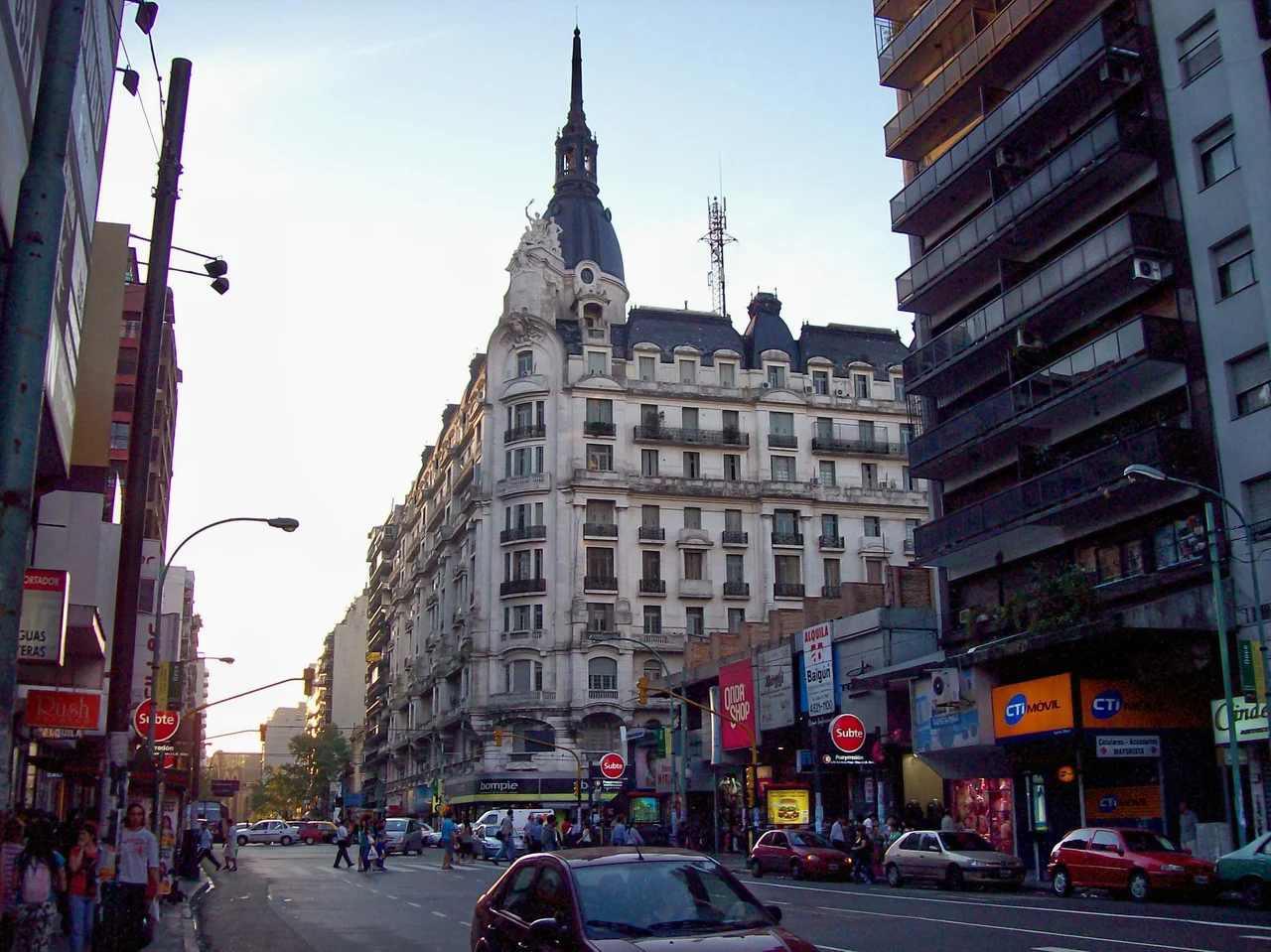

Balvanera
Stand on the corner of Rivadavia and Rincón and the past keeps interrupting the present. A relief of stone angels watches over the Café de los Angelitos, where poets and musicians once argued past midnight. A few blocks north, the old Abasto produce market — now a shopping mall — still carries the name of the boy who sang in its shadow. This is Balvanera, one of the most crowded barrios in Buenos Aires, where five distinct neighborhoods overlap in a single grid of one-way streets, and where the city seems to have stacked its commerce, its faith, its grief, and its music all in the same few square kilometers.
Five Names for One Place
Balvanera answers to many names, and locals rarely use the official one. The parish that gave the barrio its title was built around the church of Nuestra Señora de Balvanera, erected in 1831. But the zone along Corrientes Avenue is called Once, after the Plaza Once de Septiembre. The southeastern corner is Congreso, home to the neo-classical Congress building and the plaza where a single monolith marks kilómetro cero — the point from which every Argentine highway counts its distance to Buenos Aires. The northwestern stretch is Abasto, named for its old central market. Each name carries its own crowd, its own commerce, its own memory. To know which Balvanera someone means, you listen for which name they choose.
The Barrio That Made the Tango Sing
No name binds Balvanera to the world like that of Carlos Gardel. Raised in the streets around the Abasto market, the singer became El Morocho del Abasto — the dark-haired boy from Abasto — and went on to transform the tango from a danced thing into a sung one. When the wholesale produce market closed in the late 1980s and reopened as a glossy mall, the surrounding blocks of warehouses and low-rent workers' housing began to change. Yet Gardel's face still stares from murals and newspaper stands. Decades earlier, Borges had located the tango's notorious erotic origins in the brothels of the Junín y Lavalle district here. The music that became Argentina's signature was, in part, a child of these crowded streets.
Once: The Heart of Jewish Buenos Aires
Through the 1910s and 1920s, the blocks around Corrientes Avenue became the center of the city's Jewish community and the hub of its garment trade, a draw that pulled in Armenian and Arab merchants as well. For most of the twentieth century, Once sustained a thriving Yiddish theater scene; the IFT theater still stands on Boulogne Sur-Mer street, its history painted across the walls. The Gran Templo Paso and the AMIA community center anchor a living tradition here. That tradition also carries a wound: on 18 July 1994, a bombing destroyed the AMIA building and killed 85 people, the bloodiest terrorist attack ever committed on Argentine soil. The neighborhood mourns, remembers, and goes on trading.
Knowledge, Commerce, and a Night That Scarred the City
Balvanera packs more than 25,000 registered shops into streets where zoning has long favored trade — fabric and garment sellers beside the electronics importers who arrived in the late 1970s, beside the more recent Korean and Chinese merchants. On the barrio's northern edge sprawl the medicine, economics, and pharmacy faculties of the University of Buenos Aires. But the area also remembers tragedy of its own making. On 30 December 2004, the República Cromañón concert hall caught fire during a show; 194 people died and more than 1,400 were injured. For years the street outside stayed closed, a makeshift memorial that disrupted traffic and refused to let the city forget.
The Pulse of the Place
Balvanera lives at high density and higher tempo. Most residents stack into apartment buildings on small lots, and green space is scarce — the meager grass of Plaza Miserere is usually claimed by peddlers, bus queues, and street preachers of every persuasion. Rivadavia Avenue cuts the entire city east to west; cross it, and the north-south streets change their names. Corrientes runs as the great artery of commerce and entertainment. Five of the city's six subway lines reach into the barrio, and around Plaza Once the long-distance bus depots send travelers off to the farthest provinces. It is loud, congested, and relentlessly alive — a barrio that never quite stops moving.
From the Air
Balvanera sits in central Buenos Aires at roughly 34.61°S, 58.40°W, immediately west of the historic downtown. From the air, look for the green dome of the Argentine Congress at the barrio's southeastern edge and the broad straight slash of Avenida Rivadavia running east to west across the whole city. The dense low-rise grid contrasts with the river and the green of Palermo to the north. Aeroparque Jorge Newbery (ICAO: SABE) lies about 5 km northeast along the Río de la Plata shoreline and offers the closest approach; Ministro Pistarini International (Ezeiza, ICAO: SAEZ) is roughly 25 km southwest. A daytime overflight in clear weather gives the best read on the neighborhood's grid and landmarks; haze from the river is common on humid mornings.
Nearby Stories
- Ezeiza Massacre 1.9 km away
- Luján, Buenos Aires 5.1 km away
- Curutchet House 13 km away
- Colonia del Sacramento 17 km away
- Martín García Island 28 km away
- Atucha Nuclear Power Plant 37 km away
- Lobos 43 km away
- Cry of Asencio 87 km away