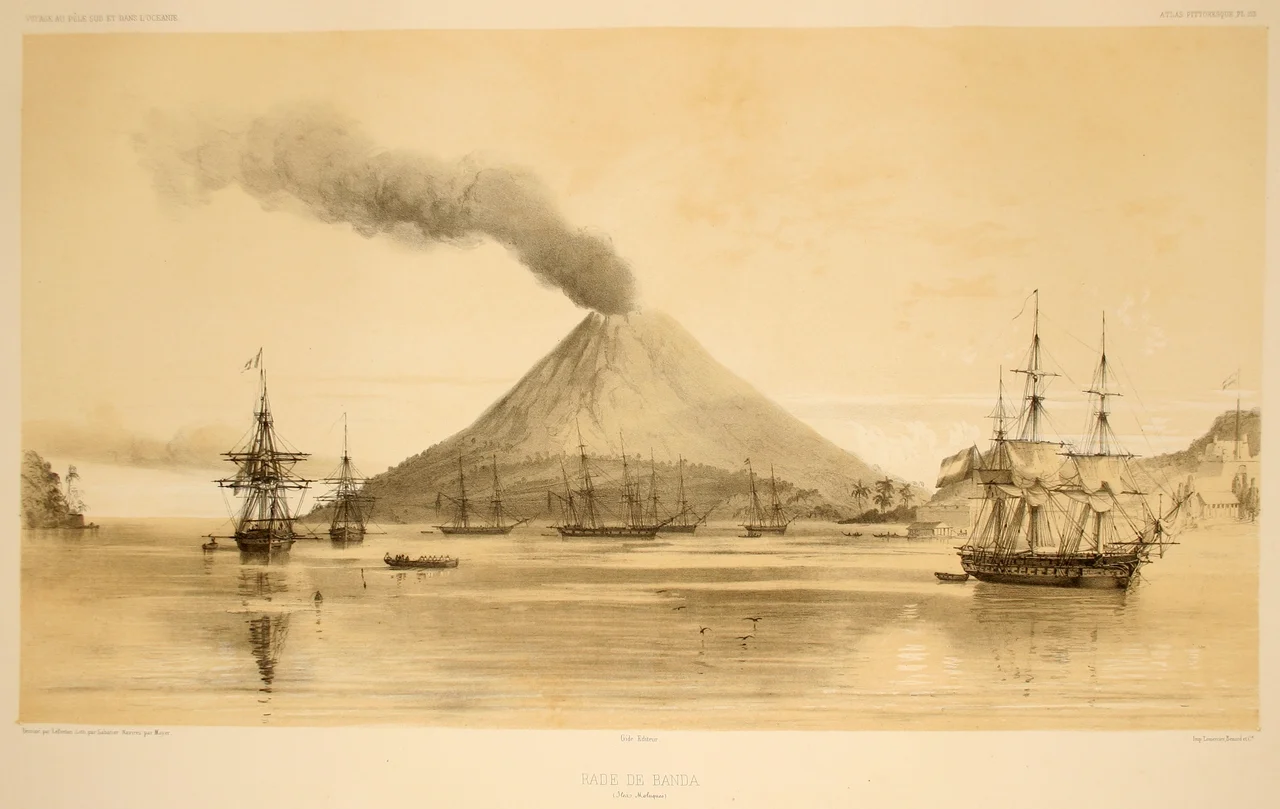

The Fire Island That Shaped an Empire
The name says it plainly: Api means fire. From the sea, the island is a textbook volcanic cone rising 640 meters out of the Banda Sea, nearly circular, roughly three kilometers across, the kind of shape a child draws when asked to sketch a volcano. But Banda Api is no illustration. Between 1586 and 1988 it erupted more than twenty times, burying nutmeg plantations under lava, sending islanders scrambling for boats, and reminding everyone in the archipelago that the ground beneath the most valuable real estate on Earth was never really theirs to claim.
The Spice at the Center of the World
For centuries, nutmeg grew almost nowhere else. The Banda Islands were its sole source, and Banda Api sat at the geographic center of the group, flanked by Banda Neira just a hundred meters to the east and the crescent of Lontor a kilometer to the south. Together these islands form the remnants of a submerged caldera seven kilometers wide. The volcanic soil that periodically destroyed the groves also made them extraordinarily productive. Trade in nutmeg and its byproduct mace brought the Bandanese great wealth, and the islands were governed by local magnates called the Orang Kaya -- the "rich men" -- who negotiated with traders from across Southeast Asia. The Portuguese arrived in the early sixteenth century, eager to control the source of a spice that Europeans believed could ward off plague. But Banda Api's riches would ultimately attract a far more ruthless power.
Blood in the Nutmeg Groves
The Dutch East India Company established a trading post in the Bandas in 1599. Within a decade, friendly relations had collapsed. In 1609, the Orang Kaya on Banda Neira killed thirty Dutch traders who had been pressing for a monopoly on the spice trade. The VOC responded with escalating violence. The campaign culminated in the Banda Massacre of 1621, when Jan Pieterszoon Coen invaded with a fleet and launched what historians have called a genocide against the indigenous Bandanese. To keep the plantations productive after the population was decimated, the VOC repopulated the islands -- including Api -- with enslaved people brought from across Indonesia, India, and the coast of China, who worked under Dutch planters known as perkeniers. The original Bandanese who survived were themselves enslaved and forced to teach the newcomers how to cultivate nutmeg and mace. By 1681, the native population had dropped to roughly one hundred people, and two hundred enslaved people were imported each year to maintain a workforce of about four thousand.
A Monopoly Broken by Botany
The Dutch monopoly held for nearly two centuries, but it ended not with a battle but with a transplant. During the Napoleonic Wars, British forces seized the Spice Islands in 1810 and carried nutmeg seedlings to Penang and Grenada. Trees that once grew only in the shadow of Banda Api's volcanic slopes took root in Caribbean soil thousands of miles away. The economic rationale for Dutch control evaporated, though the Netherlands held the islands until Indonesian independence in 1949. By then, the Bandas had become a colonial backwater rather than the strategic prize that had once justified such extraordinary cruelty. The nutmeg still grows on Banda Api today, but it is one source among many, the global market having long since moved on from the days when these few volcanic islands commanded the world's supply.
Living with the Volcano
Banda Api never stopped reminding its inhabitants of its power. A violent eruption in June 1820 sent islanders fleeing to Banda Neira. In 1890, underground rumbling produced a new crater while earthquakes damaged houses across the archipelago. In May 1901, detonations and a bright glow at the summit accompanied a series of strong earthquakes. The most dramatic modern eruption came on May 9, 1988, when a fissure split the island from north to south-southwest. Explosive activity and lava flows erupted simultaneously from three new craters, all sending molten rock to the sea. The eruption column reached an estimated sixteen kilometers in altitude. All 1,800 residents of Banda Api and 5,000 of the roughly 6,000 people on neighboring Banda Neira were evacuated to Ambon, some two hundred kilometers away. Three people died. Most of Api's residents chose not to return, relocating permanently to Banda Neira. The volcano remains active, its slopes green with regrowth, its silence never quite trustworthy.
From the Air
Banda Api sits at approximately 4.52°S, 129.88°E in the Banda Sea, about 160 km south of Seram. The nearly perfect volcanic cone (640 m) is unmistakable from altitude. The island is the centerpiece of the Banda group, with Banda Neira just 100 m to the east and Banda Besar (Lontor) curving to the south. The nearest major airport is Bandaneira Airport (WAPD) on Banda Neira island. Ambon Pattimura Airport (WAMP), approximately 200 km to the northwest, serves as the regional hub. Best viewed from 3,000-5,000 ft to appreciate the caldera structure and the relationships between the islands.
Nearby Stories
- Five Minutes of Shaking, Then the Sea Rose 59 km away
- The Abyss That Isn't a Trench 101 km away
- The Nutmeg Wars of Banda Neira 132 km away
- When the Spice Islands Shook 143 km away
- Fort Victoria: Ambon's Stone Witness 159 km away
- The Banda Sea: Where Continents Collide 249 km away
- One Stove, Three Stones 253 km away
- Where the Bird's Body Begins 338 km away