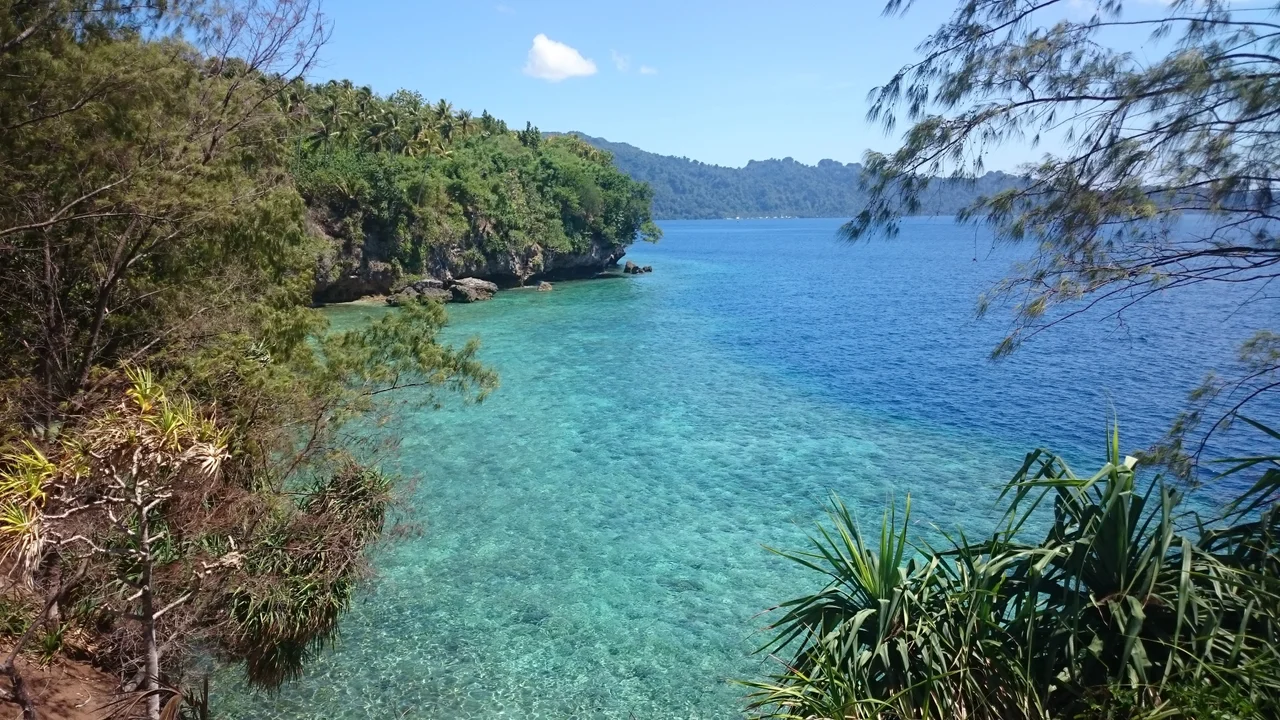

Banda Islands
In 1667, English diplomats sat across from their Dutch counterparts and agreed to one of history's most lopsided trades: a tiny volcanic island called Run, barely three kilometers long, exchanged for Manhattan. At the time, the deal made perfect sense. The Banda Islands were the only place on Earth where nutmeg grew, and nutmeg was worth more by weight than gold. Today these ten small islands in the Banda Sea sit quietly 140 kilometers south of Seram, their once world-shaking spice groves now shading villages where the biggest daily event is the morning fish market.
The Spice That Built Empires
For centuries, Arab traders kept the Bandas' location secret, selling nutmeg and mace to Venetian merchants at prices that financed kingdoms. The Portuguese found the islands in 1512, but it was the Dutch who fought hardest to control them. The VOC -- the Dutch East India Company -- waged what became known as the Spice Wars against the English, building Fort Belgica and Fort Nassau on Banda Neira to guard their monopoly. The English countered by establishing trading posts on the outlying islands of Ai and Run, paying higher prices and winning local loyalty. When diplomacy finally settled the matter in the Treaty of Breda, the Dutch got their nutmeg monopoly and the English got a consolation prize called New Amsterdam. The Dutch held that monopoly for nearly two centuries, until the British captured the islands during the Napoleonic Wars in 1810 and transplanted nutmeg trees to Ceylon, Grenada, and Singapore, breaking the stranglehold forever.
Volcanic Gardens in Deep Ocean
The Banda Islands rise from ocean four kilometers deep, a volcanic group formed from the drowned caldera of an ancient volcano. Gunung Api, the still-active cone at the center, reaches 650 meters and smokes perpetually. The crescent of Banda Besar -- the largest island at 12 kilometers long -- traces the old volcanic rim, while tiny Banda Neira sits at the caldera's heart with its colonial-era town, small airfield, and the pentagonal bulk of Fort Belgica overlooking the harbor. Farther west, Pulau Ai and Pulau Run stand isolated, the islands where English and Dutch blood was spilled over the right to buy dried seeds. The waters surrounding all of them are among the richest in Indonesia, drawing divers to coral walls that drop into the abyss and snorkelers to reefs alive with lionfish and sea turtles.
Getting There Is the Adventure
Reaching the Bandas requires patience and flexibility. SAM Air flies twelve-seat propeller planes from Ambon to Banda Neira's airstrip -- a runway so small it bisects the island. A fast boat from Ambon's Tulehu Harbour makes the six-hour crossing twice weekly, on Tuesdays and Saturdays, though rough weather cancels the service without notice. The state ferry company PELNI sends ships twice monthly on routes connecting Ambon, Banda Neira, and the Kei Islands. Once on Banda Neira, you walk. The town is compact enough that the farthest village is a 45-minute stroll, and the harbor, market, and colonial houses cluster within easy reach. Reaching the outer islands -- Ai, Run, Banda Besar, Hatta -- means finding a public boat near the market, where locals load supplies each morning and return by noon. No boats run on Fridays. Cancellations happen for every reason imaginable.
Nutmeg in Every Cup and Bowl
The spice that drew empires to these shores still pervades daily life. Bandanese cuisine revolves around fresh-caught barracuda and tuna, grilled over coals as ikan bakar, but nutmeg appears everywhere: in Sambal Pala, a fiery condiment; in ikan kuah pala Banda, a sour fish soup distinctive for its absence of turmeric; and as Manisan Pala, candied nutmeg sold in small shops along Banda Neira's lanes. Even the drinks carry the flavor -- Jus Pala, Kopi Pala, Sirup Pala, each a variation on the island's single great contribution to world cuisine. Because freezers are rare, fish must be ordered a day ahead or purchased alongside your guesthouse cook at the morning market. It is a rhythm dictated not by restaurant schedules but by the sea and the season.
What the Empires Left Behind
Fort Belgica still stands on its hill above Banda Neira, one of the largest intact Dutch forts in Indonesia, its pentagonal walls a monument to the lengths one corporation went to control a single crop. Nearby, the exile house of Mohammad Hatta -- Indonesia's first vice president, imprisoned here by the colonial government -- tells a different chapter of the same story of resistance. Nutmeg plantations on Banda Besar and Run Island remain productive, their trees descended from the groves that once justified genocide. The Bandanese language itself carries the colonial imprint: Dutch loanwords for fork, spoon, and porch sit alongside Portuguese borrowings shared with Ambonese Malay. On the Kei Islands to the east, descendants of Bandanese who fled the 1621 massacres still speak a version of the original Banda language in villages called Banda Eli and Banda Elat, keeping alive the memory of a people nearly erased for the sake of a spice.
From the Air
Located at 4.58S, 129.92E in the Banda Sea, approximately 140 km south of Seram Island. The volcanic cone of Gunung Api (650 m) is the most visible landmark from altitude. The cluster of islands is surrounded by deep ocean and clearly visible against the blue of the Banda Sea. Banda Neira has a small airfield (ICAO: WPAT). Nearest major airport is Pattimura Airport (WAPP) in Ambon, approximately 140 km to the north. Expect tropical weather with potential convective activity; seas can be rough, especially during monsoon season.
Nearby Stories
- Five Minutes of Shaking, Then the Sea Rose 40 km away
- The Abyss That Isn't a Trench 87 km away
- The Nutmeg Wars of Banda Neira 150 km away
- Fort Victoria: Ambon's Stone Witness 154 km away
- Maluku: Where the World Went to War Over Seasoning 171 km away
- The Banda Sea: Where Continents Collide 245 km away
- One Stove, Three Stones 264 km away
- Where the Bird's Body Begins 347 km away