
The Venice of the East
In 1521, the Italian chronicler Antonio Pigafetta stepped off a ship from Magellan's fleet and found himself staring at an entire city built on water. Houses perched on wooden stilts stretched along the Brunei River for kilometers, connected by plank walkways and served by a floating market thick with canoes. Pigafetta called it the "Venice of the East." Three centuries later, the British adventurer James Brooke arrived and, less charitably, dubbed it a "Venice of hovels." Both men were looking at the same place: Kampong Ayer, the water settlement that has served as Brunei's capital in one form or another for a thousand years. Today it remains the world's largest stilt village, home to roughly 30,000 residents, and it sits directly across the river from the gleaming minarets and golden domes of modern Bandar Seri Begawan.
A Capital Born on Water
The history of Bandar Seri Begawan unfolds in three acts, each pushing the settlement further from the river and onto solid ground. The first act began in the 16th century when Kampong Ayer served as the seat of the Bruneian Sultanate, a maritime power whose influence reached across Borneo and into the southern Philippines. Houses, mosques, and even the sultan's palace stood on stilts above the tidal flats. The second act arrived with British colonial administration after 1906, when Resident Malcolm McArthur began the deliberate project of building a land-based town. He constructed his own residence, Bubungan Dua Belas, on firm ground while the sultan's palace remained over the water. By 1910, Chinese merchants had opened shops on the new streets, and the shift from river to land was underway. The third act came with Brunei's oil wealth. On 4 October 1970, the old Brunei Town was renamed Bandar Seri Begawan, honoring the 28th Sultan, Omar Ali Saifuddien III, who had taken the title Seri Begawan -- "the shining and saintly" -- upon his abdication in 1967.
Wartime Scars and Independence
Japanese forces overran Brunei Town on 22 December 1941, and the occupation that followed brought economic devastation. Sultan Ahmad Tajuddin surrendered to General Tawaguchi from his base in Kampong Sumbiling. Japan imposed strict cultural programs, teaching Japanese language and values while exploiting the region's oil resources. When Allied bombers arrived in November 1944, they leveled nearly every structure in the town. By the time American and Australian forces liberated Brunei on 10 June 1945, the wartime population of 16,000 had scattered to the surrounding hills. Bruneians rebuilt from the rubble, and a five-year national development plan in 1953 poured M$100 million into infrastructure -- a staggering sum for a community of just 54,000 people. The investment transformed the capital. On 1 January 1984, at midnight, Sultan Hassanal Bolkiah declared Brunei's full independence at Taman Haji Sir Muda Omar Ali Saifuddien, a square in the city center. The nation had come into its own.
Gold Domes and Royal Grandeur
Two landmarks define the skyline. The Omar Ali Saifuddien Mosque, completed in 1958, sits on an artificial lagoon whose still water mirrors its golden dome -- a surface covered in more than three million pieces of Venetian glass mosaic. Italian marble columns line the interior, and a stone replica of a 16th-century royal barge floats in the lagoon, unveiled in 1967. Just a few kilometers downstream stands Istana Nurul Iman, the official residence of Sultan Hassanal Bolkiah. With 1,788 rooms, 257 bathrooms, and a banquet hall seating 5,000, it holds the Guinness World Record as the largest residential palace in the world. Designed by Filipino architect Leandro Locsin, its golden domes and vaulted roofs echo the Islamic and Malay architectural traditions that have shaped the capital for centuries. The palace is closed to the public except during Hari Raya Aidilfitri, when the sultan opens its doors and personally greets visitors.
Life Between River and Land
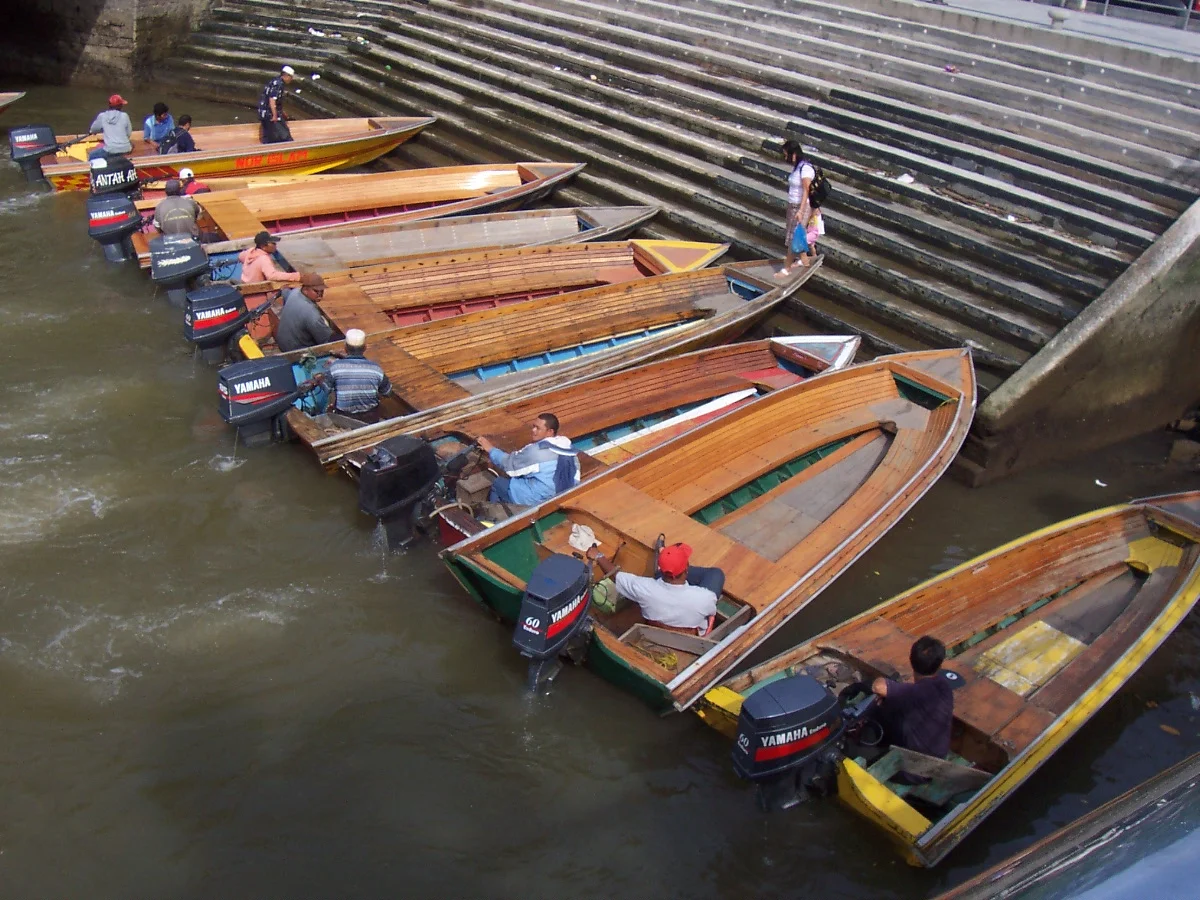
Kampong Ayer endures. Stretching about eight kilometers along the Brunei River, it comprises neighborhoods with their own schools, mosques, fire stations, and clinics, all connected by wooden walkways and served by water taxis called penambang. Passengers hail these small boats from docking points along the riverbanks, and fares are still negotiable. Across the water, on solid ground, the Gadong commercial district hums with night markets where vendors sell roti john, ambuyat, satay, and piles of durian. The Kianggeh Market, believed to be Brunei's oldest, trades in local seafood and tropical fruit. Bandar Seri Begawan is not a large city -- its municipal population stands at around 72,000 -- but it sprawls across 100 square kilometers after an expansion authorized by the sultan in 2007. Brunei International Airport lies just 11 kilometers from the center, reachable in ten minutes via the Sultan Hassanal Bolkiah Highway. The capital that Pigafetta marveled at five centuries ago is still here, still half on the water, still unlike anywhere else.
From the Air
Located at 4.92°N, 114.92°E on the banks of the Brunei River in northwestern Borneo. Brunei International Airport (WBSB) lies 11 km northeast of the city center. The Omar Ali Saifuddien Mosque's golden dome is a visible landmark. Kampong Ayer's stilt houses are visible along the river at lower altitudes. The Sultan Haji Omar Ali Saifuddien Bridge, opened in 2020, connects westward to the Temburong exclave. Equatorial climate with heavy rainfall year-round; visibility best in morning hours.
Nearby Stories
- From Residency to Memory 28 km away
- Twenty Years on the Seattle Run 30 km away
- The Abode of Peace on Borrowed Coastline 31 km away
- USS Salute: The Minesweeper That Found the Last Mine 33 km away
- The Ants of Borneo 50 km away
- Sabah State Railway 55 km away
- Starcevich Monument 74 km away
- Luconia Shoals 209 km away