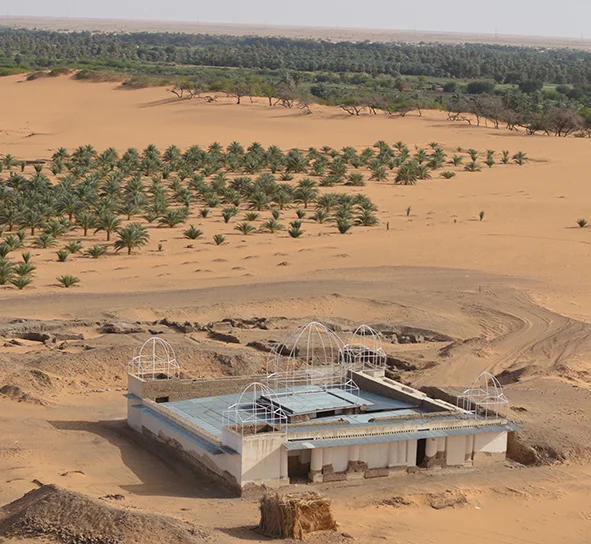

Banganarti
For seven centuries, pilgrims walking the middle Nile reached this spot and carved their prayers into the plaster. Nearly a thousand inscriptions survive on the interior walls of the Upper Church at Banganarti, left by Christian Nubian travelers between roughly 1050 and the 1700s. They scratched requests for healing, thanks for safe journeys, and pleas addressed to the Archangel Raphael, whom locals believed had taken up residence in the building. The church itself, called Raphaelion II, rose on the foundations of an even older sanctuary from the seventh century, whose lower levels still contain one of the oldest known images of the Virgin Mary in African Christianity. The village nearby, Banganarti, takes its name from the Nobiin language: Bangan-arti, the Island of the Locust.
A Pilgrim Center on the Middle Nile
Banganarti sits roughly halfway between the Third and Fourth Cataracts of the Nile, ten kilometers from Old Dongola, which was the capital of the medieval Christian kingdom of Makuria. Makuria was one of three Christian Nubian kingdoms that emerged after the collapse of the Kushite empire, converted to Christianity in the mid-sixth century, and persisted for nearly a thousand years while the Islamic world expanded around them. Banganarti functioned as a religious center within this world. Pilgrims came here from across Makuria and Nobatia to pray to Archangel Raphael for protection, for the healing of illness, and for intercession in the political crises that repeatedly threatened the Nubian kingdoms.
Two Churches, Stacked
Polish archaeologists have excavated the site since 1998, directed by Bogdan Zurawski as part of the Southern Dongola Reach Survey. Earlier work in 1984 by a Royal Ontario Museum expedition had hinted at what lay beneath the sand. The team uncovered two successive church buildings. The Lower Church, dated to the seventh century, was decorated with high-quality wall paintings including one of the oldest surviving images of the Virgin Mary in Nubian art. The Upper Church, built in the eleventh century directly over the older one, inherited its dedication to Raphael and functioned as an active pilgrim destination for another seven hundred years. The fact that Raphael was likely the patron of both churches gave the later building its name: Raphaelion II.
Kings Under the Wings of Angels
Inside the Upper Church, fifty-seven wall paintings have been preserved. Thirteen of them depict a Nubian king in hieratic pose, often shown being protected or sanctified by Archangel Raphael. Other panels show the Apostles gathered around scenes of royal authority, or high-ranking officials of the Makurian court processing in ceremonial robes. Dr. Zurawski has argued that the iconographic program of the Upper Church is rooted in political theology: the king of Makuria was being positioned as a figure under direct angelic protection, a sacred ruler for a Christian kingdom surrounded by the expanding Islamic caliphates. The paintings were not just devotional. They were propaganda in the service of legitimate sovereignty.
The Graffiti Archive
Almost a thousand inscriptions survive on the plaster of the Upper Church's interior walls. Most are pilgrims' prayers, written in Old Nubian, Greek, and Coptic. Adam Lajtar, the epigrapher attached to the excavation, has been cataloging them for more than two decades. The texts give a rare ground-level view of medieval Nubian Christianity: the names of individual pilgrims, their home villages, the dates of their visits, the illnesses they were seeking to heal, the dead they were commemorating. Medieval Nubian culture left relatively few written sources that survived the collapse of the Christian kingdoms and the conversion of the region to Islam by the sixteenth century. The Banganarti wall inscriptions are one of the largest continuous written records of ordinary people's religious life across that whole period.
A Fortified Sanctuary
Around the church, Polish archaeologists also found the remains of a medieval fortification and a substantial settlement. By the later centuries of its use, the pilgrim site at Banganarti was walled, defensible, and connected to a town that had grown up to serve the pilgrims. The Upper Church continued to function until roughly the mid-eighteenth century, long after the Christian Makurian state itself had faded into the Islamic Funj Sultanate. For several generations after the kingdom had ended, ordinary people apparently kept coming to the island of the locust, carving their prayers into walls that had heard their grandparents' voices. The site today is under continued Polish excavation in cooperation with Sudan's National Corporation for Antiquities and Museums, though the ongoing Sudanese civil war has complicated archaeological work across the country.
From the Air
Located at 18.17 N, 30.78 E in Sudan's Northern State, on the east bank of the Nile between the Third and Fourth Cataracts, about 10 km from Old Dongola. Nearest airport: Dongola Airport (ICAO HSDN), approximately 80 km northeast. Active Sudanese civil war makes airspace over Sudan hazardous for civilian overflight. From cruise altitude, the great S-bend of the Nile in the Dongola Reach is the defining navigation landmark, with Banganarti on the inner shore of the bend.
Nearby Stories
- El Khandaq 26 km away
- Northern Sudan 45 km away
- Nubia 49 km away
- Zuma, Sudan 52 km away
- Northern State (Sudan) 93 km away
- Esh Shaheinab 281 km away
- Selima Oasis 338 km away