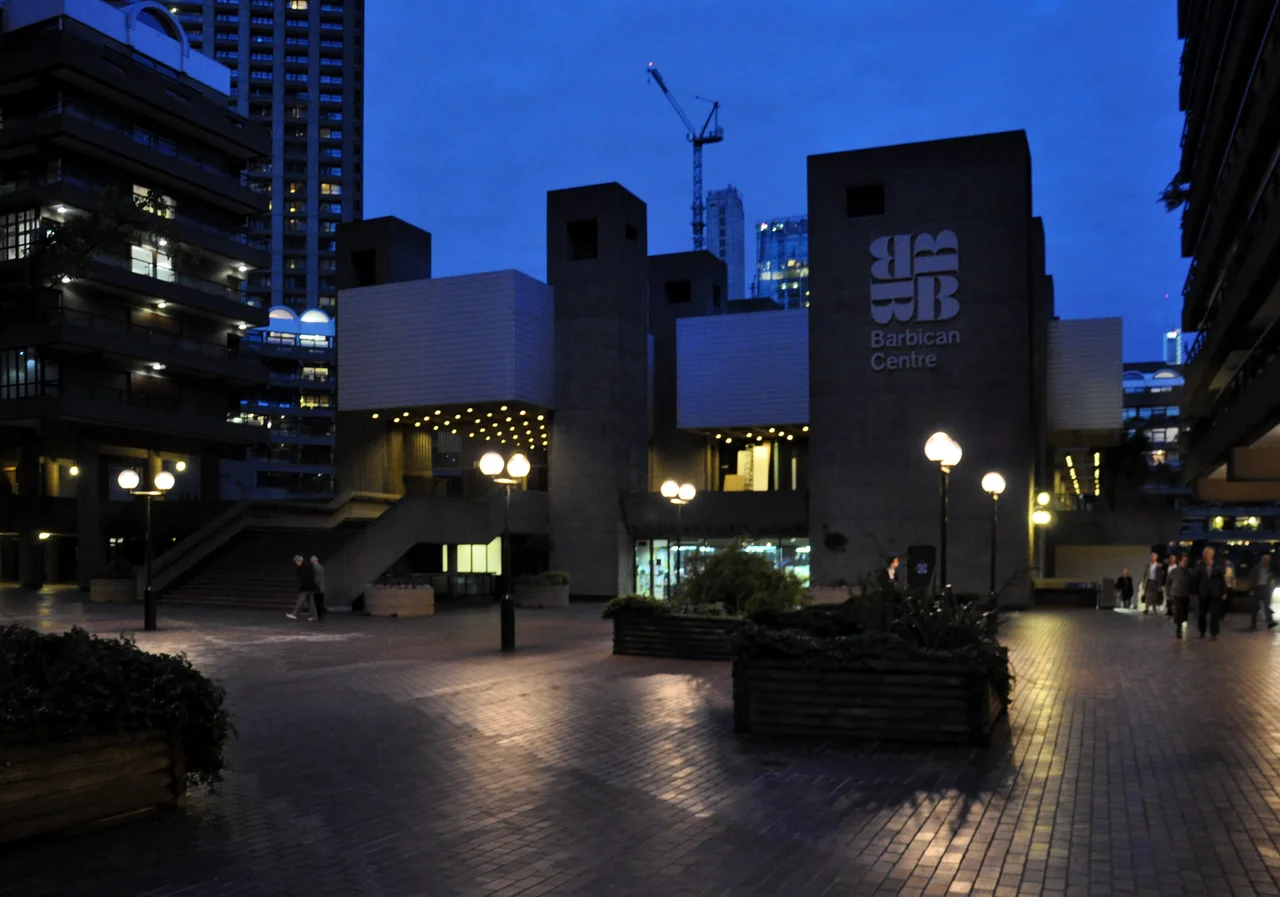

Barbican Centre
In a 2003 poll commissioned by an advertising agency, Londoners voted the Barbican Centre the ugliest building in their city. Six years later, the same complex was Grade II listed for its scale, cohesion, and ambition. Both opinions are defensible. Designed in raw concrete, with a multi-level layout so labyrinthine that painted lines on the ground guide visitors to the front door, the Barbican Centre is Europe's largest performing arts venue and one of the most thoroughgoing examples of British brutalism. It also contains a tropical conservatory, three restaurants, a public library with two free practice pianos, and the home concert hall of the London Symphony Orchestra.
A Gift from the City
The Barbican was built as the City of London's gift to the nation. The site, north of St Paul's, had been devastated by World War II bombing - the medieval ward of Cripplegate was effectively flattened in the Blitz. Out of that ruin came one of the most ambitious civic projects of the twentieth century. The Barbican Estate housing complex went up between 1965 and 1976, and the arts centre at its heart, designed by Chamberlin, Powell and Bon in the brutalist style, finally opened in 1982. It had cost £161 million. Queen Elizabeth II opened it on 3 March 1982. The vision was simple in concept and stupendous in execution: a single complex containing concert halls, theatres, cinemas, art galleries, a library, restaurants, and a tropical conservatory, all stitched together with elevated walkways and centred on an open-air lake.
The Concrete Ziggurat
Architecturally, the Barbican is what its designers wanted it to be: an unapologetic concrete ziggurat, with terraces stepping back as the building rises, plate-glass walls overlooking a courtyard lake, and a network of high-level pedestrian walkways - the highwalks - that lift visitors above ground-level traffic. The signature concrete surfaces were jackhammered by hand, an extraordinarily labour-intensive finish that exposes the aggregate and gives the building its distinctive distressed texture. The fly tower above the theatre stage was eventually wrapped in glass and converted into a high-level conservatory, full of palms and tropical ferns and fish ponds. The result is the kind of building that nobody is neutral about - either thrilling or oppressive, sometimes both at once, depending on where in it you happen to be standing.
What Lives Inside
The Barbican Hall seats 1,943 and is the London home of both the London Symphony Orchestra and the BBC Symphony Orchestra. Its acoustic has been controversial since opening: some critics found it attractively warm, others complained that it was too dry. In 1994 the Chicago acoustician Larry Kirkegaard oversaw a £500,000 acoustic re-engineering, then came back in 2001 to drop adjustable acoustic reflectors from the ceiling as part of a £7.5 million refurbishment. The Barbican Theatre seats 1,156 and was designed exclusively for the Royal Shakespeare Company, who used it as their London base until 2002 and returned in 2013. The Pit is a flexible 200-seat studio theatre. There are three cinema screens. There is the Curve, a curving free-entry gallery for new commissions. There is a public library, one of London's largest, with a special London Collection of historical books going back to the eighteenth century.
Through the Walkways
Getting around the Barbican has always been part of the experience. The highwalks raise pedestrians a storey or two above the streets, separating people from vehicles in a way that Le Corbusier would have recognised. In practice they can also be disorienting - hence the painted yellow lines on the ground, added later, that guide visitors from nearby Underground stations through the estate to the centre's front door. A 2005 to 2006 refurbishment by Allford Hall Monaghan Morris and Roger Westman tried to improve circulation: it added an internal bridge linking the Silk Street foyer to the lakeside foyer, modified the Silk Street entrance for better pedestrian access, and stripped away most of an awkward 1990s overlay of Arts and Crafts-style decoration that had been an attempt to soften the brutalism but had simply confused it.
The Wider Site
The Barbican Centre does not stand alone. The Guildhall School of Music and Drama is on the same site, sometimes using the centre's spaces for its performances. So is the Barbican Library, technically one of the City of London libraries rather than part of the arts centre itself. The Museum of London - though now relocating - has long sat at the western edge of the complex by Aldersgate. The whole Barbican Estate, with its three forty-two-storey residential towers, surrounds and intertwines with the centre, so that audiences arriving for a concert pass directly through one of London's most distinctive twentieth-century housing developments. The centre and estate together are Grade II listed.
On Screen and in Song
If you have watched the Star Wars series Andor and felt that some of its dystopian streetscapes looked unsettlingly real, that may be because they were filmed at the Barbican. The Slow Horses television adaptation of Mick Herron's novels has also leaned heavily on Barbican locations across multiple episodes. Harry Styles shot the video for his 2022 song As It Was in the Barbican Centre and Conservatory. The building's particular flavour of brutal-yet-tropical, public-yet-secretive turns out to be irresistible to filmmakers looking for an inhabited future. From the air, the centre and its estate read as a great geometric stamp pressed into the City of London - rectangles, towers, the lake's bright sliver - hard to miss, and once you have seen it from above, hard to forget.
From the Air
Located at 51.5202 N, 0.095 W in the City of London. From altitude, look for the geometric block of the Barbican Estate just north of St Paul's Cathedral and west of Liverpool Street, with the three forty-two-storey towers - Cromwell, Lauderdale, and Shakespeare - rising above the surrounding rooftops. The lake at the centre catches light on clear days. Nearest airports: London City (EGLC) approximately 4 nautical miles east-south-east; London Heathrow (EGLL) approximately 15 nautical miles west. Best viewed at 1,500 to 3,000 feet.
Nearby Stories
- Stevenage 5.7 km away
- Malling Abbey 5.7 km away
- 1952 Farnborough Airshow Crash 7.7 km away
- Ingatestone Hall 8.2 km away
- Hellfire Caves 9.1 km away
- The Carrington Event: The Solar Storm That Could Happen Again 9.8 km away
- Bletchley Park 16 km away
- Castle Hedingham 23 km away